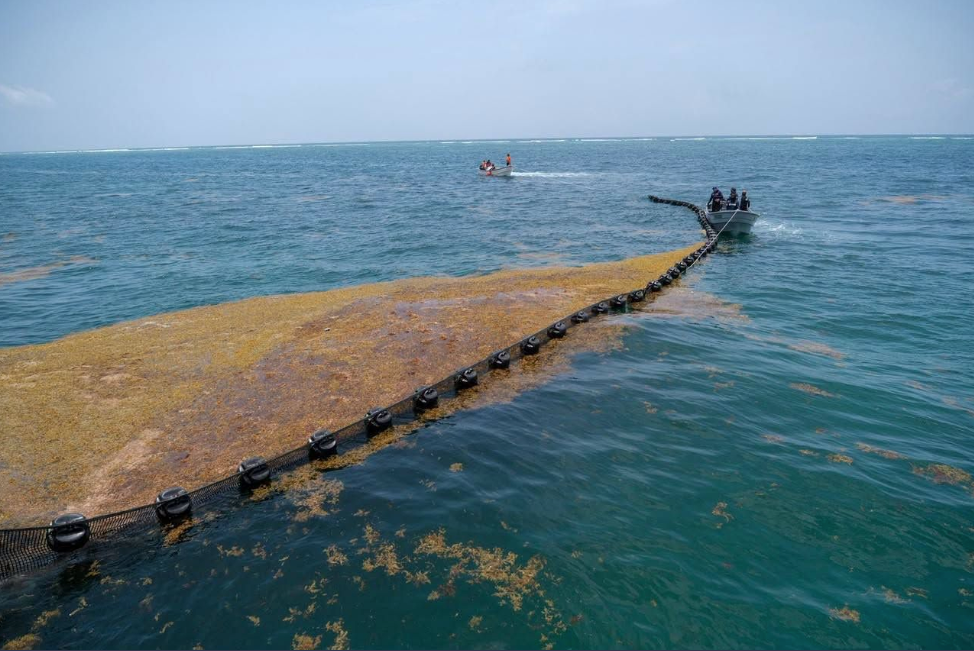
Playa del Carmen, Quintana Roo — Scientists have yet to determine why sargassum has swamped the Caribbean in record amounts this year, President Claudia Sheinbaum said Thursday as officials described 2026 as a “difficult and atypical” season for the seaweed.
“In this case, you can’t say it’s one cause — the scientific research is still ongoing,” Sheinbaum said during her morning press conference, where the government presented its Sargassum Attention and Management Strategy. She said some scientists point to climate change, since warmer ocean temperatures accelerate algae reproduction. Others note higher nutrient levels in the sea, driven by Amazon deforestation or agricultural runoff, while another hypothesis suggests that bacteria that once consumed sargassum have declined.
“Perhaps all of them are true,” Sheinbaum said. “The important thing is to keep studying so we can address it more comprehensively.”
From the Sargasso Sea to the Caribbean
Environment Secretary Alicia Bárcena traced the phenomenon’s evolution, explaining that until 2011, sargassum was largely confined to the Sargasso Sea, a region of the Atlantic near Florida. That year, the seaweed mass broke apart and drifted toward West Africa, then settled in the Tropical Atlantic between Africa and Brazil.
There, nutrient discharges from African and South American rivers — mainly phosphates and nitrates — combined with warmer sea temperatures to create ideal conditions for explosive growth. Ocean currents and winds then carry the algae into the Caribbean, where it reaches Quintana Roo and damages beaches, tourism, and biodiversity.
“What used to be a temporary phenomenon lasting a few months has become a continuous condition,” Bárcena said. She reported that the Mexican Caribbean is currently seeing between 40,000 and 90,538 tons of sargassum per day, with an estimated 10 percent reaching Quintana Roo’s coast.
Data from the University of South Florida cited by Bárcena shows sargassum levels in the region are 27 times the historical average and four times higher than in 2025.
Research into bacteria and other solutions
Authorities said scientists are exploring bacteria that could break down sargassum, though no conclusive results have emerged. “There isn’t yet a study that tells us, ‘reproduce this bacteria and the sargassum goes down,’” Sheinbaum acknowledged.
Hotel executive José Chapur said Harvard University’s environmental health department has proposed that bacteria originally consumed sargassum at its source but can no longer survive in warmer waters. Researchers are considering whether to develop heat-resistant bacteria, but the project is at a very early stage.
Edith Calixto, director of technological development at Mexico’s science secretariat, said more than 150 researchers from Mexican and foreign universities — including institutions in France, the United States, and Canada — are studying how to combat the algae, from its causes to ways to recycle or repurpose it. She stressed that any solution must not harm ocean biodiversity.
“We are exploring every possibility, but we cannot risk a collateral impact,” Calixto said. “We are talking about the ocean, which has enormous biodiversity.”
International meeting planned
Bárcena announced that an international sargassum conference will be held in Cancún on October 1 and 2, with initial funding from the European Union. Affected Caribbean countries, including the Dominican Republic and Barbados, are expected to attend, along with Brazil and Japan. Japan has shown strong interest in supporting Mexico, particularly with specialized vessels for collecting sargassum, she said.
More Environment
- Drought Crisis Forces Quintana Roo Wildlife to Seek Water Near Roads and Towns
- Dead Sea Turtle Hatchlings Found With Dog Bites at Playa del Carmen Beach
- Explorers Document New Underwater Cave System South of Cozumel
- Farm and Cattle Expansion in Quintana Roo Squeezes Native Wild Bees
- Activists Warn Playa del Carmen Real Estate Boom Is Driving Deforestation