
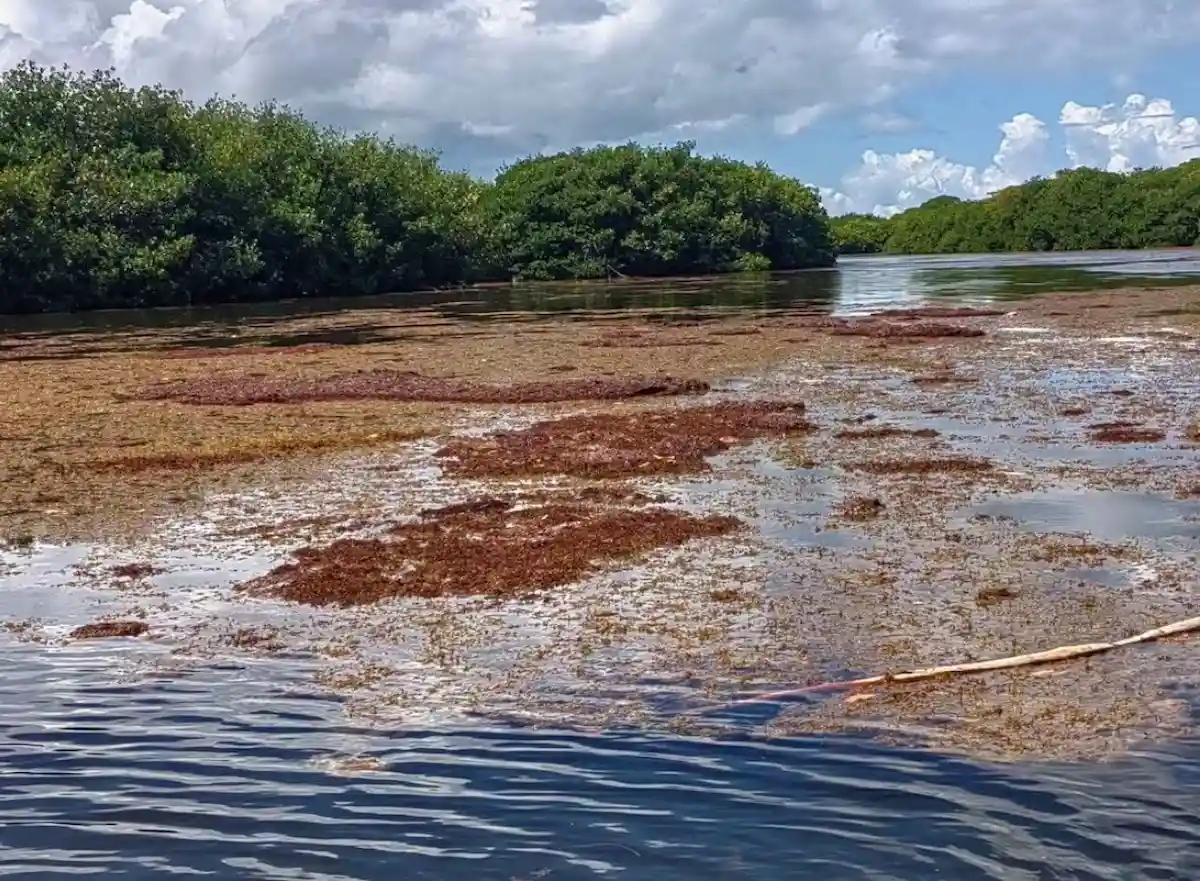
Chetumal, Quintana Roo — Tourism operators in southern Quintana Roo have shared images of sargassum invading the Bacalar Chico channel, the natural border between Mexico and Belize that separates the Xcalak Peninsula from Ambergris Caye, and say the seaweed has also reached the Zaragoza Canal, an artificial waterway that links Chetumal Bay to the Caribbean Sea.
Biologist María Luisa Villarreal Sonora said the unusual arrival should not be treated as a problem confined to Bacalar Chico and the Zaragoza Canal. Current environmental conditions, she said, could push the algae toward areas closer to Chetumal.
She said continued monitoring will determine whether the sargassum is a temporary presence or whether conditions in the coming days favor heavier accumulation in Chetumal Bay.
Concern Over Movement Into the Bay
One scenario drawing attention is the possibility that sargassum drifts from Bacalar Chico and the Zaragoza Canal into the bay’s interior. Villarreal Sonora said that while no widespread accumulation has been reported in front of Chetumal so far, existing conditions could shift the location of the mats.
The algae would become more visible in the city if it moves closer, making it a new focal point for authorities, fishermen and environmental specialists, she said. She added that the sighting comes at the end of the season, when sargassum levels are lower and the algae is already beginning to retreat.
Drought Limits Natural Cleanup
Laura Carrillo Bribiesca, an oceanographer at the Colegio de la Frontera Sur (Ecosur), a research center in southern Mexico, said sargassum has appeared in areas such as the Zaragoza Canal in recent years, but this year’s drought has worsened the problem.
She said movements of sargassum in and out of the area have been recorded since at least 2023. Hydrodynamic readings show the system still has the capacity for a “natural cleaning” driven by storms or “nortes” — the strong cold fronts that bring waves, wind and surges of water.
In 2026, however, the lack of rain has favored the accumulation of algae, and continued mass arrivals could damage the ecosystem.
“It is very premature to say there is a problem in the area,” she said. “There is a record of increases, and when there are storms, natural cleaning occurs with the waves. But right now we have a strong drought, and that prevents a renewal of the water flow. We know the system can clean itself with the current amounts of sargassum. But if this does not improve, it could become a problem.”
Carrillo said tourism operators should join in constant monitoring of the channels and that authorities should pay attention to the changes being recorded.
She also noted that even with natural cleaning, the sediments produced by sargassum remain in the ecosystem.
“Last year we placed sensors and the sargassum clogged them completely,” she said. “But a norte came and cleaned everything. The tourism operators who are there can support this work; it is important to pay attention to what they report. So far the self-cleaning capacity holds. I would not be alarmed for now. But it is time to pay more attention.”
Call for Scientific Input Before Intervention
Carrillo stressed that authorities should weigh expert opinion before intervening with containment barriers or other measures to “fight” the sargassum, given the diversity of ecosystems in the waterways and the presence of species protected under official standards, including mangroves, corals and parrotfish.
“It is definitely not viable to bring in machinery,” she said. “Attention must be paid to the flows, studies are needed before decisions are made, and scientific information must be considered. This is an area of mangroves, wetlands and shallow fish nursery zones. You cross the reef lagoon, the reef barrier, the artificial Zaragoza Canal and then Chetumal Bay with the Manatee Sanctuary. These are shallow zones where the depth can be one to two meters. It is a range of ecosystems together with protected species of ecological importance — parrotfish that are key to keeping coral reefs healthy, and protected mangroves.”
She added that another change observed in the Zaragoza Canal since it was created is the migration of species from the reefs toward the bay.
“Since it opened, a kind of colonization from the reef area toward the bay has been recorded; you can see small corals, like a corridor toward the fish nursery area, a direct connecting bridge. It must be preserved and all changes observed, because the sargassum keeps arriving,” she said. “The impact is smaller compared with other systems such as Xcalak, but it cannot be ignored because of the decomposition of sargassum, which generates more nutrients that can cause damage.”
As for the Bacalar Chico river, its status as a natural border between Mexico and Belize makes the geography more complex for the movement of sargassum and for any measures authorities might take.
“Observations from tourism operators are important. But unilateral actions cannot be taken there, and the system also has natural curves, unlike the Zaragoza Canal, which is straight and lies in Mexican territory,” she said. “Actions at Bacalar Chico have to be joint.”
More Environment
- Playa del Carmen Presses Federal Officials to Halt Wildlife Exploitation Permits
- Scientists Detect Early Signs of Groundwater Contamination in Quintana Roo
- 22 Hotels in Mexico’s Caribbean Join Dune Restoration Push
- Cancún Protesters Demand Answers on Fate of Big Cats Kept by ‘Pepe Tigre’
- Cancún Hotel Zone Projects Must Include Wastewater Pre-Treatment Plants
More Chetumal
- UT-Chetumal Prepares Aeronautics Degree to Meet Labor Demand
- Chetumal Citizens’ Council Calls Cashless Gas Station Plan Unviable in Rural Quintana Roo
- Tren Maya Freight Complex in Chetumal to Break Ground in 2027
- More Than 200 Children Evacuated From Chetumal Daycare After Electrical Fault
- Quintana Roo Prisons Add Digital Visit Booking and Family Spaces
