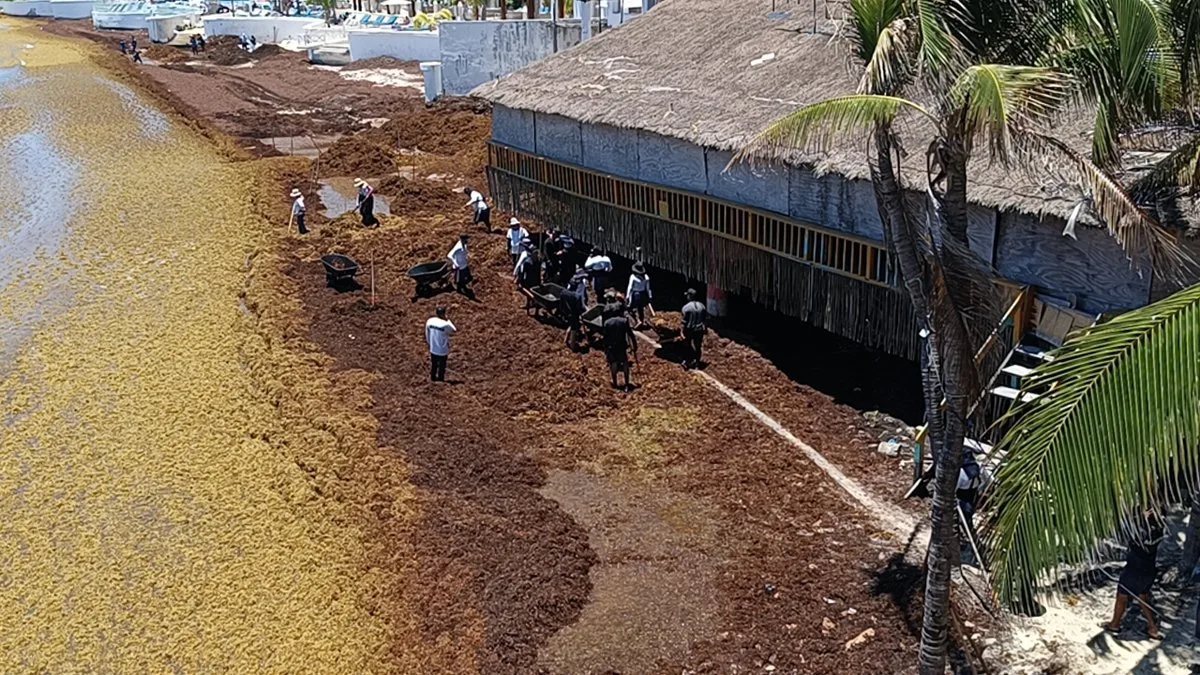
Playa del Carmen, Quintana Roo — Half of the beaches in southern Quintana Roo are now under red alert as a massive sargassum influx hits the region, with Playa del Carmen experiencing particularly intense arrivals, officials said.
Esteban Amaro, director of the Quintana Roo Sargassum Monitoring Center, said this year’s seaweed season is expected to be 25 to 30 percent more severe than 2025, when 95,000 metric tons were collected. So far in 2026, 25,000 tons have already arrived, and Amaro projects a total of 120,000 to 130,000 tons for the year.
The season began in January, three months earlier than usual, and may end sooner as a result, Amaro noted. He said May, June, and July are expected to be the most intense months.
Of the 140 beaches monitored across the state, 15 in the northern zone are on red alert, primarily in Playa del Carmen, where heavy arrivals have persisted for days. Authorities, businesses, and all three levels of government have intensified cleanup efforts.
Víctor Manuel Vidal Martínez, head of the Mexican Institute for Sustainable Fisheries and Aquaculture Research (IMIPAS), said his agency is working with business leaders to determine the commercial value of sargassum, aiming to turn the seaweed from waste into raw material.
While it is too early to set a precise price per ton, Vidal Martínez said the cost must account for labor, vessel operation, fuel, and processing. He estimated the total could range from 6 billion to 12 billion pesos per ton, depending on demand.
“It’s a value chain — collection, transport, processing. Businesses and governments will have to work together so everyone benefits, and possibly allocate a percentage to research,” he said.
Despite progress in forming partnerships and the designation of sargassum as a fishery product last year, Vidal Martínez said the official Mexican standard (NOM) governing its capture, transport, quantities, and uses has yet to be finalized. The standard is needed to unlock the full potential of these efforts.
In the southern zone, business owners in Mahahual reported significant problems. Except for the central area, seaweed arrives heavily there. In addition to barriers installed by the Mexican Navy since January, local entrepreneurs have deployed homemade barriers made from five-liter plastic bottles strung together to help block the algae.
More Environment
- Mexican Navy Opens Youth Photography Contest on Ocean Conservation
- WHO Warns El Niño Poses Major Global Health Threat
- Hurricane Polo Hits Category 5; Five Mexican States Brace for Heavy Rain
- Isla Mujeres Fishermen Face Grouper Shortage as Catch Barely Covers Local Demand
- Cancún Officials Urge Residents to Protect Pets After Reported Puma Sighting in Cuna Maya
More Playa del Carmen
- Playa del Carmen Beach Restoration Clears Environmental Hurdle, Mayor Says
- Bidding Process to Define Renovation of More Than 10 Parks in Playa del Carmen
- Body Cameras Reduce Complaints Over Police Detentions in Playa del Carmen
- Lone Robber Steals 3,000 Pesos From Playa del Carmen Pharmacy
- Three Raids in Playa del Carmen and Cancún Net One Detention and Suspected Drugs
