
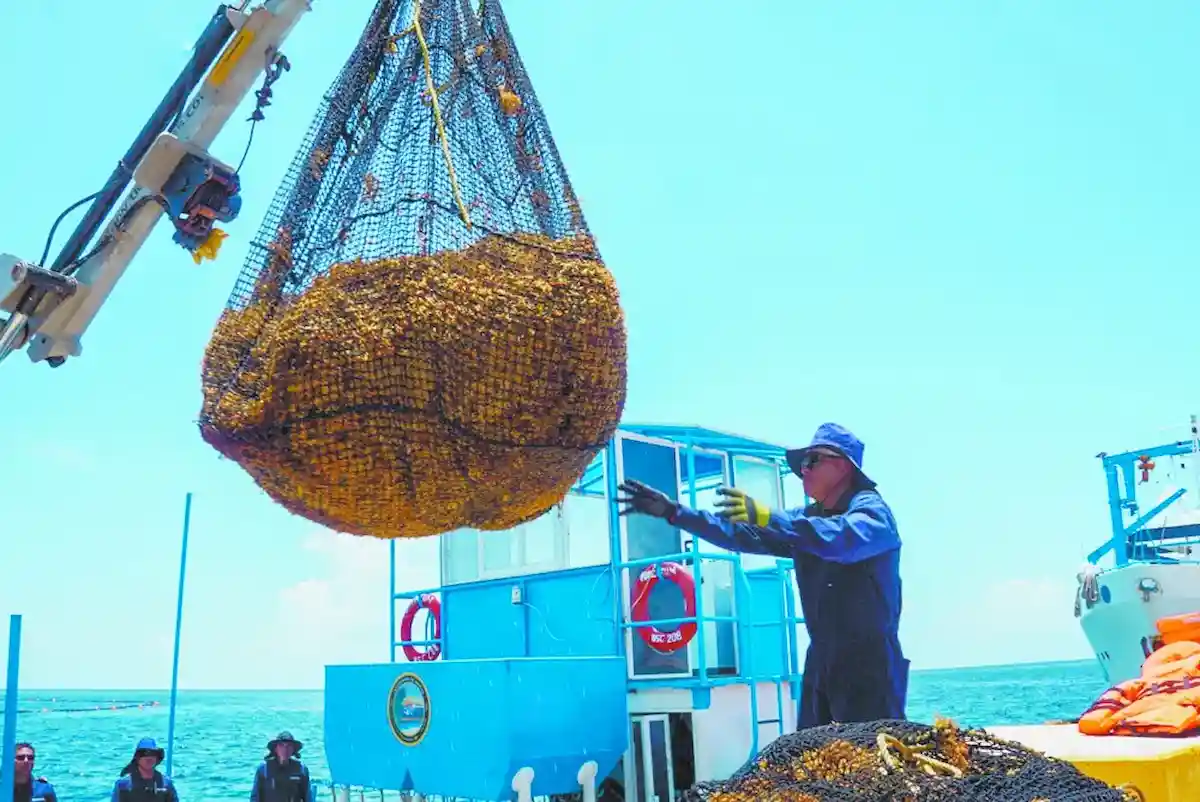
Cancún, Quintana Roo — A massive sargassum bloom in the Gulf of Mexico has grown to roughly 4.2 million tons, a 400% increase in just one year, according to Esteban Amaro, a hydrobiologist and director of the Quintana Roo Monitoring Center.
Unlike the large algal mats normally tracked across the Atlantic, this new population is reproducing on its own, independent of the region’s main currents, Amaro said. The algae are thriving on nutrient-rich discharges from the Mississippi River near Louisiana and from Mexico’s Bravo, Pánuco, Grijalva, Usumacinta and Coatzacoalcos rivers, as well as oil and agricultural runoff. Those inputs combine with the Amazon River plume, Saharan dust and discharges from the Orinoco and Magdalena rivers to create an environment rich in nutrients.
Warmer sea temperatures, which have risen from about 26 to 29 degrees Celsius, have further fueled the imbalance, allowing the seaweed to reproduce rapidly and autonomously, according to the scientist.
The macroalgae began accumulating in the area about three years ago after being pushed outside the influence of prevailing winds and currents. Since then it has formed a self-sustaining population. So far, only small amounts have reached shore in Tamaulipas, Veracruz, Tabasco and Campeche, but the northern coast of Yucatán is already seeing a major outbreak along more than 120 kilometers, from Sisal to Telchac Puerto.
Amaro, who works for the state government, estimated that large-scale landings along Gulf coast states could take hold within one or two years, once the algae population stabilizes and expands. He emphasized that the phenomenon is human-driven, caused by the excess nutrients reaching the sea.
The new Gulf of Mexico bloom adds another factor that could bring more frequent sargassum arrivals to the region’s coastline in the coming years.
More Environment
- Quintana Roo’s Beaches Are Disappearing Up to 14 Meters a Year
- Rabies Found in Fox That Scratched Baby in Cancún
- Cozumel’s Reefs Get a 3D Map Divers Can Explore Before Entering the Water
- Documentary Exposes 30 Years of Pollution in Cancún’s Chacmuchuch Lagoon
- Crocodile Surprises Tourists Swimming at Cozumel’s El Cielo Sandbar
