
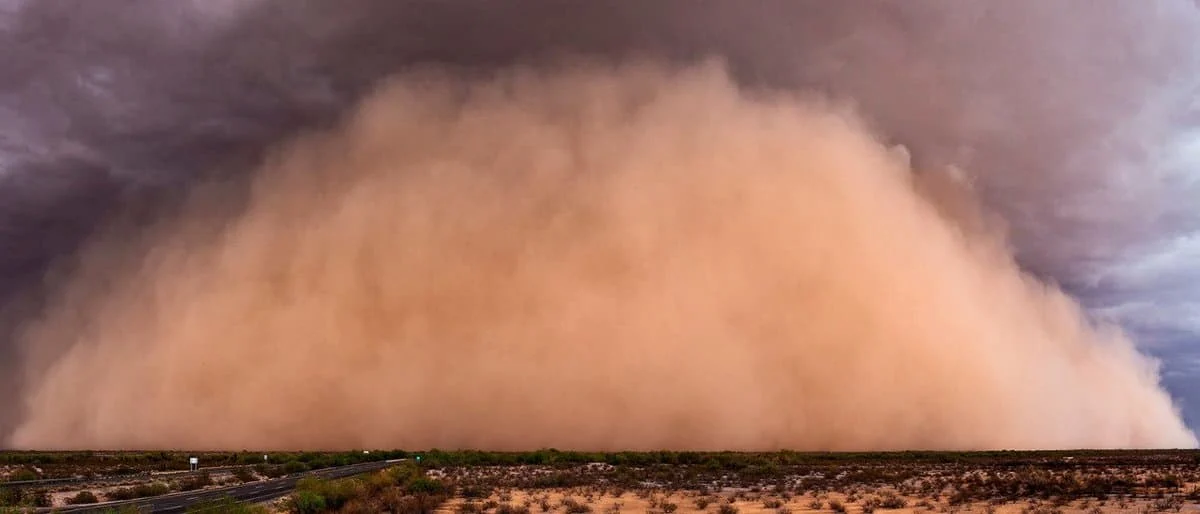
Mérida, Yucatán — A cloud of dust from the Sahara Desert has settled over the Yucatan Peninsula, suppressing thunderstorm formation and creating striking orange and red sunsets, meteorologists reported Wednesday.
Satellite imagery and weather analysis show that dust particles carried from North Africa reached atmospheric levels over Yucatán, Campeche, and Quintana Roo, reducing humidity and limiting the development of tall convective clouds that typically produce heavy rain and lightning.
While largely imperceptible to most people, the phenomenon temporarily alters atmospheric dynamics, lowering the chances of precipitation, experts said.
Despite the dust, weather models still predict rain in the coming days as new tropical systems approach and humidity increases. Officials will continue monitoring particle concentrations to forecast rainfall through the week.
Yucatán’s Civil Protection Coordination said the current dust concentration is low and poses no health or air quality risks.
The dust also creates vivid sunrises and sunsets as suspended particles scatter sunlight, intensifying orange, red, and golden hues. Photographers and skywatchers are preparing to capture the displays across Yucatán and Quintana Roo in the coming days.
The Saharan dust layer is a mass of warm, dry, mineral-laden air that forms over the African desert and travels thousands of kilometers across the Atlantic each year, reaching the Caribbean, Central America, Mexico, and parts of the southern United States.
Meteorologists noted that contrary to some popular beliefs, the current dust concentration will not cause a drought or cancel the rainy season, as tropical waves and other systems will bring increasingly frequent rainfall to the Yucatan Peninsula starting in June.
More Environment
- Cancún Orders Removal of Grounded Boats From Nichupté Lagoon
- Profepa Shuts Down Work Damaging Coastal Dune in Yucatán
- Yacht Grounded on Mahahual Reef Caused No Coral Damage, Conservationists Say
- Playa del Carmen Awaits Federal Approval to Return 20,000 Tons of Sand Recovered from Sargassum
- Playa del Carmen Councilor Questions Semarnat’s Indigenous Consultation Requirements
More Quintana Roo
- Cancún Mayor Ana Paty Peralta Says She Will Finish Her Term and Skip ‘Gino’ Segura’s Campaign
- Tren Maya Finds Reshape Understanding of the Maya ‘Collapse’
- Quintana Roo Enacts ‘Ley Nicole’ Banning Cosmetic Surgery on Minors
- Drought Crisis Forces Quintana Roo Wildlife to Seek Water Near Roads and Towns
- Quintana Roo to Add 10,000 Hotel Rooms by 2028