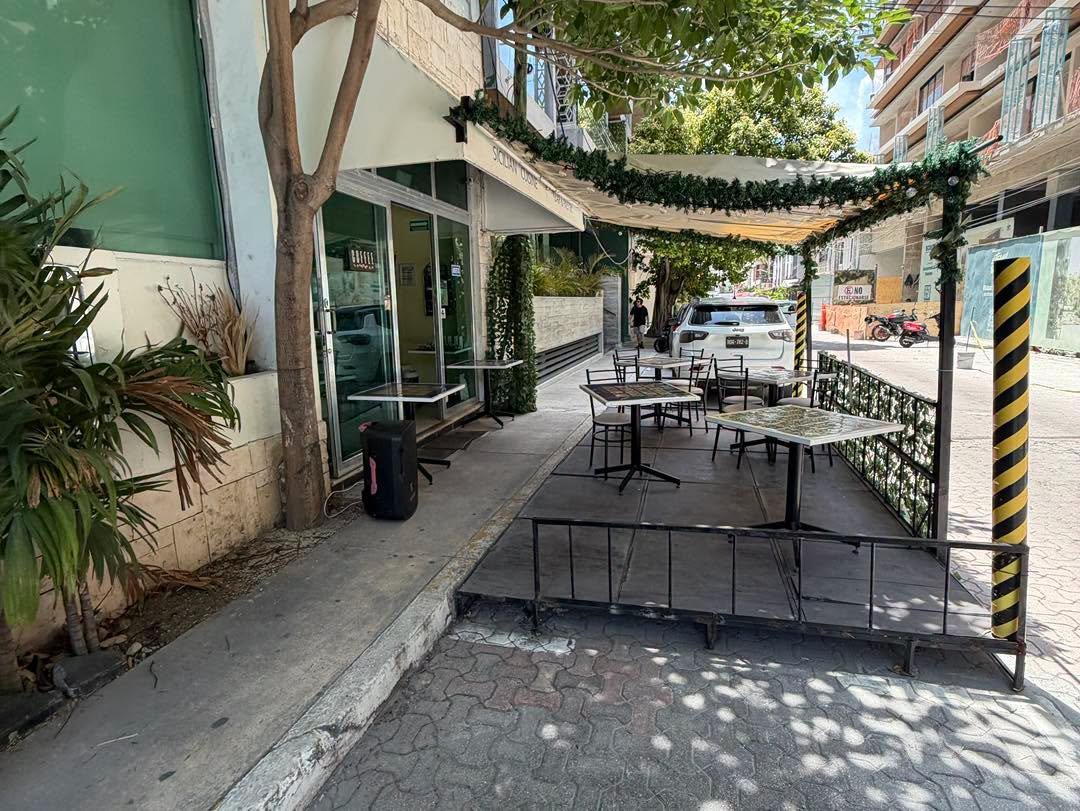
Playa del Carmen, Quintana Roo — Outdoor tables and other restaurant furniture placed on Calle 24 have prompted complaints from residents who are questioning whether a downtown business has municipal authorization to use part of the public roadway.
The complaint centers on Siciliamo, an Italian restaurant located near the intersection of Calle 24 and 10th Avenue, between 5th and 10th Avenues. Photographs circulated online appear to show tables, chairs, a canopy and additional furnishings extending beyond the restaurant property and into the street.
A social media post published July 24 accused the business of improperly taking over public space and called on municipal authorities to determine whether the installation was authorized.
The images alone, however, do not establish that the restaurant is violating municipal regulations. Playa del Carmen allows certain commercial uses of streets and other public property when the operator has obtained the required authorization and paid the applicable fees.
Under Article 122 of the municipality’s current Finance Law, businesses and individuals may be charged for using public roads or other commonly held property for commercial purposes. The law includes monthly fees calculated according to the amount of space occupied. It also establishes separate charges for exclusive-use areas, temporary street closures, fixed or semi-fixed stands and other activities conducted on public property.
The law states that payments for commercial use of public space must be made in advance during the first five days of each month. Payment is tied to the license or permit authorizing the activity, according to the municipal Finance Law approved in December 2025.
Playa del Carmen’s construction regulations also prohibit occupying a public roadway without prior permission from the municipal departments responsible for urban development or public works. Those departments can impose conditions on how and when an authorized space is used.
The central question is therefore whether Siciliamo has a valid permit covering the area occupied by its furniture and whether the installation complies with the dimensions and operating conditions established by that authorization.
As of Monday, municipal authorities had not publicly confirmed whether the restaurant holds such a permit. There was also no public announcement indicating that inspectors had visited the site, ordered the furniture removed or issued a fine. The restaurant had not posted a public response to the complaint.
Siciliamo’s own social media pages list its address as 10th Avenue and Calle 24 and promote operating hours from noon to 11 p.m., Wednesday through Monday. Its public posts do not provide information about a permit for outdoor seating.
Responsibility for checking commercial use of streets falls primarily to Playa del Carmen’s Directorate of Collection and Inspection. The department can issue inspection orders for activity conducted on public roads and verify whether a business has the necessary authorization. The municipality maintains a specific procedure for public-road inspections.
The complaint touches on a broader issue in Playa del Carmen’s tourist center, where restaurants, shops, street vendors and other businesses compete for limited space. Outdoor seating can add activity to a commercial district, but improperly placed furniture may restrict pedestrian movement, eliminate parking or loading space and interfere with vehicle access.
Municipal enforcement has previously included campaigns to reorganize commercial activity around 5th Avenue. In July 2025, Mayor Estefanía Mercado and members of her administration conducted an inspection tour of the pedestrian corridor to identify problems involving commercial activity, public services and the use of common areas.
Residents may request an inspection or submit a complaint through the municipal Directorate of Citizen Participation. The city’s citizen complaint service accepts written reports concerning public services and municipal matters.
Until the city confirms the restaurant’s permit status, the legality of the Calle 24 installation remains undetermined. The presence of tables in the street is not automatically illegal, but it requires municipal authorization and must remain within the space and conditions approved by the government.
More Business
- Cozumel to Get First Direct Flight From Europe With New Milan Route
- Cancún Airport Tops 400 Daily Flights for First Time Since August
- Quintana Roo Urges Homebuyers to Verify Property Records Before Buying
- Maya Ka’an Named Among National Geographic’s 25 Best Destinations for 2027
- Quintana Roo Eyes ‘Set-Jetting’ Boom as Expedia Report Links Film Exposure to Bookings
More Playa del Carmen
- Félix the Dog Rescued from Seized Villamar Home
- Two Women Arrested on Drug Dealing Charges in Playa del Carmen
- Prosecutors Seek Public’s Help to Find 24-Year-Old Missing Man in Playa del Carmen
- Facade Chunks Fall Onto Playa del Carmen’s Quinta Avenida, Prompting Closure
- Playa del Carmen New Urban Development Plan Approval Slated for Early 2027