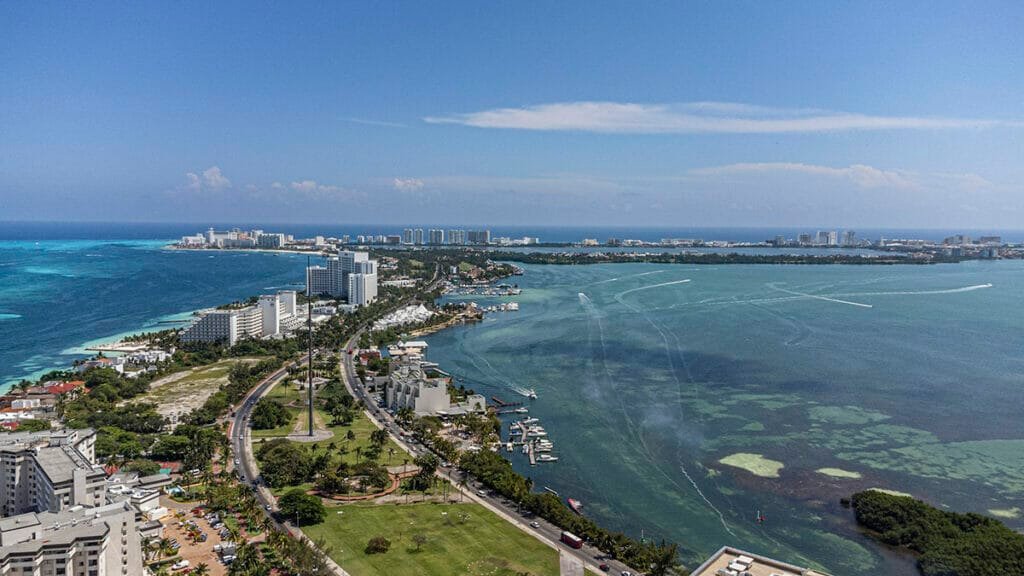
Cancún, Quintana Roo — The hotel zone of Quintana Roo will close the year having spent 226 million pesos, under a financial plan that pairs routine upkeep with larger improvement works, the head of the state’s tourism infrastructure agency said.
Ricardo Archundia, operational president of the Instituto de Infraestructura Turística de Quintana Roo (Infratur), said 115 million pesos of this year’s budget covers operation, conservation and maintenance, while the remaining 106.1 million pesos comes from a 30-month improvement program launched in 2025.
“This year it is 226 million pesos, of which 115 million are for operation, conservation and maintenance; the other 106.1 million come from the 30-month improvement program we have, which includes all the streetlights that were replaced, the speed reducers, the paving we are carrying out, and the boarding and drop-off areas remodeled with solar panels,” Archundia said.
He said the strategy is designed to keep the road operating while a comprehensive renovation planned for the medium term is carried out. Part of the 226 million pesos falls under a 30-month master plan that will conclude in September 2027.
Cumulative investment in the modernization effort through 2027 will reach 336 million pesos, covering streetlights, paving, solar-powered bus stops and speed reducers.
Archundia said the spending breakdown follows an earlier study of operational and capital requirements, a diagnosis that allowed Infratur to divide the budget into concrete actions spread across the three years of execution.
“We loaded a lot of the work into 2025, some remains for this 2026 that we are finishing, and next year we have little modernization left, but it is inside the committed 30-month package,” he said.
Infratur expects a budget similar to this year’s for 2027, with the budget classification ensuring the 336 million peso plan finishes successfully in September 2027.
Speed Reducers Shifting Traffic Flow
The agency’s most prominent works this year focused on speed reducers. Four are planned, and two are already in place: one in front of Playa Delfines and one in front of the Cristo Resucitado church. Both have worked correctly, though lighting details still need to be completed.
“We have found that the speed reducer works better than the traffic light, that is a fact, because the speed reducer operates on demand; if there is a pedestrian, the car stops and it takes seconds for them to cross, but if there is no pedestrian, traffic flows continuously. A traffic light means a full stop; it distracts you for a minute and seconds at a total stop, with or without a pedestrian crossing. So we have found that it gives us a better benefit,” Archundia said.
More Government
- Lee Heads to UN for Trump Talks, Then Mexico Summit
- Pacific Tropical Depression Forecast to Become Hurricane Polo, Possibly Category 3
- Puerto Morelos Expands Civil Registry Services With Mobile Brigades
- Playa del Carmen Mayor Delivers Second Government Report, Touts 46% Drop in Homicides
- Cancún Mayor Ana Paty Peralta Delivers Second Government Report
More Cancun
- Cancún Drivers Accuse Quintana Roo Mobility Institute of Abusive Inspections and Impound Fees
- Puenteando Festival Returns to Cancún’s Nichupté Bridge for Third Edition
- Cancún Ranks Second in Mexico for Food Waste as Residents Discard 260 Grams Daily
- Tropical Wave 40 Lashes Quintana Roo, Toppling CFE Pole and Cutting Power in Cancún
- Cancún Shelter Holds 32 Migrant Minors Awaiting Family Reunification