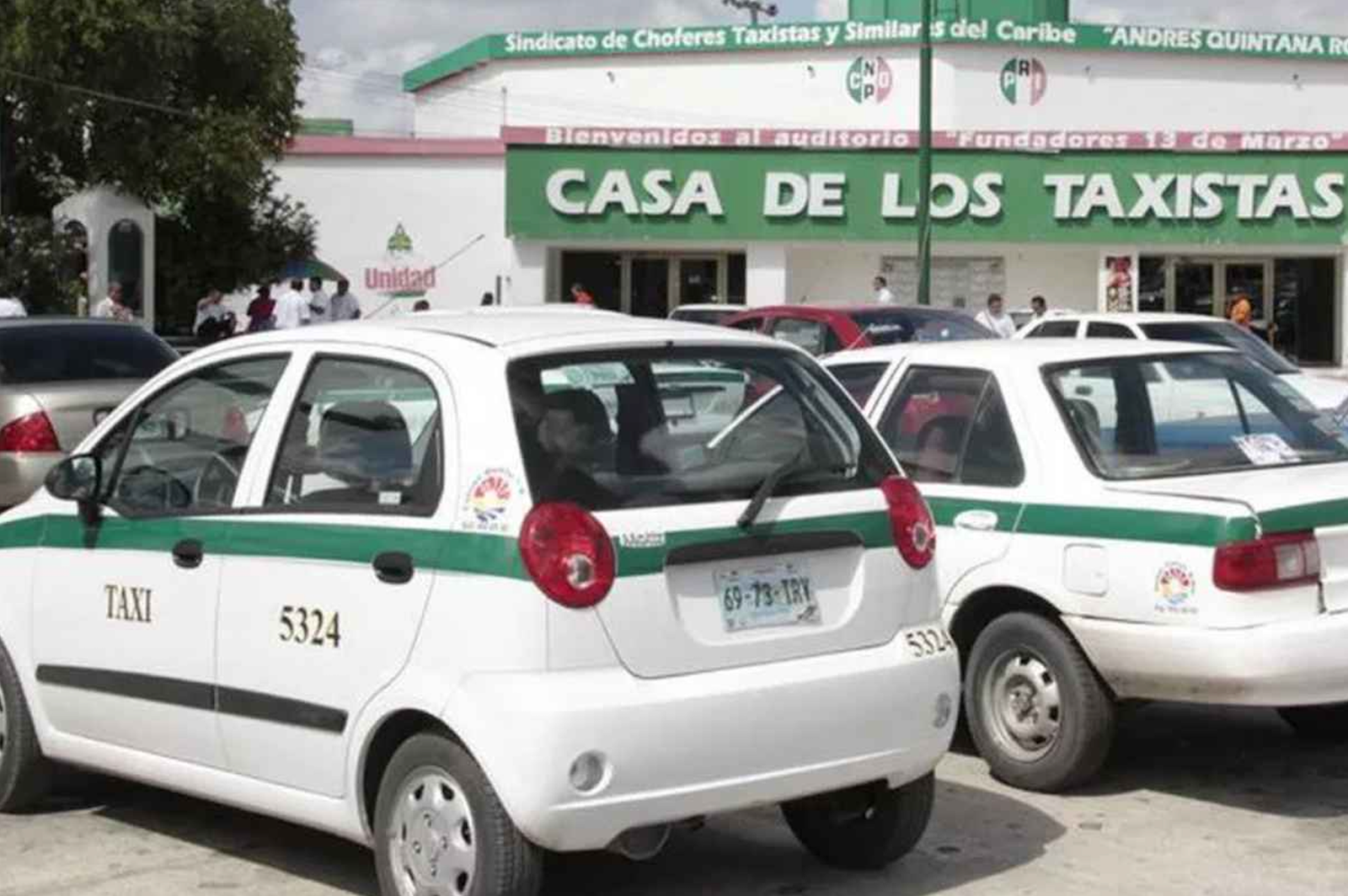
Cancún, Quintana Roo — The Andrés Quintana Roo taxi union, once regarded as Latin America’s most powerful urban transport organization, is electing a new secretary general in an internal vote shaped by a lack of transparency, a severe financial collapse and ongoing criminal investigations.
Two main factions are competing for control of the organization: the Planilla Dorada, or Golden Slate, led by Julio Castillo, and the Planilla Verde, or Green Slate, headed by Michel Díaz Valdez and Carlos Arceo.
Golden Slate: Audits and a Debt Rescue Plan
At a news conference, Castillo laid out the scale of the financial collapse affecting more than 9,000 members, including concession holders, drivers and the families who depend on the sector. He said roughly 4,500 concessions — half of the union’s fleet — are inactive or idle because of institutional neglect, drivers’ inability to pay their dues and a severe lack of technical oversight by the outgoing leadership.
Castillo also detailed the decline in the union’s assets. At the start of the current administration, a taxi plate in Cancún was worth as much as 220,000 pesos on the open market; today it sells for between 35,000 and 40,000 pesos. Monthly lease income for concession holders has fallen from 4,500 pesos to just 1,000 or 1,500 pesos, an amount too small to cover the fees the organization itself charges.
Against that backdrop, the Golden Slate is proposing a “Cuota Cero,” or Zero Fee, program that would offer discounts of up to 90 percent on accumulated debts, make it easier for members to regularize their accounts and ensure that idle plates do not keep generating arrears while they remain off the road.
Castillo said auditing the union’s finances, making the handling of its resources transparent and fixing critical backlogs in the disability, unemployment and death benefit fund are urgent priorities. According to the candidate, compensation payments of 500,000 pesos owed to members with more than nine years of service are running as much as 14 years late.
He also criticized the use of the union as a political springboard, saying its leader on leave, Rubén Carrillo, prioritized his seat as a local deputy for the Labor Party (PT) and left the leadership in a power vacuum for more than eight months, with the priorities of rank-and-file drivers unattended.
Green Slate: Sports and Rebuilding the Union’s Social Fabric
The Green Slate, led by Díaz Valdez and Carlos Arceo, is centering its campaign on rebuilding the union’s social fabric and making use of its existing infrastructure. During campaign visits with union families, Díaz said his priority would be to restore the prominent sporting role the organization held for decades.
The plan aims to expand the active pool of athletes from 600 to more than 2,500 children, young people and adults in sports including baseball, soccer, basketball, softball, cycling and track and field. Díaz said the slate would reopen facilities now abandoned, promote youth development programs and push local athletes toward state and regional competitions.
The proposal rests on the recognition that the union owns sports facilities and has a strong tradition of developing athletes, but needs to revive participation, strengthen competition and project its athletes beyond internal leagues.
Half a Century of Transport Power in Cancún
Founded on Dec. 16, 1972, the Andrés Quintana Roo union grew alongside Cancún’s rapid tourism development, building an empire that stretched from tourist transport companies and tow-truck units to health clinics for its members. For decades it operated in the political arena and was popularly known as the “Green Octopus,” allegedly an electoral arm and slush fund for successive state governments.
From its beginnings, the union was structured to provide safe, reliable transport for both tourists and residents.
In recent years, however, a halt in the issuance of new concessions and violence linked to the infiltration of organized crime plunged the organization into an unprecedented period of insecurity and institutional decline. The crisis came into full view in October 2024, when board member José Luis Corral Morales was abducted and found dead days later on the outskirts of the city.
A week later, the Quintana Roo State Prosecutor’s Office arrested interim secretary general Salomón “N,” known as “Mafer,” and commissioner Óscar Antonio “N,” accusing them of orchestrating the killing.
On Nov. 4 of that year, state and federal forces raided the union’s offices. In the interim leader’s office, authorities seized suspected drugs and cartridges of various calibers, and located a property allegedly used for torture.
Members now face a historic vote that will decide not only who leads the union, but whether the organization survives.
More Business
- Mexico City’s Quintonil Named Best Restaurant in Latin America, Fourth Worldwide
- Quintana Roo Tourism Activity Slips 0.8% Despite Cruise Boom
- Mexico Confirms H5N1 Bird Flu at Yucatán Egg Farm, 862 Birds Dead
- Isla Mujeres Residents Blast Golf Cart Rentals for Taking Over Public Parking
- Tulum Council Approves Request for 75 Million Peso Credit to Cover Operating Costs
More Cancun
- VIMA Foods Aims to Double Mexico Revenue to $140 Million in Five Years
- Mexican Caribbean Forecasts Winter Tourism Surge as Flight Seats Rise 24 Percent
- Cancún Opens Participatory Budget to Newly Regularized Neighborhoods
- Gunmen Shoot Taqueria Employee as He Closed Up in Cancún
- Cancun Family Identifies Missing Man in Viral Video, Leading to Reunion After Five Months