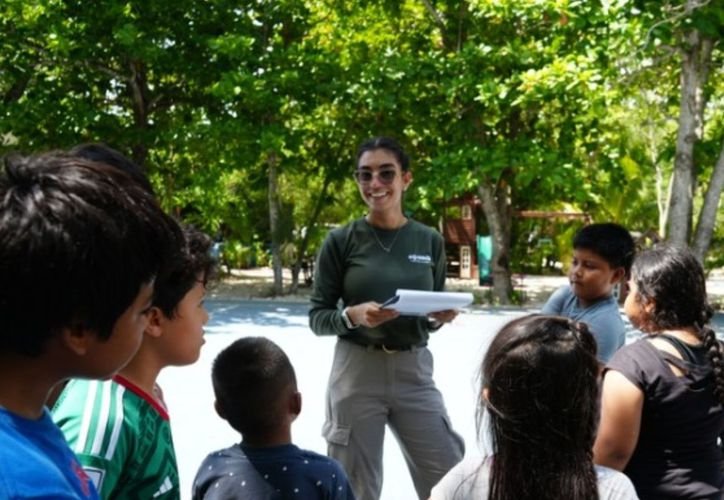
Puerto Aventuras, Quintana Roo — Fundación Eco-Bahía brought 40 students from Puerto Aventuras and Akumal together for an environmental education workshop designed to shift common fears about snakes into knowledge and respect for wildlife.
The event, called “Meet the Snakes: From Fear to Respect,” was part of the foundation’s broader environmental education program and was organized in partnership with the Ángeles Mastretta Library in Puerto Aventuras and the Hekab Be Educational Center in Akumal. Fourteen participants came from the library, while 26 attended from the educational center.
The initiative aimed to break down myths and fears surrounding snakes using scientific information, interactive games and direct participation. Organizers said learning about nature is the first step toward respecting it, and participants explored the animals’ characteristics and their role in keeping ecosystems balanced.
Students rotated through three stations — “Meet the Snakes,” “Myth or Fact?” and “Memorama” — and the activities also included a Jeopardy-style game and exercises adapted to different age groups.
Through questions and games, children and teenagers were able to identify misconceptions about snakes and understand that these reptiles are part of the Mexican Caribbean’s biodiversity and serve important functions in the environment.
Luis Verdín, director of Fundación Eco-Bahía México, said environmental education has the power to change how younger generations perceive and interact with nature.
The program is designed to give students tools to observe, understand and value the biodiversity around them, replacing fear and misinformation with knowledge and respect.
Fundación Eco-Bahía said the event is part of a long-term strategy to bring environmental education beyond the classroom and into local communities. The organization also invited the public to support conservation efforts through its official website.
More Environment
- Activists File Complaints Over Heavy Machinery on Cancún’s Playa Delfines Dune
- Semarnat Denies Permit for Beach Restoration Project in Puerto Morelos
- Cancún Hoteliers Push to Reactivate Beach Recovery Trust
- Experts Warn of Climate Crisis in Mexican Caribbean, Urge Urgent Action
- Scientists Say Sargassum Must Be Stopped in the Atlantic, Not on Cancún’s Beaches
More Puerto Aventuras
- Former Puerto Aventuras Mayor and Two Ex-Officials Ordered to Trial on Extortion Charges
- Playa del Carmen Council Advances Land Approvals for Two IMSS Medical Units
- Estefanía Mercado Announces High School and 24-Hour Health Care for Puerto Aventuras
- Quintana Roo Youth Sailors Join Mexico’s Team for Optimist Championship in Uruguay
- Prosecutors Detail Extortion Scheme Targeting Puerto Aventuras Street Vendors