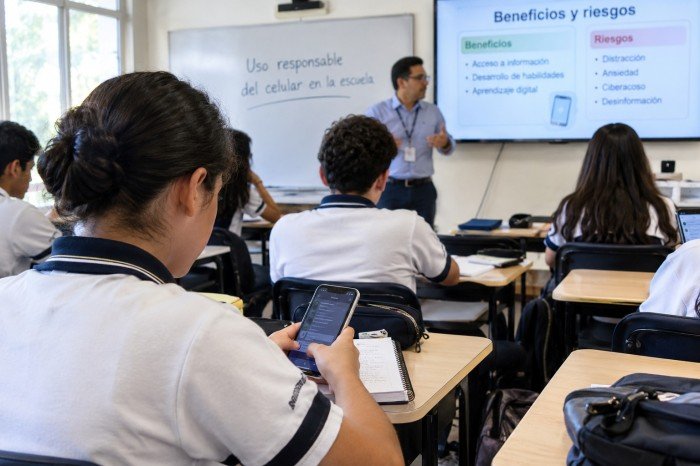
Cancún, Quintana Roo — The regulation of cell phone use in schools has opened a new chapter in Mexico’s education debate, as teachers, authorities, students and parents consider how to take advantage of digital tools without letting them become an obstacle to learning.
Javier Aguirre, head of the Division of Multidisciplinary Sciences at the Playa del Carmen campus of the University of Quintana Roo (Uqroo), took part in a regional forum on the role of screens in daily life, held with representatives from southern and southeastern states. The meeting looked at the impact of mobile devices in educational spaces.
The forum was divided into three working groups: basic education, upper secondary and higher education. Participants included teachers, education officials, students and parents, as well as audience members who raised questions and comments.
Although the official results of the working groups had not yet been released, Aguirre said there was broad participation by teachers and a marked interest in being heard. He also highlighted the position of students, who recognized both the benefits and the negative effects that excessive cell phone use can bring.
One of the main ideas put forward was that regulating does not mean prohibiting. For basic education, participants are considering setting strong rules on the use of screens, while in upper secondary, each school could define its own provisions according to its context, together with parents and students.
In an interview with Radio Fórmula, Aguirre said it is important to take into account differences between schools, since not all students have the same access to technological devices. For that reason, in addition to setting rules, he said it is necessary to strengthen digital skills so that young people can use the tools appropriately and for educational purposes.
The meeting also addressed issues related to safety, consumption habits and emotional care. Aguirre said the use of devices should be analyzed comprehensively, and education authorities need to create conditions that allow them to be used responsibly.
The perception of students themselves was another notable element. According to Aguirre, several young people recognized that the phone can cause anxiety and distraction, although they also expressed concern about overly strict regulation. A 17-year-old student, for example, raised the importance of preserving spaces to develop digital skills and critical thinking.
The debate also incorporated risks associated with the digital environment, including online violence and insecurity. During the talks at the forum, six problems linked to cell phone use were identified: addiction, distraction, social comparison, cyberbullying, misinformation and insomnia.
Given this scenario, Aguirre said one of the main challenges will be to find a balance between returning to traditional tools, such as handwriting, and the teaching of digital skills. The goal, he said, is for students to navigate the technological environment in a critical, efficient and safe way.
More Community
- Appeals Court: Detained Migrants Have No Right to Bond Hearings
- Activists File Complaints Over Heavy Machinery on Cancún’s Playa Delfines Dune
- Same-Sex Couples in Cancún Face Hurdles Certifying Concubinage
- Quintana Roo Human Rights Commission Closes 930 Complaints With Only 13 Recommendations
- Graffiti Artists Erase Cancún’s ‘Wall of Corrupt Politicians’ as Activists Prepared to Restore It
More Cancun
- Cancún–Isla Mujeres Boat Cooperatives Sink Under Heavy Losses as Only 20 of 130 Vessels Stay Active
- Vacation Rental Host Confronts Visitax Charge at Cancún Airport
- Cancún Named World’s Most Active City in World Wellness Weekend 2026
- Victims of Crimes Against Women Protest at Playa Delfines Over Court Failures in Cancún
- Chetumal and Cancún Diverge Sharply on Public Safety Perceptions, INEGI Survey Shows