
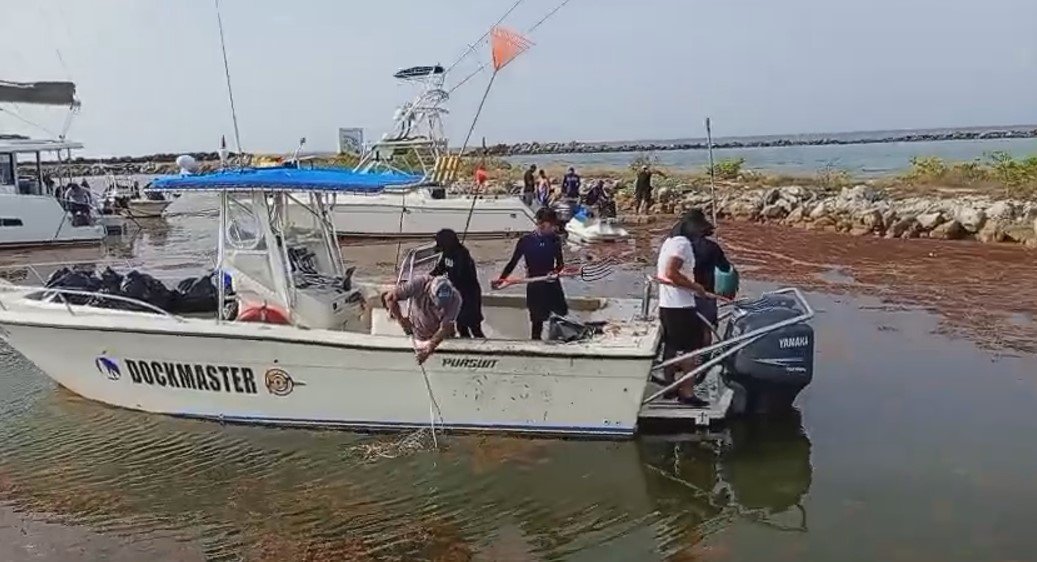
Puerto Aventuras, Quintana Roo — Faced with another heavy wave of sargassum, members of the Puerto Aventuras maritime community launched their own cleanup operation Tuesday morning, using private boats to remove seaweed from the jetty area and the Caleta.
The effort began around 7 a.m., when local service providers, captains, boat owners, and marina workers headed out to collect accumulated sargassum from one of the most important navigation and recreation areas in the residential-tourist community.
The cleanup was not a government operation. It was a local response by people whose livelihoods are directly tied to keeping Puerto Aventuras’ waterways usable.
For boat captains, fishing charters, tour operators, dive providers, sailing crews, and marina businesses, sargassum is more than an unpleasant smell or an eyesore. When it piles up in channels, caletas, and near jetties, it can interfere with navigation, affect water quality, discourage visitors, and create additional maintenance problems for boats and equipment.
The timing is especially difficult. Puerto Aventuras, like much of the Riviera Maya, is dealing with one of the strongest sargassum seasons in recent years. The University of South Florida’s Optical Oceanography Laboratory reported that sargassum amounts in most Atlantic and Caribbean regions continued rising in May, with several regions showing record-high levels for that month. The lab warned that 2026 was on track to be another major sargassum year, with beaching events expected to continue and likely increase in June.
NOAA also notes that large amounts of sargassum have become a recurring problem in the Caribbean, Gulf of Mexico, and tropical Atlantic since 2011. While floating sargassum can provide important habitat offshore, excessive landings near the coast can create serious problems when the seaweed accumulates and decomposes.
In Puerto Aventuras, the local cleanup comes as work continues on a broader anti-sargassum barrier system approved by residents earlier this year. The project includes a main barrier of approximately 900 meters, along with two complementary structures planned for the areas in front of the Yacht Club Caleta and Kantenah Caleta. The goal is to reduce the amount of seaweed entering sensitive water areas before it reaches beaches, channels, and recreational zones.
The project carries an estimated investment of 6.6 million pesos, roughly $350,000 USD. Residents approved the plan during a mid-February assembly after months of discussion over how to protect Puerto Aventuras’ beaches and waterways during what was already expected to be a challenging sargassum year.
Progress reports from the Colonos association have indicated that fundraising and installation work have been moving forward, with community participation playing a major role. But barriers take time to install, and sargassum does not wait.
Participants said immediate action was needed to keep the Caleta and jetty area functioning while the larger mitigation project continues. For many, the situation reflects a broader reality along the Mexican Caribbean: sargassum management now requires a mix of offshore monitoring, barriers, boats, beach crews, local funding, municipal support, and community response.
Puerto Aventuras is not alone. Across Quintana Roo, government agencies, the Mexican Navy, municipalities, hotel zones, private communities, and local businesses are all trying to manage a natural phenomenon that has grown into a recurring environmental and economic challenge.
The impact is felt quickly in tourism-driven communities. When sargassum reaches shore in large quantities, it affects the visitor experience, beach access, swimming conditions, photographs, wedding locations, boat tours, waterfront restaurants, and rental demand. In communities like Puerto Aventuras, where marinas, vacation rentals, restaurants, tours, and real estate are closely connected, poor coastal conditions can ripple through the local economy.
Local business owners and service providers say the concern is sharper this year because vacation rentals and tourism occupancy have already been softer. Sargassum adds another pressure point at a time when many businesses are trying to keep visitors engaged during a difficult season.
For now, the maritime community’s response is both practical and symbolic. The boats in the Caleta are not a permanent solution, but they are a sign that Puerto Aventuras is not waiting passively for the next wave to arrive.
The barrier project may become the longer-term defense, but Tuesday’s cleanup showed that the people who work on the water every day are already part of the first line of response.
More Environment
- Cancún’s Protected Natural Areas See Tourism Slump, With 600,000 Visitors Expected in 2026
- Bamboo Growers From 13 Mexican States Form National Association
- Hepatitis A Outbreak Prompts Class Suspension in Tizimín Village
- Cancún Animal Welfare Hospital Reaches 85% Completion in First Phase
- Up to 20 Sanctioned Offenders a Day Perform Community Service in Playa del Carmen
More Puerto Aventuras
- Mexico’s Environment Ministry Rejects Energy Storage Project Near Playa del Carmen
- Puerto Aventuras Migrant Shelter Issues Urgent Call for Food and Basic Supplies
- Man Detained in Puerto Aventuras After Allegedly Setting Fire to Home During Argument
- Search Ends, but Questions Mount After Fatal Puerto Aventuras Jet Ski Trip
- Body of Missing Monterrey Tourist Found Near Holbox After Jet Ski Disappearance
