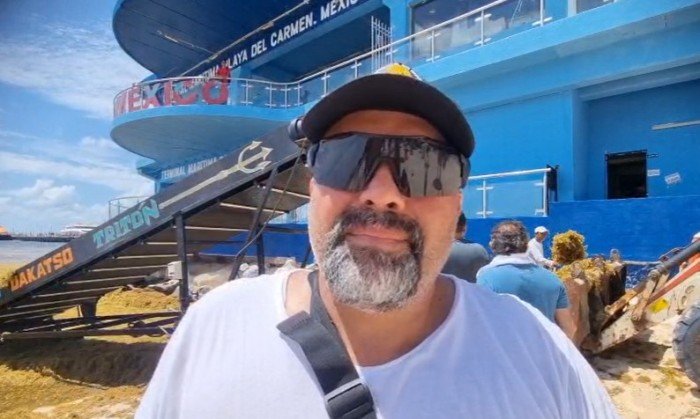
Playa del Carmen, Quintana Roo — The new sargassum collection vessel showcased at President Claudia Sheinbaum’s press conference was designed by a Playa del Carmen company in collaboration with the Mexican Navy.
Dagoberto Ruiz, director of Dakatso, confirmed the collaboration, which lasted several months.
“It comes with software to document collection volumes and a conveyor belt system that can collect up to 600 tons in an eight-hour shift,” Ruiz said during a sargassum cleanup event held with Amexme and the Playa del Carmen City Council.
Unlike the Natans, the sargassum vessel currently in use, which requires manual unloading of collected seaweed, the new vessel features an automated removal system that requires almost no physical effort.
The system bags the biomass at the stern of the vessel and uses 15 belts to transfer the load directly to a dump truck.
Ruiz said the new vessel supports the federal government’s goal of increasing sargassum collection offshore or in shallow waters, so that only minimal amounts are removed from beaches.
“Good things are coming for the state; more equipment is on the way,” he said.
Although offshore collection is no longer Dakatso’s responsibility, Ruiz said the process could be made more efficient by working in waters further south, where sargassum originates. Its volume would be smaller there than if crews waited for it to reach the central and northern parts of the state, due to its reproduction cycle.
More Development
- Mexico Shuts Down Coastal Dune Works in Chabihau Over Destruction of Protected Vegetation
- Yucatán Congress Approves Donating 56 Hectares to Tren Maya, Drawing Objections
- Quintana Roo Expands Beach Restoration Project to Cancún, Puerto Morelos, Playa del Carmen and Cozumel
- Playa del Carmen Vacation Rentals Still Lag Far Behind Hotel Tax Obligations
- Calica Loses Zofemat Concession as Federal Tribunal Sides With Semarnat
More Playa del Carmen
- Playa del Carmen Launches ‘Parquemanía’ to Revive Public Parks
- Playa del Carmen Council Approves New Unit for Older Adults
- Cuban Man Arrested in Playa del Carmen Over Cancún Fatal Shooting
- Playa del Carmen Mayor ‘Very Upset’ With Parking Meter Operator Playaparq
- Business Leaders Urge Playa del Carmen to Diversify Economy as Tourism Slumps