
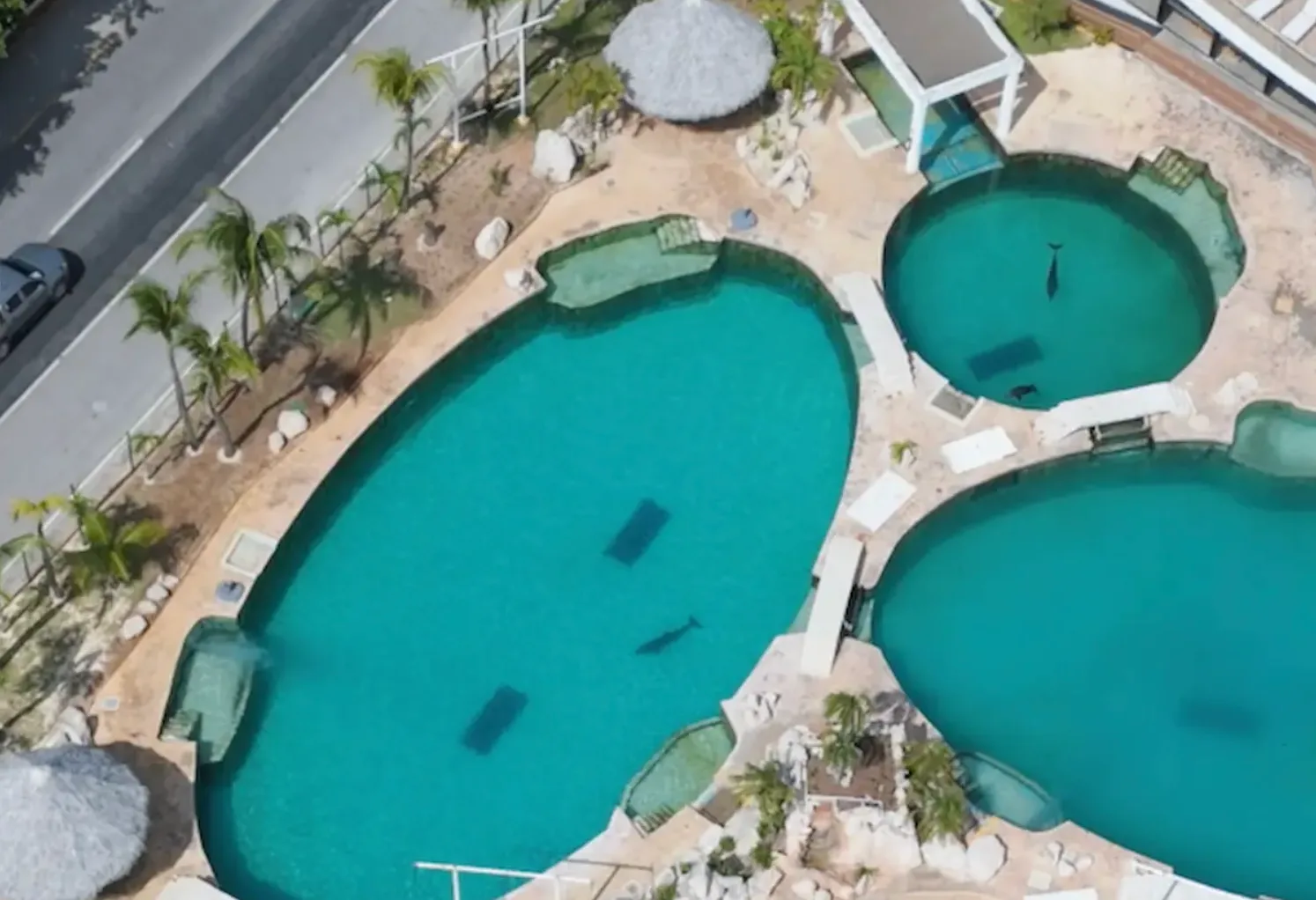
Cancún, Quintana Roo — Nine dolphins are caught in a legal and operational limbo at a closed Cancún tourist park, more than a year after Mexico moved to phase out the captive-dolphin entertainment model.
The dolphins — Solei, Oceanía, Mincho, Diego, Squalo, Flex, Apolo, Solomon and Satu — have remained at the former Dolphin Discovery facility in Ventura Park since the park stopped receiving visitors months ago. All are over 30 years old and many suffer from chronic health problems, according to records reviewed by animal welfare groups.
Mexico’s Federal Attorney for Environmental Protection (Profepa) closed the dolphinarium in October 2025 and opened an administrative case against the operator. The animals have been kept under official care while the legal process unfolds.
A Reform Without a Rulebook
In July 2025, the Mexican Congress approved changes to Article 60 Bis of the General Wildlife Law banning reproduction of marine mammals in captivity except for conservation purposes. The reform also ordered that captive cetaceans be moved to sea pens and barred interactive practices such as riding dolphins or holding their fins.
But the regulation needed to enforce that law still has not been published. The rule, which should have been issued in January 2026, is supposed to specify how dolphins are transferred to sea pens, what those enclosures must look like, and how authorities and owners are expected to comply.
“The regulation should have been released in January 2026 as the law required, to avoid misinterpretation,” said Mariel Bravo, director of the advocacy group Empty the Tanks in Mexico. “For example, the obligation to move dolphins from pools to sea pens within 18 months of the law’s publication expires in April 2027. We don’t see preparations being made.”
Bravo’s organization is urging Profepa and Dolphin Discovery to move the nine animals to existing sea pens the company operates in Isla Mujeres and at Chankanaab, Cozumel. “They can take them in, or prepare another space,” she said. “To avoid waiting so long, this would be the solution: move them to Isla Mujeres or Cozumel, where sea pens already exist. It’s better to be in the ocean than in a tank waiting to die.”
Health Concerns Mount
Clinical files reviewed by Empty the Tanks describe a grim outlook: the dolphins suffer from chronic ailments affecting their gastrointestinal, respiratory, blood, oral, ocular, metabolic and skin systems. Some have severe dental damage, advanced erosion of teeth, long-standing eye disease and tumors. The group also documented repetitive behaviors consistent with compromised welfare.
Yolanda Alaniz Pasini, a scientific consultant with the marine mammal conservation group COMARINO, said decades in captivity have altered the dolphins’ physiology and behavior, making any decision complex.
“The law says there shouldn’t be dolphins in concrete pools, but that doesn’t happen overnight,” she said. “Being in a concrete pool means not hearing or feeling the sea. It’s scientifically proven that it gradually undermines their physiology, brain function and nervous system. It’s persistent chronic stress that encourages all sorts of disease.”
Profepa told Mongabay Latam that the animals receive daily food, veterinary attention and constant monitoring, and that Dolphin Discovery remains responsible for their upkeep while the administrative case continues. The environment department of Quintana Roo state said after an April 2026 visit that the animals — seven males and two female Indo-Pacific bottlenose dolphins (Tursiops aduncus) — had “constant care, veterinarians, proper diets, clean water and daily monitoring.”
Those assurances are contradicted by aerial video released in early August by the advocacy group Veeleaf, which shows a single feeding during a full day, the dolphins exposed to the sun for nearly 12 hours with no visible shade, and long stretches of stillness. “They are all sick, and some are quite delicate,” said Araceli Domínguez, president of the Grupo Ecologista del Mayab (GEMA), who has tracked dolphinarium conditions in Quintana Roo for two decades. “The water in their pools is too warm, and there is no shade where they can take cover.”
A National Inventory Takes Shape
The Ventura Park case is part of a larger challenge. Profepa says it is now compiling a national inventory of marine mammals held in captivity, which will be used to implement the new law. The most recent official count, produced in 2018, recorded 229 dolphins in 33 facilities, with 18 of those in Quintana Roo — by far the largest number of any state. Nayarit, Guerrero and Baja California Sur each had three; Mexico City had two; and Veracruz, Sonora, Guanajuato and Jalisco had one each.
By 2026, Empty the Tanks estimates around 350 marine mammals are still in captivity, including sea lions and manatees. The number of active dolphinariums has fallen to 27 after the closure of four in Quintana Roo, one in Baja California Sur and one in Guerrero.
Historical records reviewed by the group show recurring causes of death among captive dolphins. “They always die of the same things,” Bravo said. “The information we obtained from past administrations lists deaths from septic and bacterial shock, pneumonia, cardiac arrest and gastrointestinal obstruction — signs of mistreatment and deficient care.”
Mongabay Latam sought comment from Dolphin Discovery and Mexico’s federal environment ministry (Semarnat), but neither responded to interview requests or emailed questions before publication.
What happens to the nine dolphins may determine the credibility of Mexico’s reform. “The call is for authorities to act as soon as possible,” Domínguez said. “We need to begin closing more dolphinariums and take dolphins to a refuge where they can spend their final years in better conditions. They have already given part of their lives for human entertainment. It’s time to move them elsewhere.”
More Environment
- Polo strengthens to a Category 5 hurricane off Mexico’s Pacific coast in Record Time
- Cozumel Launches Rabies Vaccination Drive With 3,000 Free Doses for Pets
- Sargassum Collection in Quintana Roo Tops 133,000 Tons, Setting New Record
- Isla Mujeres Collects Over 160,000 Tons of Waste in Five Years
- Tulum Beach Cleanup Pulls 32 Kilos of Marine Debris From Playa del Pueblo
More Cancun
- Cancún: 3 Kidnappers Get 80-Year Sentences Each
- Erasmo Catarino Nearly Drowns at Cancún Beach, Rescued by Raúl Sandoval
- Three Raids in Playa del Carmen and Cancún Net One Detention and Suspected Drugs
- Cancún Enters Final Year With 2.3 Billion Pesos in Public Works
- Benito Juárez to Regulate Cancún Vacation Rental Boom With New Urban Development Plan