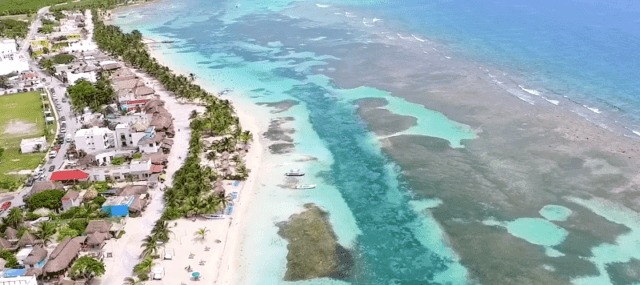
Mahahual, Quintana Roo – Mexico’s federal government says it will work with residents of Mahahual, Quintana Roo, on a new plan to limit large-scale tourism development in the area following the collapse of Royal Caribbean’s controversial “Perfect Day Mexico” project.
Environment Secretary Alicia Bárcena visited Mahahual this week after Semarnat confirmed that the proposed water park and cruise destination would not be approved in its current form. The project, announced by Royal Caribbean in 2025, had been planned for a coastal site near the Costa Maya cruise port and was expected to begin operations in 2027.
The federal government now says it wants to develop a special framework for the area in coordination with Semarnat, the Tourism Ministry, Fonatur, the Quintana Roo government, and local communities. President Claudia Sheinbaum said the goal is to protect Mahahual from large-scale tourism projects that could damage fragile ecosystems, while allowing a more sustainable model of development to move forward.
Bárcena later clarified during her visit that the government is not proposing to declare Mahahual an official Natural Protected Area, a designation that had raised concern among some residents and business owners. Instead, she said the objective is to create a roadmap for tourism that protects the environment while responding to the town’s long-standing needs.
Mahahual, a small coastal community in southern Quintana Roo, has been shaped for years by cruise tourism through the Costa Maya port. The town has also struggled with sargassum, infrastructure problems, waste management, limited public services, and uneven economic benefits from tourism. The debate over Royal Caribbean’s project exposed deep divisions: some residents welcomed the possibility of jobs and investment, while others feared the loss of mangroves, pressure on the aquifer, damage to reef ecosystems, and further dependence on mass cruise tourism.
Royal Caribbean’s “Perfect Day Mexico” was modeled after the company’s private destination concept in the Bahamas. Early descriptions included beaches, pools, restaurants, bars, and more than 30 water slides, including several large themed attractions. Environmental groups including Greenpeace warned that the project could affect mangroves, karst systems, turtle nesting areas, wildlife habitat, and the nearby Mesoamerican Reef system.
Semarnat’s rejection marked a significant shift in the national conversation around tourism development in the Mexican Caribbean. For years, large tourism projects have been promoted as economic engines, but the Mahahual case shows growing resistance to models that place heavy environmental pressure on small communities.
The federal government has said future development in Mahahual should generate local benefits for hotels, restaurants, tour operators, and small businesses, rather than concentrating profits outside the community. Residents also asked officials for practical support, including better sargassum management, waste solutions, communication with authorities, and investment in basic infrastructure.
Royal Caribbean has expressed disappointment over the decision but has indicated it remains interested in future investment in Mexico. Reports suggest any revised proposal would need to address the environmental concerns raised by authorities and the community.
For now, Mahahual’s future remains unresolved. What is clear is that the town is no longer being discussed only as a cruise destination. It has become a test case for whether the Mexican Caribbean can still attract tourism investment without sacrificing the ecosystems and communities that make the coast worth visiting in the first place.
More Environment
- Cancún Orders Removal of Grounded Boats From Nichupté Lagoon
- Profepa Shuts Down Work Damaging Coastal Dune in Yucatán
- Yacht Grounded on Mahahual Reef Caused No Coral Damage, Conservationists Say
- Playa del Carmen Awaits Federal Approval to Return 20,000 Tons of Sand Recovered from Sargassum
- Playa del Carmen Councilor Questions Semarnat’s Indigenous Consultation Requirements