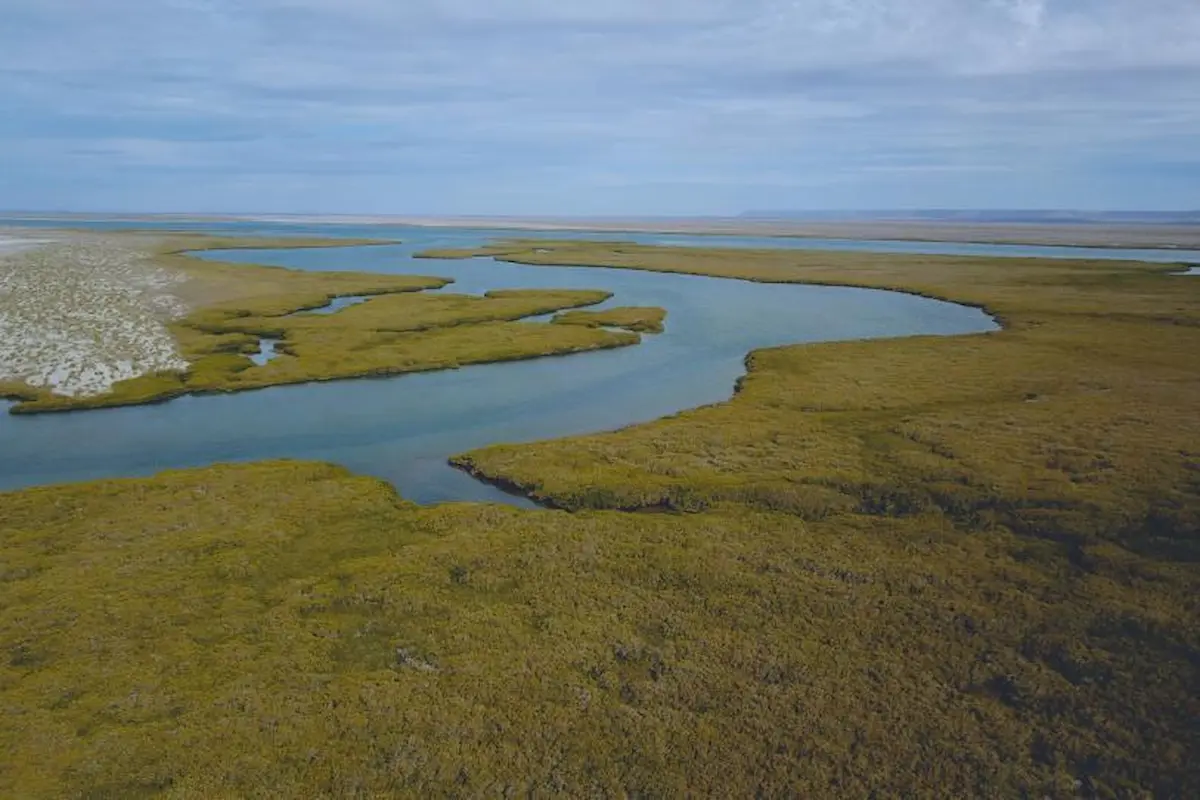
Mexico City — Mexico lost more than 27,000 hectares of mangroves over the past five years, with most of the decline concentrated in the Yucatán Peninsula states of Quintana Roo, Campeche and Yucatán, according to a new report from the National Commission for Knowledge and Use of Biodiversity (Conabio).
The report, “Mangroves of Mexico: Update and Spatial Dynamics 2025,” found that mangrove coverage fell from 905,086 hectares to 877,464 hectares between 2020 and 2025, a net loss of 27,622 hectares, or about 3 percent. The three Yucatán Peninsula states still account for 61.3 percent of the country’s total mangrove area, which spans 17 coastal states and represents 0.4 percent of Mexico’s national territory.
At a presentation of the report, Conabio Executive Secretary Raúl Jiménez Rosenberg said the reduction in mapped area does not necessarily mean the mangroves have disappeared. The new assessment, based on Sentinel 2 satellite imagery, high-resolution photographs and field work, includes a revised classification that distinguishes disturbed mangroves and accounts for mangroves that have migrated inland to higher ground as sea levels rise.
Jorge López-Portillo, a researcher at the Institute of Ecology (INECOL), said the 2025 national mangrove monitoring shows a complex situation. “Although the net loss is moderate, the data show a much more worrying qualitative deterioration,” he said.
The area of disturbed mangrove has more than quintupled, jumping from 9,680 hectares in 2020 to 52,130 hectares in 2025. That means a significant portion of mangroves still appears on maps but is showing structural or functional damage, including loss of height, reduced density and water stress.
The deterioration was most pronounced in two regions: the Yucatán Peninsula, which lost 23,000 hectares, and the northern Pacific coast, which lost 20,000 hectares. But virtually every coastal state was affected, López-Portillo noted.
- Veracruz: 1,248 hectares
- Tabasco: 2,179 hectares
- Guerrero: 1,161 hectares
- Oaxaca: 1,153 hectares
- Chiapas: 1,848 hectares
The restoration cost is estimated at about 70,000 pesos per hectare, he added.
Mexico still ranks fourth globally in mangrove extent, with 6 percent of the world’s total, trailing only Indonesia (19 percent), Brazil (9 percent) and Nigeria (7 percent). The states with the smallest mangrove areas are Baja California (0.005 percent of the national total), Michoacán (0.15 percent), Jalisco (0.26 percent) and Colima (0.43 percent).
The report also found a decline in mangrove “greenness” during the 2020–2025 period, particularly in the Gulf of Mexico and the Yucatán Peninsula. That trend contributed to the rise in disturbed mangrove area, making 2025 the year with the largest loss of healthy mangrove condition. One example cited is the Nuevo Campechito site in Campeche, where the loss of greenness was detected as early as late 2020, though some recovery has recently been observed.
The new distribution map also detected mangroves growing further inland in areas where they had not previously been reported. López-Portillo noted that mangrove migration is not a new phenomenon. Between 1986 and 2001, researchers documented mangrove expansion into lagoons and interior strips at Bahía Magdalena in Baja California Sur, linking the trend to coastline changes, rising sea levels and higher temperatures associated with El Niño.
There are also signs of recovery. Restoration efforts have helped mangrove areas rebound along the route to Isla de Jaina in Campeche, at Laguna Madre in Tamaulipas and in Alvarado, Veracruz.
The report highlights different pressures by region. On the northern Pacific coast, aquaculture farms are the main driver of mangrove loss. In Sinaloa, the report says, shrimp farms are now deforesting mangroves to establish new ponds, a shift from previous years when they were built behind existing mangrove stands. In Jalisco, agricultural activity is encroaching on mangrove areas as flat land is limited by nearby mountain ranges.
In Quintana Roo, infrastructure expansion has been a major factor in mangrove decline. Deforested land cleared for housing developments in Yucatán and Guerrero is also having indirect effects, as these projects sit adjacent to mangrove areas and disrupt surrounding ecosystems.
More Environment
- Brain-Eating Amoeba in Mérida Mall Lake Prompts Surveillance of 240 People
- Beach Weddings Plummet as Sargassum Swamps Quintana Roo
- Quintana Roo Business Group Seeks Public Dashboard for Sargassum Spending
- Autocar Adds 100 Hybrid Buses to Its Cancún Fleet
- Crews Remove Fuel From Yacht Grounded on Mahahual Reef to Prevent Spill
More Quintana Roo
- Mexico Drill Saturday Will Sound Alerts on 80 Million Phones
- Cancun Hotels Look to 2027 for Rate and Occupancy Rebound
- Cancún Mayor Ana Paty Peralta Says She Will Finish Her Term and Skip ‘Gino’ Segura’s Campaign
- Tren Maya Finds Reshape Understanding of the Maya ‘Collapse’
- Quintana Roo Enacts ‘Ley Nicole’ Banning Cosmetic Surgery on Minors