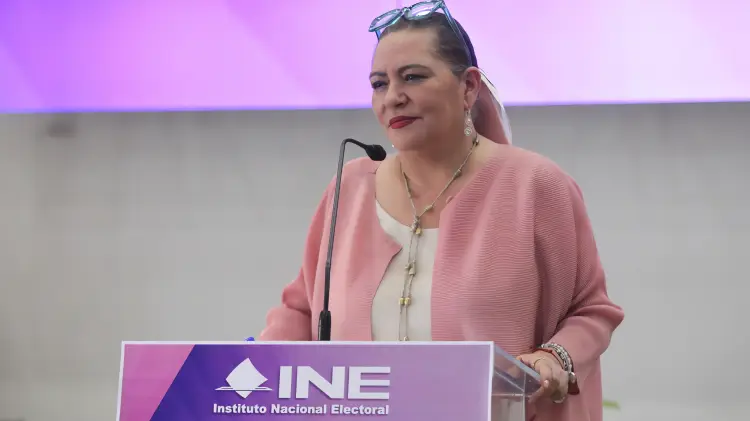
Mexico City — The president of Mexico’s National Electoral Institute (INE), Guadalupe Taddei, said the agency will not take on the role of vetting candidates for ties to organized crime, warning that doing so would compromise its impartiality and exceed its constitutional mandate.
Speaking at a press conference, Taddei rejected a government proposal to create a Commission for the Verification of Candidate Integrity, which would have reviewed the backgrounds of aspiring officeholders and alerted political parties to potential links to criminal groups, corruption, or illicit financing.
The initiative, put forward by President Claudia Sheinbaum, sought to amend the General Law of Electoral Institutions and Procedures to establish the commission with five electoral councilors serving three-year terms. The commission would have had access to information from the Financial Intelligence Unit (UIF) and the Federal Prosecutor’s Office (FGR). The mechanism was intended as a preventive evaluation, not a criminal process, allowing parties to decide whether to keep or drop a candidate.
Taddei argued that the INE lacks the legal and methodological tools to assess risks based on alleged illicit ties. Its mission, she said, is limited to organizing elections and upholding principles of legality, fairness, and transparency. Turning the institute into a body that judges the probity of candidates would place it at the center of partisan disputes.
The proposal follows several cases of mayors and officials arrested on suspicion of links to criminal groups, particularly in the states of Mexico and Morelos. Operation Enjambre uncovered possible schemes of cartel infiltration into municipal structures through illicit campaign financing, affecting at least eight municipalities in Morelos.
Sheinbaum has argued that both the INE and political parties need preventive mechanisms to identify risky profiles before they appear on ballots. The reform is set to be debated in the next extraordinary session of Congress and has sparked a debate over the boundaries between security, democracy, and political rights.
Experts warn that without clear rules and transparent criteria, the mechanism could lead to arbitrary decisions or political pressure. Meanwhile, the INE has reiterated its willingness to analyze measures that strengthen electoral integrity but insists it cannot assume investigative functions or become an inquisitorial authority over candidacies.
More Lifestyle
- Hundreds of Riders Expected for Tulum’s Fourth Federated Horseback Ride
- Quintana Roo Plans Two Wastewater Plants and Two Aqueducts for Cancún and Playa del Carmen
- Playa del Carmen Ranks Second in HIV Cases in Quintana Roo, Official Says
- Cancún Taco Festival Aims to Revive Local Economy in Low Season
- Screwworm Cases Detected in Two Dogs and a Horse in Tulum