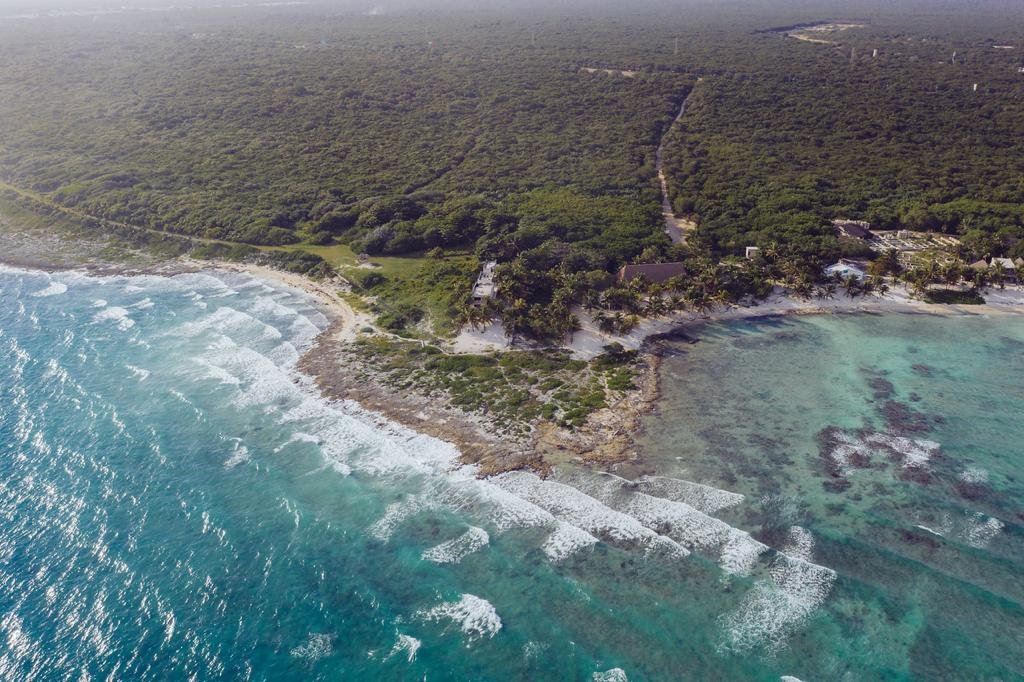
Playa del Carmen, Quintana Roo — A growing citizen campaign is calling for the cancellation of major tourism and real estate developments planned for the coastal corridor between Punta Venado and Paamul, warning that one of the Riviera Maya’s remaining relatively undeveloped stretches of coastline could be transformed by a new wave of large-scale construction.
The petition, launched on Change.org on June 14, 2026, specifically targets two recently approved developments: Proyecto Venado and the Complejo Ecoturístico Riviera Maya. As of the latest count reviewed, it had collected more than 300 verified signatures and was continuing to gain support. Its organizer, Liset Arcos Radtke, is asking federal authorities to cancel the projects, reject future development that could directly affect protected natural areas, make construction plans public before approval and open a broader national debate about Mexico’s tourism-development model.
The concern is not based on one isolated hotel proposal. Together, the projects represent hundreds of new hotel rooms, dozens of private residences, roads, commercial areas, artificial water features and supporting infrastructure on large tracts of land south of Playa del Carmen.
Proyecto Venado: 191 Hotel and Residential Units
SEMARNAT, Mexico’s federal environmental authority, authorized Proyecto Venado, promoted by Residencial Punta Venado, after evaluating an environmental impact statement first submitted in September 2024.
The project would include 108 hotel rooms, 50 special suites and 33 private residences, along with internal roads, a wastewater treatment plant, a reverse-osmosis facility and artificial lagoons. The approved development would occupy about 16.8 hectares of a property exceeding 111 hectares, or approximately 15 percent of the total site, according to the project’s environmental documentation. The remaining area is proposed to retain its existing vegetation cover.
SEMARNAT granted two years and six months for construction and authorized an operating period of 50 years. The project is registered under environmental file number 23QR2024U0089.
The site lies within the broader Punta Venado-Paamul corridor, south of Playa del Carmen, near two major federal protected areas: the Caribe Mexicano Biosphere Reserve and the Felipe Carrillo Puerto Flora and Fauna Protection Area.
That geographical point requires some care. Available reporting describes Proyecto Venado as located between or adjacent to these protected areas, but that is not the same thing as proving that the entire development footprint lies inside both reserves. The precise legal boundaries and zoning of each project site matter, particularly because some protected areas allow certain activities under specific management rules while restricting others.
A Second Major Project Nearby
Proyecto Venado is not the only development raising concerns. In April 2026, SEMARNAT also authorized the Complejo Ecoturístico Riviera Maya, promoted by Oleum Joint Venture, S. de R.L. de C.V., on a nearby 72.8-hectare property.
According to reporting based on the administrative resolution, that project calls for two hotels with 214 and 215 rooms, respectively, for a total of 429 rooms, along with a beach club, commercial area, roads, service areas and three wastewater treatment plants. More than 25.5 hectares were authorized for land-use change, primarily affecting secondary medium sub-evergreen forest vegetation and, to a lesser extent, coastal dune vegetation. The plan also involves limited indirect intervention in mangrove habitat associated with an elevated bridge.
The project’s environmental review began in December 2023 and included a public consultation period in early 2024. SEMARNAT issued its final resolution on April 28, 2026, approving the development subject to environmental conditions and mitigation measures.
Some local reports have cited a figure of 572 rooms for this project, but the detailed reporting on the April 2026 resolution identifies 429 rooms across two hotels. Until the underlying federal resolution is reviewed in full, 429 is the more clearly documented figure.
Taken together, Proyecto Venado and the Complejo Ecoturístico Riviera Maya would add at least 587 hotel rooms and suites, plus 33 private residences, along with extensive supporting infrastructure.
Why Environmentalists Are Concerned
The Punta Venado-Paamul corridor is one of the less intensely urbanized coastal stretches immediately south of Playa del Carmen. The petition describes it as important habitat for jaguars, tapirs, birds, sea turtles and other wildlife, as well as a movement corridor connecting coastal and inland ecosystems.
The broader region sits alongside two important federal conservation areas.
The Caribe Mexicano Biosphere Reserve, decreed in 2016, covers approximately 5.7 million hectares, most of them marine, and was created to protect a vast range of coastal and marine ecosystems off Quintana Roo.
The Felipe Carrillo Puerto Flora and Fauna Protection Area, decreed in 2024, covers 53,227 hectares across portions of what are now the municipalities of Playa del Carmen, Cozumel and Tulum. The federal government has described it as an area protecting well-conserved tropical forests and other important ecosystems.
The petition argues that the undeveloped beaches and forests of the Punta Venado-Paamul corridor also provide nesting habitat for sea turtles, wildlife movement routes and natural protection against erosion and storm damage.
Those broader ecological functions are well established: mangroves, dunes and reefs can help buffer coastlines from storm surge and erosion while providing nursery grounds and habitat for marine species. However, the exact biodiversity present on each project site and the expected impacts of each development are matters that should be evaluated from the project’s environmental studies rather than assumed solely from the petition.
Development Versus Conservation
The companies behind the projects have presented a different argument. In its justification for Proyecto Venado, the developer pointed to continued demand for sun-and-beach tourism, nature tourism, business travel, adventure tourism, events and conventions, arguing that new hotels and related infrastructure support investment and economic activity in Quintana Roo.
SEMARNAT’s authorization of a project does not mean the agency has concluded there will be no environmental impact. Rather, it means the project was found eligible to proceed under specific conditions, mitigation requirements and restrictions established through the federal environmental review process.
For opponents, however, that is precisely the larger concern. They argue that the issue is not simply the footprint of one hotel or one residential complex, but the cumulative effect of several major developments along a coastal corridor that has so far escaped the level of urbanization seen in Cancún, Playa del Carmen and Tulum.
The petition states bluntly that once large real estate projects begin to take hold in natural areas, further development tends to follow.
That is an argument, not a proven outcome. But it reflects a debate that has become increasingly familiar across the Riviera Maya: how much more tourism development can the coastline absorb before the natural landscapes that made the destination famous are fundamentally changed?
What the Petition Is Asking For
The campaign calls for the immediate cancellation of Proyecto Venado and the Complejo Ecoturístico Riviera Maya, as well as the rejection of other real estate projects that lie within or directly affect protected natural areas.
It also asks authorities to make project plans public before approvals are granted and to begin a national discussion about the kind of tourism model Mexico wants to pursue.
At this stage, the petition itself has no legal power to cancel an environmental authorization. Doing that would generally require administrative action, judicial review, an amparo, a successful legal challenge or another formal process.
But the campaign does put a spotlight on a part of the coast that may soon look very different. The Punta Venado-Paamul corridor sits between the heavily developed tourism centers of Playa del Carmen and Puerto Aventuras. For now, significant stretches remain forested and relatively untouched by large hotel complexes.
Whether that remains true is now at the center of a growing public fight over development, protected areas and the future of one of the Riviera Maya’s last less-developed coastal corridors.
More Environment
- Screwworm Cases Detected in Two Dogs and a Horse in Tulum
- Playa del Carmen Recognized as International Bull Shark Zone
- Five Zones in Playa del Carmen Lose Urban Jungle to Construction Boom
- Hurricane Isaias Strengthens to Category 3 as Heavy Rain Hits Quintana Roo
- Hurricane Isaías to Bring Rain and Heat to Cancún and Playa del Carmen This Weekend
More Playa del Carmen
- Quintana Roo Riders Resume ‘Vest Law’ Talks, No Protests
- Quintana Roo Plans Two Wastewater Plants and Two Aqueducts for Cancún and Playa del Carmen
- Playa del Carmen Ranks Second in HIV Cases in Quintana Roo, Official Says
- Playa del Carmen to Build Tactical Operations Center to Boost Fifth Avenue Security
- Environmentalists Submit Citizen Initiative to Protect Playa del Carmen’s Chen Zubul Site From Submarine Power Line