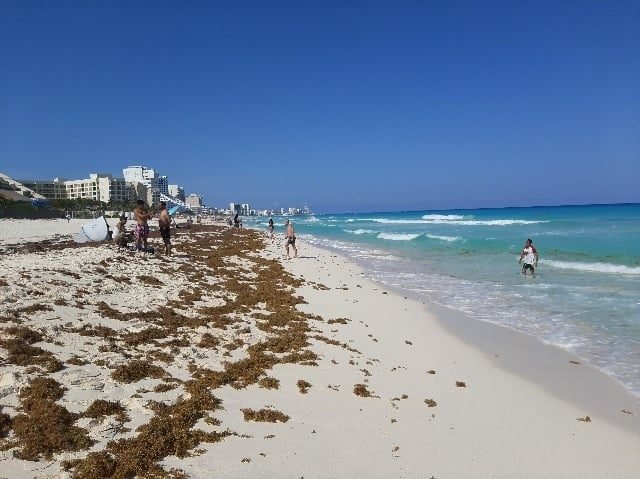
Cancún, Quintana Roo — Mexico’s Navy (Semar) has downgraded its sargasso alert level from red to yellow for Quintana Roo, signaling a decrease in the amount of seaweed reaching the state’s beaches.
The change comes after several months of intense sargasso landings across the Mexican Caribbean. Although the phenomenon remains active, officials said conditions show less seaweed along the coastline compared with the peak period in May and June.
What Does Yellow Alert Mean?
The yellow alert does not mean sargasso has disappeared. It indicates that landings are continuing but at lower volumes than the season’s most critical period. Authorities are maintaining monitoring of ocean currents and conditions to anticipate future arrivals and coordinate cleanup efforts.
Puerto Morelos and Xcacel Still Expect Arrivals
According to Navy forecasts, about 17 tonnes of sargasso are expected to reach the coast at Puerto Morelos over the next 24 hours. Another area under watch is Xcacel, with an estimated 16 tonnes expected. Xcacel is part of a state-protected natural area and hosts a sanctuary for sea turtle nesting, making additional seaweed a conservation challenge.
2026 One of the Busiest Sargasso Seasons
This year has already seen one of the highest sargasso volumes in nearly six years of monitoring. Federal authorities report that about 90,548 tonnes of seaweed have been collected so far in 2026 — the highest figure in the monitoring period. Coastal municipalities were forced to step up cleanup efforts to cope with the massive landings.
Playa del Carmen Shows Signs of Recovery
Some tourist destinations are already seeing noticeably less seaweed. In Playa del Carmen, several beaches have a reduced presence of sargasso. However, tourism operators point out that the effects of the season remain visible in the water, which still has a dark tint in some areas. They estimate it could take about two more months for the sea to fully return to normal.
Winds Could Signal End of Season
Service providers and specialists expect changes in wind direction during the autumn that could further reduce arrivals. That could set the stage for the end of the 2026 sargasso season, though officials caution that ocean conditions can shift and affect how much seaweed reaches the shore. In the meantime, municipalities continue cleanup work to keep beaches from being covered for long periods.
Government Announces 2 Billion Peso Fund
The easing comes after a particularly difficult season. The federal government announced a fund of more than 2 billion pesos ($106 million) to strengthen sargasso containment, collection, and processing efforts, as well as explore ways to put the seaweed to use.
Although the alert has been lowered, authorities say vigilance remains active along Quintana Roo’s coast. Forecasts for Puerto Morelos and Xcacel show that some areas may still see landings in the coming days. Residents, tourists, and businesses are urged to follow official updates. The decline in the alert is a positive sign for the tourism sector, but it does not yet mean the season is over. Wind patterns, ocean currents, and the behavior of the Great Atlantic Sargassum Belt will determine when the 2026 landings finally come to an end.
More Environment
- Hurricane Simon Threatens Puerto Vallarta as Category 4
- Mexico’s Environment Agency Rejects Four Major Tourism Projects in Quintana Roo
- Sargassum Closes In on 53 Quintana Roo Beaches as Tulum and Puerto Morelos Take the Worst Hit
- Semarnat Denies Environmental Permit for GL Dreams Subdivision in Puerto Morelos
- Caribbean Sargassum Becomes Fertilizer for Global Beer Brands
More Quintana Roo
- Morena Launches 11 Municipal Races in Quintana Roo: Who’s In?
- Rafael Marín Confirms Morena Bid for Cancún Mayor in 2027
- Quintana Roo Tops Mexico’s Human Trafficking Cases, Sheinbaum Warns
- Buen Fin 2026 Set for November 13-17 With Five Days of Deals in Cancún
- IMSS Launches Winter Vaccination Drive in Quintana Roo With 263,000 Doses