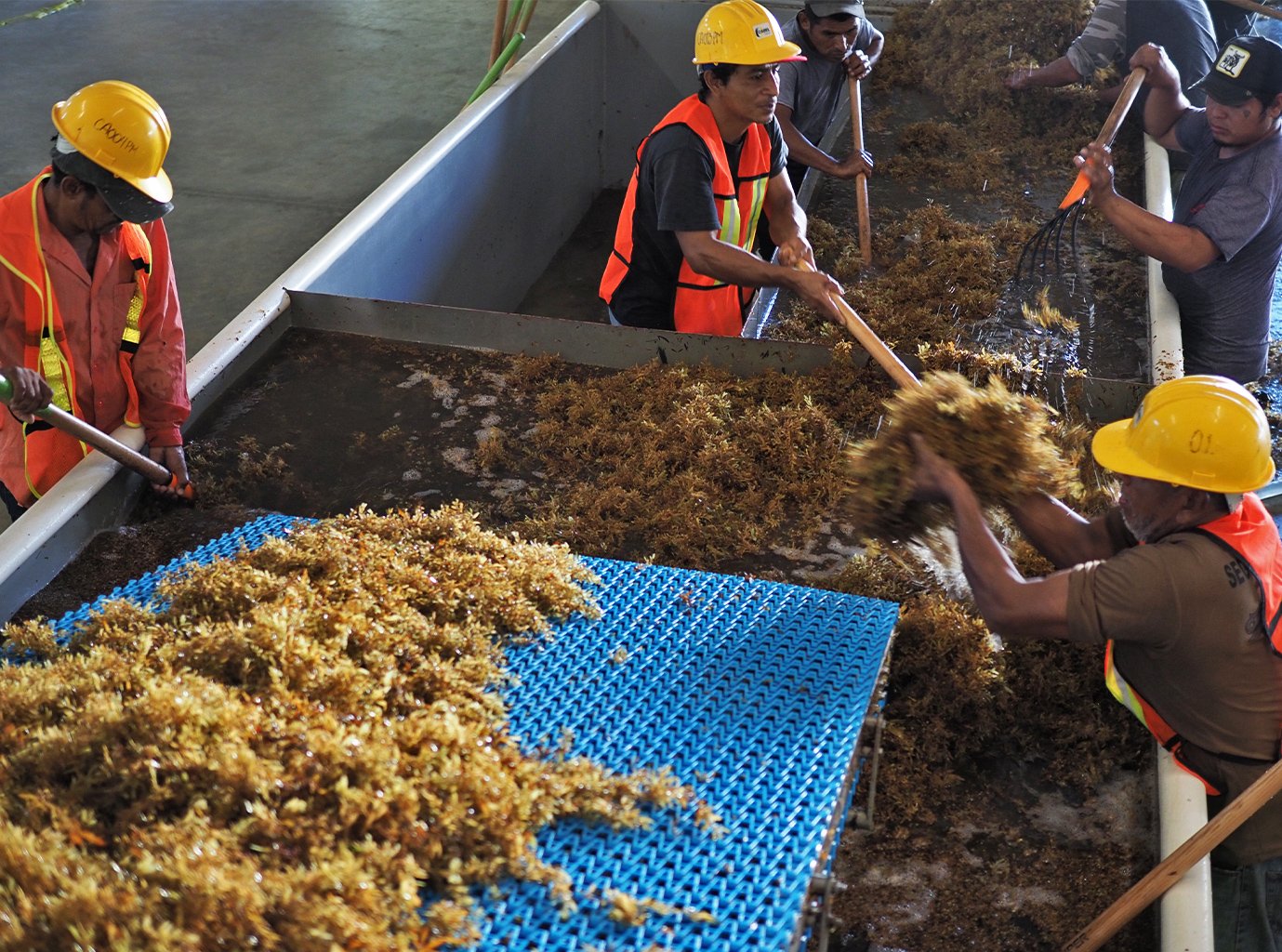
Cancún, Quintana Roo — Sargassum is usually news when it piles up on a Caribbean beach. A company working with seaweed collected in Quintana Roo sees another use for it: turning the algae into a product applied to crops, including barley that may eventually be used for beer.
Sarga AgriScience, a business developed from Carbonwave’s sargassum work, makes an agricultural product called SargaPower. Carbonwave says its process begins with coastal collection and cleaning in Quintana Roo before the seaweed is refined into materials for other uses. Sarga AgriScience markets its extracts as products intended to help crops cope with stress and improve yields.
The connection to beer needs a little unpacking. Sargassum is not being added to the beer. It is processed into a product used while barley is growing. Rodrigo Malagón Millán, the company’s sales director, said it has been applied to barley crops sold through agricultural firm CHS and linked to brands including Corona and Heineken. He also said those brands have tested grain grown under the system. The companies have not independently confirmed the specific supply-chain relationship in the material reviewed for this article.
What the Product Is Meant to Do
Malagón described SargaPower as a biostimulant: a product applied alongside normal farming practices to help plants handle water and other environmental stress. He said it does not replace conventional fertilizer. At an application rate of one liter per hectare, he reported yield increases of up to 18%.
That “up to” matters. It describes a reported result, not a yield increase every farmer should expect. On its own website, Sarga AgriScience highlights a 12.5% barley yield increase from field trials. Results can vary with the crop, weather, soil and the way a trial is conducted. The company also says its products are being used on tomatoes.
For the Mexican Caribbean, the idea is appealing: seaweed that costs communities money to remove could become a raw material with commercial value. But making a product from some collected sargassum is not the same as solving the region’s beach-cleanup problem. That would depend on how much seaweed the operation can take, what it costs to collect and process, and whether customers keep buying the finished product.
A Claim About Approval That Needs Clarification
Malagón said the product has regulatory backing from Mexico’s Cofepris and the U.S. Food and Drug Administration. The precise status of those claims is important. Cofepris explains that plant nutrient products sold in Mexico require sanitary registration, but a registration number for SargaPower was not supplied with the claim. No product-specific FDA approval was identified in the official material reviewed.
There is a separate, verifiable credential: the Organic Materials Review Institute lists SargaPower among products for use in organic production. An OMRI listing should not be described as FDA approval.
Safety testing is particularly relevant when seaweed is headed for farmland. Research on Mexican Caribbean sargassum notes that its composition varies and that arsenic can be a concern. That does not establish a problem with SargaPower, but it explains why testing and processing standards matter more than simply calling a product “natural.”
Carbonwave is pursuing other uses for refined sargassum as well, including emulsifiers for cosmetics, while work on materials such as vegan leather and inputs for 3D printing remains in development. The barley application offers a striking possibility: a troublesome beach arrival becoming useful far from the coast. How large that benefit becomes will depend on verified crop results, safe processing and the scale the company can sustain.
More Environment
- Quintana Roo Seeks UN Help Against Sargassum After Record Year
- Playa del Carmen’s Water Pollution Rules Exist but Go Unenforced, Activist Says
- Conapesca Has Issued No New Commercial Fishing Permits in Playa del Carmen for 17 Years
- Environmentalists Denounce Road and Gate Built in Cozumel Mangrove Tied to Royal Caribbean Project
- Mincho, the Dolphin Whose Injury Helped Change Mexican Law, Dies in Cancún
More Cancun
- Cancún to Open Art Sales Gallery With Works by 200 Local Creators in 2027
- Five Arrested on Drug Charges in Cancún’s Region 91
- Cancún DIF Detects 50 Child Labor Cases as Program Tracks 250 Families
- Day of the Dead Festivals Revive Cancún’s Economy as Tourists and Holiday Paychecks Flood In
- Cancún’s Day of the Dead Festival Draws More Than 110,000 Over Four Nights