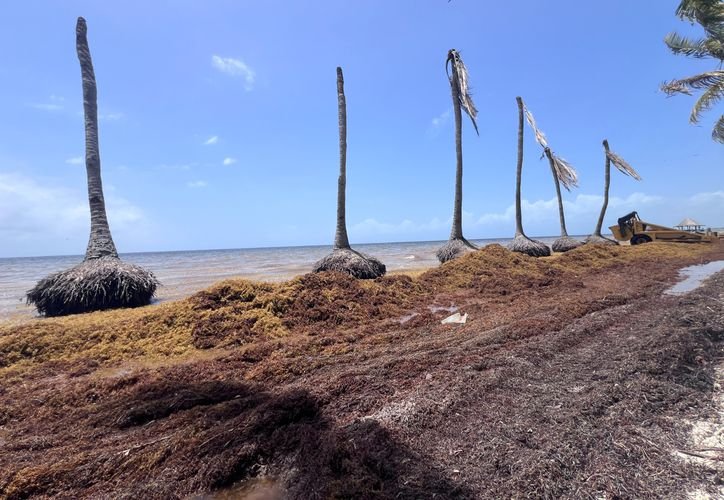
Quintana Roo, Mexico — The Mexican Institute for Research in Sustainable Fisheries and Aquaculture (IMIPAS) is developing the technical foundations for a Mexican Official Standard (NOM) governing the comprehensive management, collection, processing, and use of pelagic sargassum in the Mexican Caribbean.
The initiative follows the official recognition of sargassum as a fishery resource in the 2025 update of the National Fisheries Charter. IMIPAS Director Víctor Manuel Vidal Martínez said the institute is intensifying scientific research to shift from merely containing the problem to turning it into an economic and environmental opportunity.
In Quintana Roo, where sargassum has been a recurring challenge for beaches and tourism, the standard is especially relevant. Massive seaweed arrivals primarily affect the municipalities of Benito Juárez, Puerto Morelos, Solidaridad, Tulum, and the mainland area of Isla Mujeres.
So far in 2026, state and federal authorities have collected tens of thousands of tons of sargassum along the state’s coasts, at significant cost to governments and the hotel sector.
Vidal explained that the NOM will establish clear, mandatory criteria for sargassum management—from collection at sea and on beaches to processing and final disposal. Currently, a regulatory gap creates uncertainty about permitted uses and necessary quality controls.
Key risks the standard aims to mitigate include the potential presence of heavy metals, organic pollutants, or microorganisms that could accumulate in sargassum and transfer to derived products such as fertilizers, animal feed, or construction materials.
The technical regulation will define safety and traceability parameters to ensure that products made from sargassum pose no risk to human health or the environment, Vidal said.
IMIPAS has identified multiple potential uses for sargassum that could be safely developed under clear regulations: animal feed supplements, organic fertilizers, biofuels, bioplastics, water treatment materials, textile fibers, dyes, and construction biomaterials such as bricks or blocks.
In Quintana Roo, where sargassum has traditionally been seen only as a problem, this shift toward utilization represents an opportunity to generate jobs in collection, processing, and manufacturing chains, while reducing final disposal costs and contributing to a circular economy.
The standard aligns with ongoing state initiatives, including agreements between the hotel sector and government for sustainable sargassum management, and the National Sargassum Attention Strategy promoted by the Environment and Natural Resources Secretariat (Semarnat) and the Mexican Navy (Semar).
More Environment
- Mexican Navy Opens Youth Photography Contest on Ocean Conservation
- WHO Warns El Niño Poses Major Global Health Threat
- Hurricane Polo Hits Category 5; Five Mexican States Brace for Heavy Rain
- Isla Mujeres Fishermen Face Grouper Shortage as Catch Barely Covers Local Demand
- Cancún Officials Urge Residents to Protect Pets After Reported Puma Sighting in Cuna Maya
More Quintana Roo
- Quintana Roo Congress Ranks Among Mexico’s Least Transparent
- Riviera Maya Business Groups Push to Block 35.8% Hike in Mexico’s Tourist Entry Fee
- Quintana Roo Climbs 12 Spots to 9th in Competitiveness Index
- Sargassum Collection in Quintana Roo Tops 133,000 Tons, Setting New Record
- Quintana Roo Courts European Airlines to Boost Winter Flights to Cancún