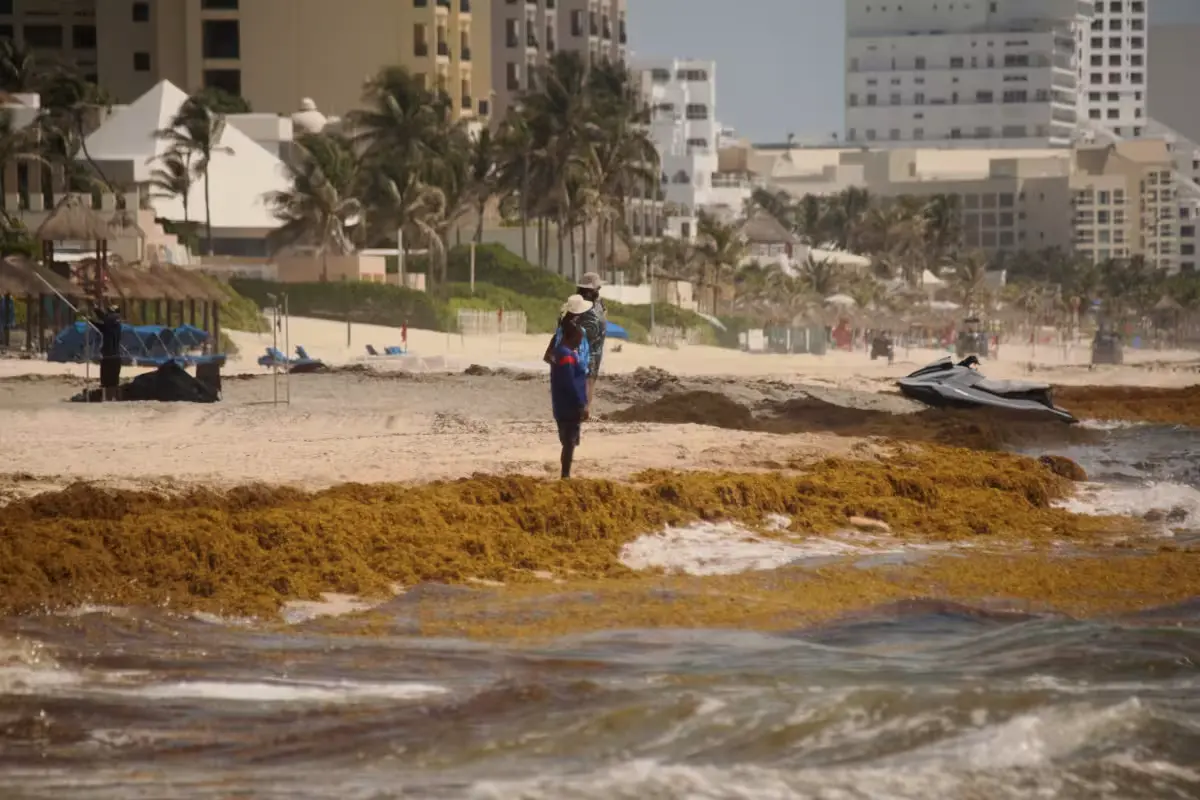
Cancún, Quintana Roo — The beaches of Cancun’s hotel zone are nearly empty at the height of the summer vacation season, despite an official count of more than 455,000 tourists in the area. A record influx of sargassum — roughly 119,000 tons expected by the end of the year — is keeping visitors out of the water, halting boat tours and cutting deeply into the income of local vendors and workers.
On Monday, visitors from across Mexico and abroad still came to Playa Ballenas, Playa Delfines and Playa Forum, where the brown seaweed was clearly visible. The Oceanographic Institute of the Gulf and Caribbean Sea said nearly 40,000 tons of sargassum are currently adrift in the region. Esteban Amaro Mauricio, coordinator of the state government’s Environmental Monitoring and Sargassum Center, said arrivals are expected to continue through the rest of summer and into autumn.
The Costa Maya area has received 11,700 tons so far, part of the roughly 97,000 tons that have reached Quintana Roo this year. State environmental authorities estimate that by the end of 2026 the total will reach about 119,000 tons, surpassing the 92,500 tons collected in 2025. In recent weeks, dozens of beaches have remained under red alert, and some were temporarily closed because of the volume of seaweed.
The worst-hit areas include Tulum, Playa del Carmen, Puerto Morelos, Mahahual and several stretches of the Riviera Maya corridor. Conditions can change quickly from one beach to another depending on winds, currents and coastline orientation.
Amaro said the season started unusually early and has broken records. “This year has been historic; we broke last year’s record and had a very large arrival, especially in the southern zone,” he said. He attributed the increase to climate change and ocean warming, along with nitrogen and phosphorus carried by large rivers in South America and Africa. “That, combined with the warming water, makes the perfect storm for sargassum to develop significantly,” he said.
He repeated that the most effective way to manage the seaweed is to collect it at sea. “The right thing is to collect it in the water, not when it is reaching the beach,” he said.
Quintana Roo currently uses anti-sargassum barriers, specialized boats and the ocean-going vessel Natans. The federal government has said it will add more vessels and extend the barriers. Environment Secretary Alicia Bárcena recently said this year’s volume is four times that of 2025 and 27 times the historical average, calling the current season extraordinary for the Mexican Caribbean.
Businesses Feel the Sargassum Pinch
The empty shoreline is hurting businesses. Omar, a parasailing operator at Playa Ballenas, said he completed only 10 rides over the weekend and saw no improvement on Monday. “The tourist looks from the balcony of his room, sees the water is dirty and full of sargassum, and no longer wants to leave the hotel; he prefers to stay with the services included. There’s nothing to do but wait for someone to decide to fly for a while,” he said.
Elena, a waitress at a nearby hotel, said activity has been unusually low because so few people are on the sand. “In high season I go crazy serving dozens of tourists a day; that gives me peace of mind because it means my job is secure. When I see little movement, I worry there could be layoffs,” she said.
Street vendors are also struggling. Emilio, who sells hats under the hot sun every day, said he works until 8 p.m. and sometimes sells only two or three hats. “I have to do it to earn money for food. The beach is empty. I hope today isn’t one of those days when I sell nothing,” he said. He walks the shoreline from the San Miguelito beach access to beyond the Hard Rock hotel, which is closed for remodeling, cutting off a stretch of potential customers.
At Playa Delfines, tour operators said some visitors who board boats for parasailing try to cancel once they see the amount of seaweed, but the service is already in motion, so crew members try to persuade them to go ahead. Restaurants and nightclubs along Kukulcán Boulevard near Playa Gaviota Azul also report fewer customers.
“We are about to enter the lowest season. August will be complicated, same as September and part of October, until foreign tourists return in November. We’re doing everything we can to attract clients before activity drops even more,” said Cristel, a service provider.
Cleanup Crews Work Overtime
More than 30 workers from the Municipal Public Services Department are carrying out daily cleanups along 400 meters of Playa Delfines. Their work includes removing solid waste and hazardous materials such as metal scraps and glass. Hilario, one of the workers, said the maintenance is permanent. “We clean periodically to preserve the sand. We remove pieces of metal and glass that are risky, as well as cigarette butts and plastic fragments,” he said.
Using shovels, mesh screens and protective gear, the crew sifts the sand, working in stretches of up to 20 meters toward the water. Two tractors equipped with Surf Rake machines gather the seaweed, which is moved to a nearby dune before being hauled to its final destination.
Kevin, another crew member, said shifts run daily because the sargassum does not let up. “We also have to work carefully so we don’t interfere with the bathers who stay on the beach,” he said.
Local families have welcomed the efforts. Rosa Maria, who was visiting Playa Delfines with her children, said she has come to the beach since she was young and wants to keep the tradition alive. “A clean beach says good things about those of us who live in Cancun. We have to set an example so tourists understand this is a place worth caring for. The work these guys do is admirable, because they spend all day in the sun removing cigarette butts, metals, plastics and other waste,” she said.
Other visitors chose to take photos at the large ‘Cancun’ letters rather than go into the water. They acknowledged the scenery was beautiful but said they planned to look for another beach with better conditions.
More Tourism
- Pacific Tropical Depression Forecast to Become Hurricane Polo, Possibly Category 3
- Grupo Xcaret President Touts Mexico’s Culinary Diversity at Apapaxoa 2026
- Isla Contoy Cleanup Removes 249 Kilos of Waste From Marine Park
- Mexico Investigates Possible Aeroméxico Data Leak of 15 Million Records
- Marc Dubrick Dominates Ironman 70.3 Cozumel, Wins Wire-to-Wire
More Quintana Roo
- Quintana Roo Transport Union Prepares Bid for 20% Fare Increase
- Quintana Roo Business Group Urges Taxpayers to Prepare for 2027 Fiscal Changes
- Toni Chaves Reelected to Lead Riviera Maya Hotel Association Through 2028
- Quintana Roo Judicial Branch Certifies More Than 70 Mediation Facilitators
- Quintana Roo Reports 33 New Dengue Cases, Reinforces Prevention Efforts