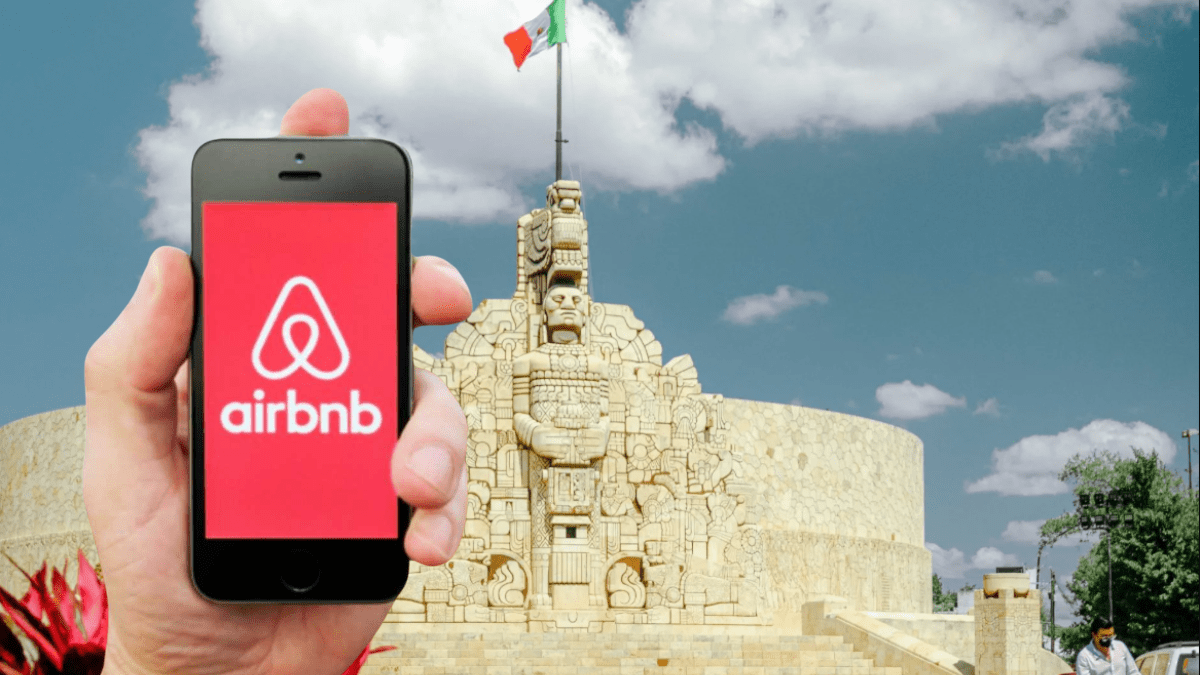
Merida, Yucatan — Merida ranks among the top 10 Mexican cities with the most Airbnb listings, according to data from the activist project Inside Airbnb shared exclusively with Quinto Elemento Lab.
The Yucatan capital has 6,662 short-term rental properties on the platform, placing it 10th nationwide and fourth in the Yucatan Peninsula. The data shows that 1,455 municipalities across Mexico — 59% of all localities — have at least one Airbnb listing, with more than 254,000 entire homes and 40,000 hotel rooms advertised on the platform.
After Merida, the Yucatan towns with the most Airbnb listings are Progreso (1,499) and Valladolid (1,111). The so-called “Caribbean route” — the top 10 cities and municipalities on the peninsula — includes Merida, Progreso, Valladolid, and seven Quintana Roo municipalities: Playa del Carmen (14,963), Tulum (12,142), Benito Juarez (8,872), Cozumel (2,238), Isla Mujeres (1,796), Puerto Morelos (1,532), and Bacalar (1,286).
Among the companies operating on the platform is Vacasa, a U.S. firm with 382 properties across several states, including Yucatan and Quintana Roo.
The data indicates the phenomenon is not limited to major cities hosting international events like the 2026 World Cup or beach destinations. Airbnb has also expanded into colonial cities like Merida and smaller municipalities, consolidating a national presence that continues to grow despite local concerns.
Inside Airbnb founder Murray Cox said the platform has become “an economic tool to incentivize the conversion of homes into tourist accommodations.”
In response to the expansion, authorities in various municipalities are analyzing regulatory mechanisms to address the effects of short-term rental growth on housing markets and community life.
Concentration in Merida’s Historic Center
Inside Airbnb’s analysis identifies Merida’s historic center as one of the areas in Mexico with a high concentration of short-term rentals, alongside Playa del Carmen, Bahia de Banderas, Oaxaca, and Monterrey.
Merida also hosts large property managers such as Homirent, which operates 839 units across 28 complexes in Mexico City, Queretaro, Merida, Tulum, and Cancun.
Commercial Hosts Dominate
The investigation highlights that much of the business is controlled by commercial hosts and property management companies, often acting as intermediaries for investors seeking returns through short-term rentals. This model has accelerated the growth of accommodation supply in urban markets, including historically and culturally attractive cities like Merida.
‘Touristification’ in Colonial Cities
The report identifies Merida as one of Mexico’s colonial cities experiencing “touristification” — a term used by academics and activists to describe the mass arrival of tourists, foreign migrants, exclusive real estate developments, and properties for temporary use. The phenomenon also occurs in San Miguel de Allende and Oaxaca, where governments have promoted urban renewal and historic center improvements that increase appeal to visitors.
Specialists warn that the concentration of tourist accommodations can drive up housing costs. Patricia Olivera Martinez, a researcher at the UNAM College of Geography, explained that rising land values trigger a chain of economic effects on rents, taxes, and services.
“This chain begins with the increase in land prices, which raises property taxes, which in turn increases rents. Residents decide to sell or rent. Demand for water and food becomes very high. Stores that distribute food raise prices more and more. Life in these places becomes much more expensive, and that generates displacement,” she said.
While cities like Playa del Carmen have begun implementing regulations for short-term rentals, the debate over Airbnb’s effects continues to grow across Mexico. In Merida, the platform maintains a significant presence in the historic center and is part of the city’s ongoing transformation toward tourism.
More Business
- Playa del Carmen Taps HR Directors to Boost Local Hiring
- Hospital O’Horán Performs First Robotic Appendix Surgery; Patient Treated Free of Charge
- Mexico Hoteliers Warn of 1.1 Million Air Tourist Loss as U.S. Arrivals Slump
- Cadillac Launches Escalade-V ‘Checo’ Pérez Edition in Mexico for 4.1 Million Pesos
- Mattel Unveils Barbie Día de Muertos 2026 Doll Inspired by La Catrina