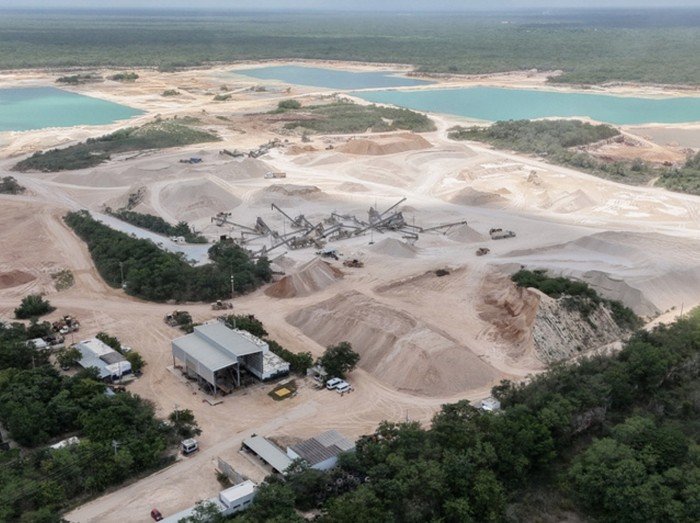
Mérida, Yucatán — Maya communities in the municipalities of Mérida and Umán are pursuing multiple legal cases against stone quarry operations they say are expanding across their land without respecting their rights to territory, prior consultation and a healthy environment.
The cases involve the communities of Yaxcopoil, San José Tzal, Hotzuc and Tebec, where residents have turned to environmental authorities and the courts in an effort to halt the damage they attribute to the quarries.
In the most recent action, the Maya community of Yaxcopoil filed a citizen complaint on August 19 with the federal Environment Secretariat (Semarnat) and the environmental enforcement agency Profepa, as well as with state environmental authorities and the National Institute of Anthropology and History (INAH). The complaint targets the CYPSSA-Peninsula quarry and another operation whose legal name, according to a document released by the collective Utsil Kuxtal, is unknown.
The community says both quarries were installed without consultation and questions their proximity to populated areas and archaeological heritage. A technical study attached to the complaint places the operations 994 meters from the Yaxcopoil town center, 1,918 meters from the Yaxcopoil-Tanmul archaeological site and about 600 meters from a stationary gas tank. The collective says these distances would violate established criteria for quarry operations and notes that no closure procedure has been initiated so far.
The conflict extends beyond Yaxcopoil. In March, Maya residents of San José Tzal, Hotzuc and Tebec filed an amparo lawsuit against federal and state authorities over omissions they say allowed a quarry operated by the company PROSER to keep running. According to their statement, the extraction covers roughly 529 hectares and began without an environmental impact assessment or an adequate consultation and consent process. Residents report effects from dust, explosions and material extraction.
Although the amparo was admitted, the Fourth District Court denied both the provisional and definitive suspensions requested, allowing extraction to continue. That ruling was appealed and is now set to be reviewed by a Collegiate Tribunal.
The communities and Utsil Kuxtal warn that the quarries, which they describe as open-pit mining, can damage territory, the environment, cultural heritage, housing and water supplies. They are calling on the federal and state governments and the judiciary to take steps to prevent environmental, social and heritage damage that could become irreversible.
More Environment
- Quintana Roo’s Beaches Are Disappearing Up to 14 Meters a Year
- Rabies Found in Fox That Scratched Baby in Cancún
- Cozumel’s Reefs Get a 3D Map Divers Can Explore Before Entering the Water
- Documentary Exposes 30 Years of Pollution in Cancún’s Chacmuchuch Lagoon
- Crocodile Surprises Tourists Swimming at Cozumel’s El Cielo Sandbar