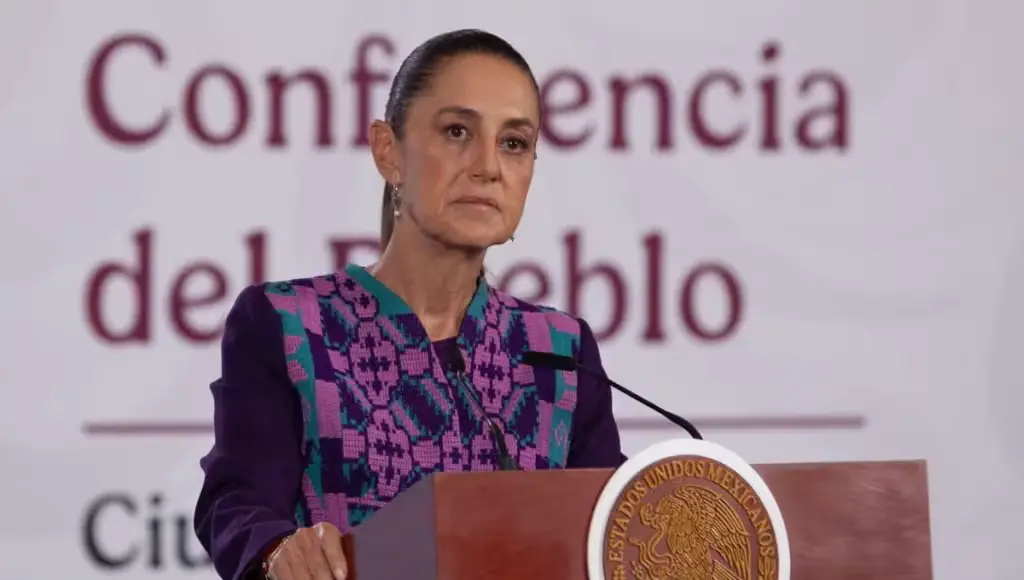
Playa del Carmen, Quintana Roo — A proposed constitutional reform pushed by President Claudia Sheinbaum to bar dual nationals from the presidency and governorships has sparked a legal debate over whether it would create two classes of Mexican citizens.
The reform, announced this week, would prevent Mexicans who also hold another nationality from becoming president or governor. Sheinbaum said the measure is already being drafted, arguing that those who lead the executive branch must represent Mexico exclusively.
“If you have dual nationality, then who do you represent, Mexico or another country?” Sheinbaum said in explaining her position.
Lawyer and academic Ignacio Alonso Velasco warned that the proposal would represent a setback from decades of constitutional evolution that has removed restrictions based on parentage and expanded access to elected office for Mexicans by birth.
The controversy emerged after Sheinbaum brought up the case of former Tamaulipas Gov. Francisco Javier García Cabeza de Vaca, who holds both Mexican and American citizenship. She said her government is analyzing the constitutional initiative under the argument that heads of the executive branch should represent only Mexico, and later confirmed the proposal is being drafted.
Alonso Velasco said the discussion should be framed around political rights and the Constitution’s evolution. Article 116 sets requirements for governors, including being a Mexican citizen by birth and a native of the state or meeting residency requirements. Article 32 contains special provisions for offices reserved for Mexicans by birth, while the Nationality Law regulates cases of people considered nationals of another state at birth.
The issue has precedent. García Cabeza de Vaca and former Chihuahua Gov. Javier Corral have both faced legal disputes over their dual nationality. In Corral’s case, the Electoral Tribunal ruled that his dual nationality resulted from being born in the United States, not from a voluntary decision to acquire another citizenship.
Alonso Velasco also noted that Mexico has previously debated similar restrictions. For decades, presidential candidates had to meet additional requirements related to their parents’ nationality. A 2011 Supreme Court ruling struck down a Morelos constitutional provision that required gubernatorial candidates to be Mexican by birth and children of Mexican-born parents, finding it imposed undue restrictions on the right to run for office.
The debate has a direct connection to Quintana Roo. Article 80 of the state constitution currently requires gubernatorial candidates to be “Mexican by birth and native of the entity, or a child of a father or mother born in the entity, or have effective residence of no less than ten years immediately before election day.”
According to Alonso Velasco, the civil association Mexicanos de Corazón presented a citizen initiative to modify this requirement to the current legislature, but it remains stalled in the Constitutional Points Commission.
Alonso Velasco argued that the federal proposal opens a fundamental question: whether holding a second nationality is by itself sufficient reason to restrict the political rights of Mexican citizens by birth. Loyalty to the country, he said, is not necessarily determined by the existence of another passport but by the behavior of public officials, their respect for institutions, and their compliance with the law.
He added that Mexico faces problems such as corruption, impunity, insecurity, and institutional weakness that should weigh more heavily when evaluating candidates than family origin or the possibility of another nationality.
The proposed reform is only beginning its legislative path, but the debate is already on the table: whether protecting national sovereignty requires restricting access to certain offices, or whether doing so would effectively create Mexicans with different levels of political rights.
More Government
- Quintana Roo’s Beaches Are Disappearing Up to 14 Meters a Year
- Rabies Found in Fox That Scratched Baby in Cancún
- Cancún Brings Electricity to Three Popular Neighborhoods With 358 New Meters
- Quintana Roo Identifies 780 Irregular Settlements, Prepares Regularization Strategy
- Cozumel’s Reefs Get a 3D Map Divers Can Explore Before Entering the Water