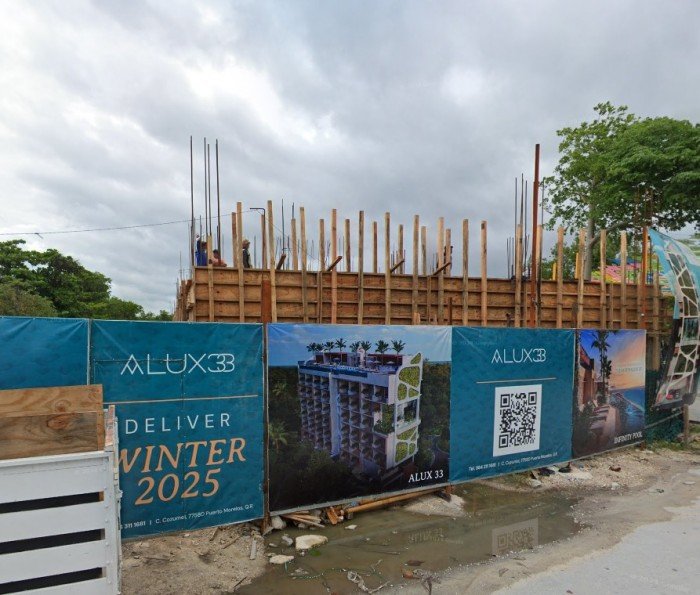
Puerto Morelos, Quintana Roo — A federal judge has ruled that Quintana Roo’s state Environment and Ecology Department (SEMA) exceeded its legal authority when it issued an environmental permit for the Alux 33 condominium project in this coastal municipality, a task that falls to federal regulators.
The civil association Defendiendo el Derecho a un Medio Ambiente Sano (DMAS) announced the ruling by the ninth district judge in Quintana Roo in amparo case 959/2025G-1, which the group filed against the permit granted for the development in a coastal area next to mangrove.
In a statement, DMAS said the decision “should set a precedent for how state environmental authorities act” and should push the agency to stop assuming federal powers. The group added that the ruling opens the door to reviewing other similar permits issued in coastal areas or where mangrove is present.
Federal Denial, State Approval
The Alux 33 project was planned near the corner of Cozumel street and Niños Héroes avenue, in an area that now appears degraded but still held vegetation shortly before the 2020 pandemic.
The developers filed an environmental impact statement, which the federal Environment and Natural Resources Department (Semarnat) denied. They instead obtained a state environmental permit and used it to secure a municipal construction license.
In June, a judge annulled that construction license after finding that the Puerto Morelos municipal government violated the law by failing to verify that the project held a federal environmental permit. Now another court has revoked the SEMA permit that was used to obtain it.
According to DMAS, SEMA not only assumed an authority reserved exclusively for the federal government but did so knowing the area has mangrove and interacts with it, after both Semarnat and the National Commission of Protected Natural Areas (Conanp) concluded the project was not viable.
“The ruling states expressly that SEMA’s Directorate of Environmental Impact and Risk ‘is not legally competent’ to issue an environmental impact statement authorization for a property where a coastal wetland ecosystem such as mangrove exists,” the group said.
Ineffective Justifications
The Alux 33 project drew direct scrutiny of SEMA, which on more than one occasion defended the authorization despite the federal denial.
Among the most striking points: SEMA itself concluded in a 2022 technical opinion that the project was incompatible with federal regulations and that the land should remain under a 20-year prohibition because of irregular deforestation there. Just months later, SEMA issued its environmental permit, arguing that the absence of mangrove on the site and its lack of connectivity to mangrove were sufficient grounds to authorize the development.
SEMA director Óscar Rébora defended the permit in a series of posts on Twitter, saying the land was already degraded and held only “opportunistic secondary vegetation.” He also said the site fell under state jurisdiction because it was not part of a coastal ecosystem.
Carlos Manrique, deputy secretary for environmental protection and conservation, also defended the project in a statement, saying the technical opinion that rejected it had no legal weight and was based on a photographic analysis without a site visit.
The federal judge who revoked the permit rejected those arguments, determining that the absence of mangrove on a property is not sufficient reason to deny federal jurisdiction over a coastal property.
The ruling requires SEMA not only to revoke the environmental permit it issued but also to issue a new one stating that it lacks jurisdiction to handle the matter.
More Courts
- Quintana Roo Wills at 3,000 Pesos as Notary Campaign Deadline Nears
- FBI’s Ten Most Wanted: Five Caught Hiding in Mexico
- Appeals Court: Detained Migrants Have No Right to Bond Hearings
- Same-Sex Couples in Cancún Face Hurdles Certifying Concubinage
- Quintana Roo Human Rights Commission Closes 930 Complaints With Only 13 Recommendations
More Puerto Morelos
- Two Women Arrested on Drug Dealing Charges in Playa del Carmen
- Puerto Morelos Opens Janal Pixan 2026 ‘Mar de Almas’ Festival
- Semarnat Denies Permit for Beach Restoration Project in Puerto Morelos
- Scientists Say Sargassum Must Be Stopped in the Atlantic, Not on Cancún’s Beaches
- Puerto Morelos launches weekly sargassum watch until 2026