
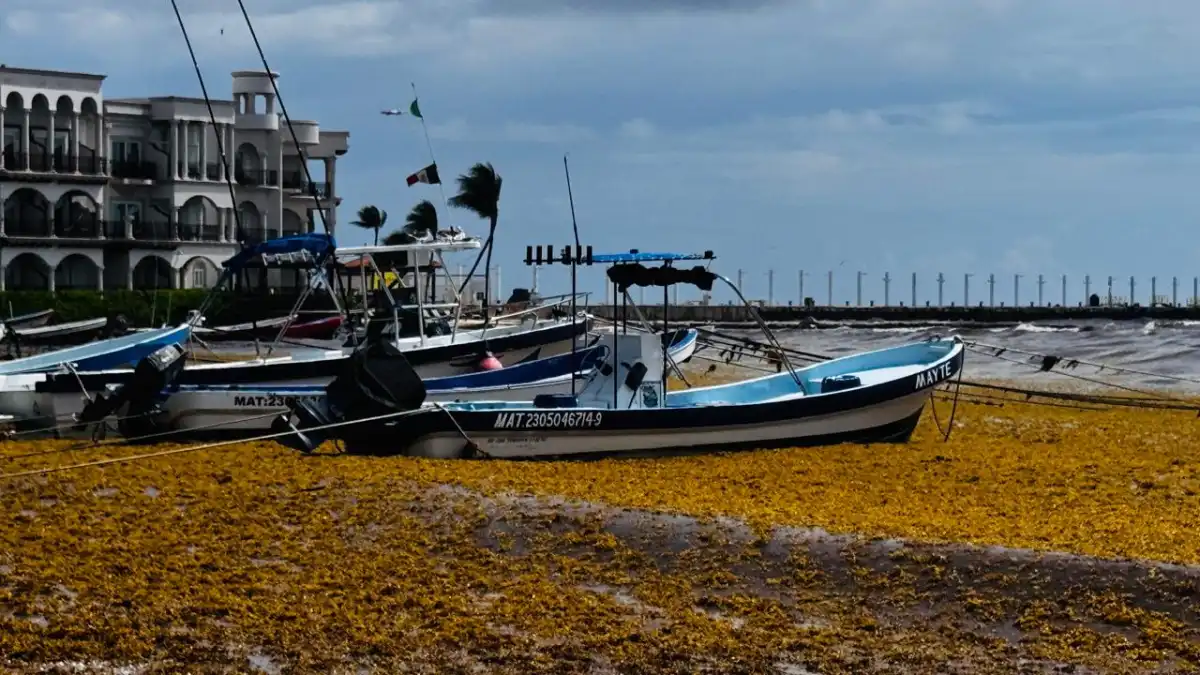
Playa del Carmen, Quintana Roo — Heavy sargassum fouled the shoreline and the local economy of this Caribbean resort town in 2026, stranding or damaging 60 small boats whose owners now say they cannot afford the 10,000 to 20,000 pesos (roughly $540 to $1,080) each vessel needs in repairs.
José Gómez Burgos, president of the “Mar Caribe” and “Haman-Há” tourism cooperatives, said mud produced by the decomposing seaweed trapped the vessels, and that owners have no money left to repair them after months of collapsed tourism revenue.
Some boats suffered only minor damage; others have ruined outboard motors. Operators said income from water-based tours fell from 2,000 to 3,000 pesos a day over the past three years to about 500 pesos a day in 2026 — far short of what a family needs in a town with Playa del Carmen’s cost of living.
Operators say warnings went unheeded
Boat operator Juan Cervando, a musician by trade, described the 2026 sargassum influx as historic compared with 2025. He said the problem had been flagged in previous years, but the municipal government took no precautions to protect the destination.
Snorkeling trips, deep-sea excursions, cave diving and sport fishing all declined as the algae piled up and made it difficult to head out to sea, largely because of the smell.
“My colleagues have gotten by catching seafood to feed their families and sell part of the catch to deal with this difficult economic situation,” Cervando said. “I’m a musician, but this year, with tourism down and everyone affected, as a boat operator I do what I can to earn the day and take in at least 600 pesos to support my family, mainly for food, because we live day to day and there’s no money for anything else.”
Santos Cat Chan, legal representative of the “Playa del Carmen” boat operators, said nautical operations were at times paralyzed and activity fell to as little as 5 percent of normal. He said his colleagues went through a stressful stretch after exhausting their savings, and that with weather conditions unstable, they still have no forecast for the upcoming winter holidays.
Small hotels were hit as well, with occupancy falling to 10 percent. Arrivals from the main source markets — the United States, Canada and Mexico — shrank, and the high-spending segment that had been declining gradually since 2024 dropped sharply in 2026, Gómez Burgos said.
Cleanup effort criticized as insufficient
Workers said the municipal government failed to prioritize collecting and removing the seaweed before it rotted, apparently waiting for heavy swells to clear the beaches. A lack of coordination between agencies contributed to the economic collapse, Cat Chan said.
Diver Juan Velázquez said the destination lived through one of its worst stretches because of the volume of seaweed reaching the shore. The Zofemat federal maritime-terrestrial zone brigade was too small to handle the emergency and, despite its scale, the municipal government did not hire outside crews as previous administrations had done, he said.
Beaches 72 and 88 and Punta Esmeralda were among the hardest hit. Conditions have since improved and no rotting algae remains, but residents say the coastline does not look as it did in 2020 or 2022. They blame part of the deterioration on hotels that exceeded coastal building limits and constructed on the dune, leaving sharp rocks that pose a risk to swimmers.
Despite the losses, the workers said they do not know how they will pay their property tax. “We have no money and the municipal government didn’t help us during this difficult period,” one said.
Erosion outlasts the seaweed
Gómez Burgos said sargassum began visibly affecting the coast around 2013, though volumes then were not yet a threat. That year, sand was dumped on the beach and the first loads of algae arrived; machinery buried the seaweed directly in the sand even though the beaches were still wide.
The practice of digging pits in the dunes, depositing the sargassum and covering it with more sand weakened the shoreline and left it exposed to erosion from moisture and tides. The coastline now looks free of algae, but the loss of sand is the more serious problem, he said. Heavy swells hitting hotel structures have further damaged the coastal strip.
Volumes grew substantially between 2015 and 2018, hurting the local economy and overwhelming the municipal government’s capacity to respond. Recales in 2024 were smaller than those of 2026.
Gómez Burgos said that in 2006 he proposed to municipal and state officials that a containment wall be built 500 meters off the first line of breaking waves, starting at El Recodo beach, to protect the coast. He said officials laughed at the idea and told him he was crazy.
“They didn’t believe us, they thought we were crazy, but 2026 proved we weren’t,” he said.
Sargassum has since cleared from El Recodo, but the water there retains a chocolate tint, and erosion has severely damaged more than 500 meters of coastline.
Fishing fills the gap, for now
With no visitors, the boat operators turned to fishing in September and October. Catches bring in about 500 pesos a day — barely enough to feed a family of three or four — and each worker has invested around 10,000 pesos in nets that also wear out.
Gómez Burgos said the fishing season runs through December, with liseta, chacchí and snapper available, and that the approaching “nortes” weather pattern could help keep some activity going. If the beaches hold up through the winter holidays, he said, operators could recover and reinvest in their equipment.
Biologist Gabriel Robles said restoring the eroded shoreline will take time and field research. A comprehensive plan cannot be drawn up in days but requires months of data collection, assessments and consultations with academics, universities and scientists before it is submitted to the Environment and Natural Resources Ministry (Semarnat), which reviews and approves the required environmental impact statement.
With little time left in the current municipal administration, a beach recovery project is unlikely to be completed, Robles said, because a ruling from Semarnat’s environmental impact and risk office typically takes five to nine months.
More Business
- Cancún Restaurant Owners Press for Tax Incentives to Revive Avenida Yaxchilán
- Grupo Lomas Cuts Workdays and Boosts Promotion to Shield Mexican Caribbean Tourism
- Mexican Caribbean Must Overhaul Its Tourism Model, STARC Director Says
- Hotel Occupancy in Quintana Roo Drops Below 60 Percent
- Prosecutors Raid Isla Mujeres Rehab Center Over Abuse Allegations
More Playa del Carmen
- Playa del Carmen Councilor Pushes for Direct Federal Funds for Indigenous Communities
- Deer Trapped in Playacar Fence Rescued After Social Media Reports
- Playa del Carmen Adds Lifeguard Stations and Patrol Vehicles as Swimmers Ignore Red Flags
- Playa del Carmen Offers 21,000 Flu Vaccine Doses to Older Adults and Young Children
- Playa del Carmen to Deploy 100 Tourist Police on Quinta Avenida
