
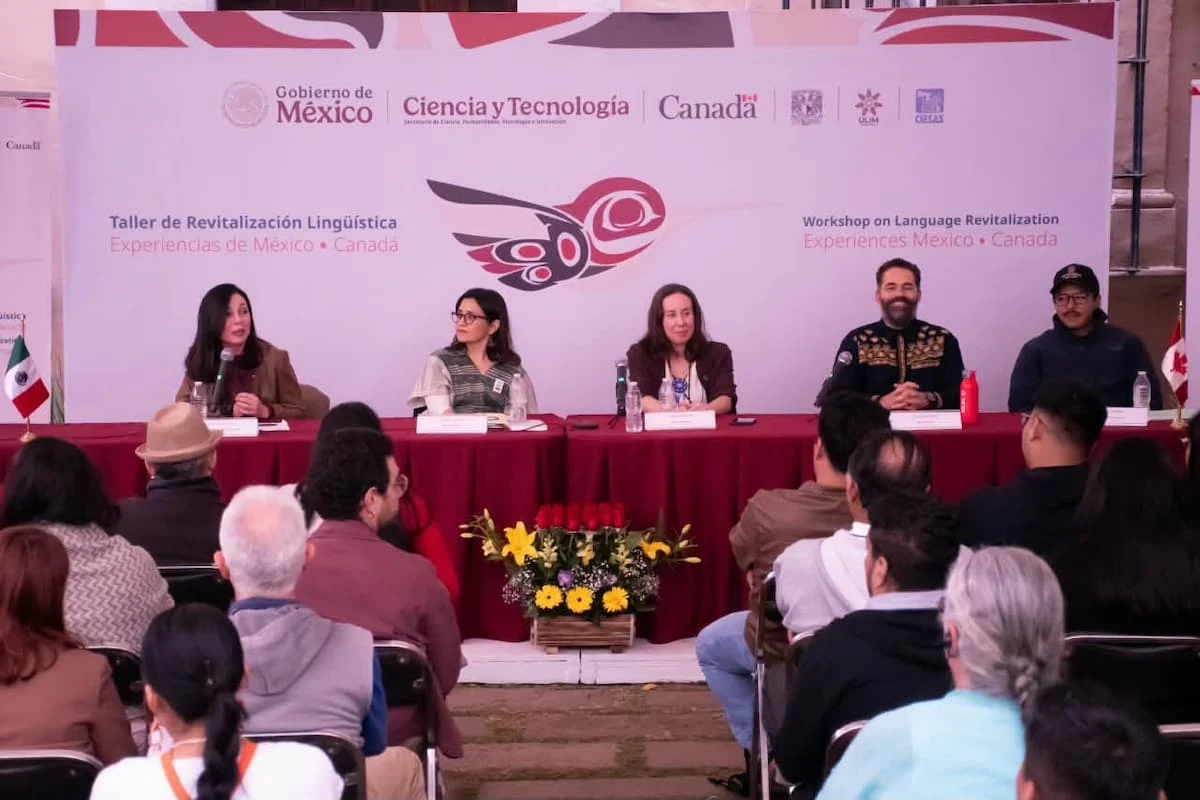
Mexico City — Indigenous peoples must sit at the center of language policy, setting their own goals, carrying out the work and taking part in evaluating the results, a senior Mexican science official said at the close of a three-day binational workshop.
Violeta Vázquez-Rojas Maldonado, deputy secretary for science and humanities at the Secretariat for Science, Humanities, Technology and Innovation (Secihti), summarized the sessions of the Linguistic Revitalization Workshop: Mexico–Canada Experiences, organized by Secihti and Canada’s Social Sciences and Humanities Research Council.
She stressed that passing a language from one generation to the next is what keeps it alive. “Formal education should remain a support, but a language that is not transmitted between generations has very little chance of surviving,” she said.
Vázquez-Rojas Maldonado added that community ownership of the process is essential, which requires long-term relationships that outlast institutional or political cycles.
Stable Funding Called Essential
Among the points of agreement at the meeting, she said, was the need for stable and sustained financing. She noted that under Mexico’s current administration, and particularly under President Claudia Sheinbaum, the government elevated several social programs to constitutional rank in response to demands from Indigenous communities.
Communities must be able to decide their own future, have the material conditions needed to pass on their languages and enjoy social spaces free of discrimination against their speakers, she added.
Karine Duhamel, a representative of the Canadian Social Sciences and Humanities Research Council, said international partnerships such as the one between Canada and Mexico matter and described the revitalization effort as a significant starting point. “We live in a time of opportunity, but also of risk, though none of that should take away from the idea that each of these Indigenous communities charts its own path,” she said.
María Regina Martínez Casas, director general of the Center for Research and Higher Studies in Social Anthropology (CIESAS), said the three days of sessions prompted deep reflection on the linguistic realities of those taking part. “We are building a vine that will bear fruit in the medium and long term,” she said.
New Tools and a Call to Universities
At the meeting, the National Research Network on Indigenous Languages (Renili) presented its first results, including a bibliographic information system on Indigenous languages and the first form of the National Observatory of Languages at Risk.
The network also issued a statement urging higher education institutions to bring their rules in line with the General Law on Linguistic Rights of Indigenous Peoples, to recognize the bilingual and multilingual trajectories of students who speak Indigenous languages, and to give those languages the same status as Spanish and foreign languages in the requirements students must meet to enter, remain in or graduate from academic programs.
The workshop was one of the first results of a memorandum of understanding signed in March 2026 with Canada’s Social Sciences and Humanities Research Council. It brought together Indigenous representatives, speaking communities, academic institutions and authorities from both countries, who shared revitalization experiences at UNAM’s Institute of Philological Research, the University of Indigenous Languages of Mexico (ULIM) and CIESAS.
More Culture
- Cozumel Festival Honors Day of the Dead With Light, Dance and Memory
- What Salt, Water, Candles and Flowers Really Mean on a Day of the Dead Altar
- Cave Divers Push to Revive Jacinto Pat Museum in Tulum to Showcase Caves and Underground Rivers
- Bacalar’s Paseo de las Almas to Feature More Than 20 Decorated Boats
- Quintana Roo Hands Two Artisan Carts to 33 Craftspeople in Playa del Carmen
