Cancún, Quintana Roo — Federal and state officials are developing a National Sargassum Attention Plan that is expected to expand offshore collection, scientific monitoring and the productive use of the seaweed washing onto Mexico’s Caribbean coastline.
Governor Mara Lezama participated in a virtual working session Saturday with federal authorities, scientists and technical teams following President Claudia Sheinbaum’s recent visit to Quintana Roo.
The meeting included Rosaura Ruiz Gutiérrez, head of the federal Secretariat of Science, Humanities, Technology and Innovation, representatives of the National Tourism Promotion Fund and Quintana Roo Ecology and Environment Secretary Óscar Rébora Aguilera.
“Protecting our Mexican Caribbean is a priority,” Lezama said in a statement following the meeting.
Sheinbaum said the federal plan would be presented in approximately two weeks. Although its complete scope and budget have not been released, the president said one of its priorities would be increasing the amount of sargassum intercepted at sea before it reaches beaches.
The approach represents a shift away from relying primarily on beach cleanup, which begins only after the seaweed has entered shallow water or accumulated onshore.
Offshore collection can reduce the amount that must be removed from tourist beaches and limit the time sargassum spends decomposing near hotels, homes and coastal communities. It may also prevent heavy machinery from repeatedly operating on beaches, where mechanical removal can take sand along with the seaweed and disturb turtle-nesting areas.
Collecting it at sea is more complicated. Floating mats move with winds, waves and currents, while severe weather can quickly change their direction or break them apart. Collection vessels must also avoid capturing turtles, fish, crabs and other marine life that use floating sargassum as habitat.
An Exceptional Atlantic Season
The national plan is being prepared during another exceptionally heavy sargassum year across the Atlantic and Caribbean.
Satellite observations showed record-high sargassum levels in the Caribbean Sea during June 2026. The total amount across the Caribbean, Gulf and Atlantic regions placed 2026 on track to become at least the second-largest sargassum year in the satellite record, according to the June regional outlook.
The volume observed offshore does not translate directly into a specific amount arriving in Quintana Roo. Beach landings depend heavily on currents, wind direction, tides and the shape of each section of coastline. This is why Cancún, Isla Mujeres and the western side of Cozumel can experience relatively clear conditions while exposed beaches farther south receive large accumulations.
Sargassum is a natural floating brown algae that provides food and shelter for fish, juvenile sea turtles and other marine animals in open water. The problem begins when unusually large masses enter coastal areas and decompose.
Dense accumulations can block sunlight, reduce oxygen in nearshore water and damage seagrass beds and coral communities. Decomposing seaweed can also release hydrogen sulfide, ammonia and methane. Hydrogen sulfide produces the familiar rotten-egg odor and may cause headaches, nausea and respiratory irritation at elevated concentrations.
The effects extend to tourism, fishing and municipal services. Coastal governments must pay for workers, vehicles, collection equipment, transport and disposal sites, while businesses can face cancellations when beaches become difficult to use.
Building On Existing Marine Operations
Mexico already operates a sargassum response coordinated by the Secretariat of the Navy, working with state and municipal governments, hotels and private contractors.
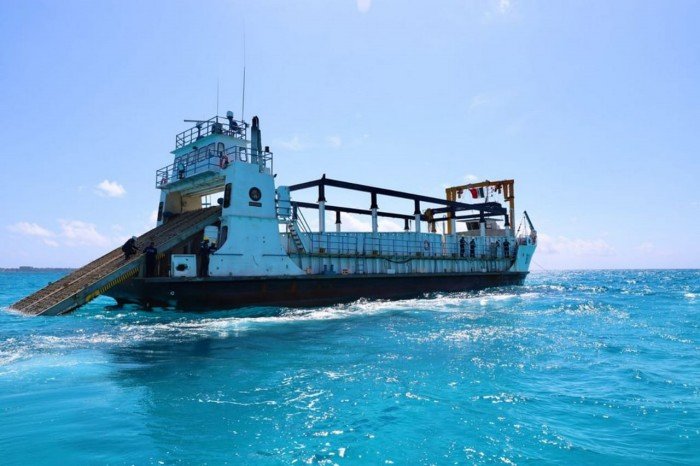
The existing system includes coastal collection vessels, a larger ocean-going sargassum vessel, small boats and floating barriers positioned near some of Quintana Roo’s most affected communities. The Navy has previously reported deploying thousands of meters of barriers along the state’s coastline.
Barriers are designed to redirect or contain floating seaweed so it can be collected before reaching shore. Their effectiveness varies according to wave conditions, water depth and local currents. They must also be placed where they do not interfere with navigation or damage coral reefs and seagrass.
Sheinbaum has indicated that Mexico intends to increase its offshore capacity. Further details are expected when the national plan is presented, including the number and type of vessels, where they will operate and how federal responsibilities will be divided among the Navy, environmental agencies, scientific institutions and tourism authorities.
The plan is also expected to address what happens after collection. Sargassum has been studied as a possible raw material for construction products, soil additives, fuels, paper and other goods. Turning it into a commercial product remains difficult because freshly collected material contains large amounts of water, salt and sand, and may also contain arsenic or other contaminants.
Any large-scale use requires testing, processing standards and a reliable supply chain. Sargassum collected offshore is generally cleaner than material removed from beaches, which may make it more suitable for some forms of processing.
Scientific teams are also expected to contribute forecasting, environmental monitoring and guidance on safe collection. Mexico already uses satellite observations and oceanographic models to track floating mats and estimate where they may reach the coast. The National Commission for the Knowledge and Use of Biodiversity operates a satellite-based early-warning system, while the Navy issues regular forecasts for Quintana Roo.
The coming federal plan will need to connect those forecasts with vessels, barriers, municipal cleanup crews and storage facilities. The government has not yet announced its cost, implementation schedule or measurable collection targets.
Lezama said Quintana Roo would continue working with federal agencies and scientists to develop a longer-term response. The full plan is expected to clarify whether the new strategy can move the state beyond emergency beach cleanup and toward coordinated interception, processing and environmental monitoring throughout the Mexican Caribbean.
More Environment
- Mexican Caribbean Has Lost More Than 70% of Its Corals, UNAM Scientist Warns
- Sargassum Barrier Installation Begins in Puerto Aventuras
- Cancún to Open Glass Collection Center as Part of Circular Economy Push
- Cave Divers Push to Revive Jacinto Pat Museum in Tulum to Showcase Caves and Underground Rivers
- Snakes Account for Nearly Half of Cancún’s Wildlife Reports, Firefighters Say
More Quintana Roo
- Quintana Roo Urges Homebuyers to Verify Property Records Before Buying
- Call to Scrap Visitax Puts Quintana Roo’s Tourist Fee Under Scrutiny
- Quintana Roo Eyes ‘Set-Jetting’ Boom as Expedia Report Links Film Exposure to Bookings
- Caribbean Hoteliers Ask Mexico to Earmark 28% of Non-Resident Fee for Tourism Promotion
- Belize Tightens Río Hondo Border Patrols, Presses Mexico on Maya Train Extension