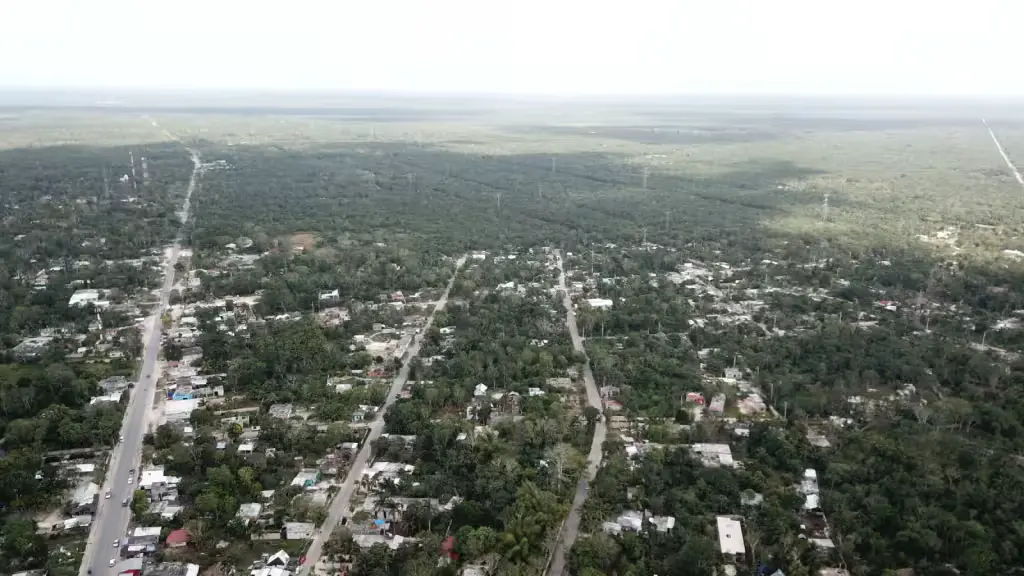
Leona Vicario, Quintana Roo — Members of the Leona Vicario ejido have ordered an audit of more than 12 million pesos collected from landholders and developers under a land regularization program that has yet to produce a single property title.
The dispute erupted at the ejido assembly on Sunday, September 6, 2026, when representatives of Tire Terracasa Inmobiliaria Real Estate, S.A. de C.V. were summoned to report on the contract the company signed with the ejido on September 24, 2024.
The agreement gave the firm authority to intervene in the regularization of landholdings and to manage the issuance of property titles. According to the information presented to Diario CAMBIO 22, however, the document does not precisely establish the total surface area — in square meters or hectares — covered by the program.
Nearly two years after signing, landholders and ejido members say they have received none of the promised titles and know of no verifiable results from topographic surveys, technical studies, certified plans or files submitted and concluded before agrarian authorities.
Despite that record, the company allegedly collected more than 12 million pesos from people seeking legal certainty over the land they occupy, purchased or intend to develop within the ejido.
Payments Cover 88 Hectares, Company Says
At the assembly, the company’s legal representative, Eusebio Arnaldo Arreola Semadeni, reportedly told members that the payments collected correspond to roughly 88 hectares.
His presentation was not accompanied by a complete, verifiable breakdown of landholders, surface areas, individual amounts, payment dates, invoices, receipts or the procedural status of each file. Nor did he provide a delivery schedule for titles or a specific date for concluding the procedures.
According to the source, one of the few concrete results is a list containing the general details of the landholders and the amounts each is said to have paid. That record may serve as an administrative starting point, but it does not itself constitute a regularization or guarantee that those listed will obtain property titles.
If the more than 12 million pesos correspond exclusively to the 88 hectares cited at the assembly, the average collected would exceed 136,000 pesos per hectare. The audit will need to confirm that figure, since it has not yet been determined whether both numbers cover exactly the same payments and beneficiaries.
Funds Spent on Offices, Payroll and a Hotel Event
Explaining where the money went, Arreola Semadeni reportedly said it was used to remodel offices, buy office supplies, cover payroll and organize an event at a hotel in Puerto Morelos.
The answer drew objections from those present, who noted that no documents were presented showing progress proportional to the contract’s core purpose: regularizing the land and securing property titles.
Among the documents allegedly not produced were topographic surveys, plans, land-use change studies, assembly resolutions for each parcel, concluded agrarian files and certificates issued by the National Agrarian Registry (RAN).
Regularizing ejido land requires far more than drawing up a list of interested parties and collecting payments. Depending on the legal status of each parcel, it can involve recognizing rights, assembly agreements, boundaries, measurements, registration of agrarian acts and procedures to attain full ownership.
It remains publicly unknown how many files were assembled, how many reached the RAN, how many drew objections, how many are still pending and which authorities have formally intervened.
It is also unclear whether the administrative expenses were expressly authorized by the contract, what budget was approved for each item and what share of the more than 12 million pesos went to technical work.
Report Was Requested in October 2025
Questions about Tire Terracasa did not begin in September 2026. As early as October 2025, before the ejido’s leadership changed, Francisco Arreola Barraza and company representatives were asked to submit a report on the program’s progress, according to the account given to this outlet.
The request was evaded for several months, and the report ultimately had to be listed as item seven on the agenda for the September 6 assembly.
Francisco Arreola Barraza is identified as the company’s majority partner, while Arreola Semadeni acts as its legal representative. Fausto Eduardo Ramírez Bastida has also taken part in promoting the program among landholders and developers.
The delay in producing results deepened concern, since landholders remain without titles despite the time elapsed and the sums they paid. The uncertainty goes beyond money: without concluded agrarian procedures, landholders may struggle to sell, inherit, finance, formally build on or fully prove rights over their land.
Who Received the Payments?
One of the first points the audit must clarify is who legally received the funds. One account holds that landholders paid Tire Terracasa directly; another indicates that during the assembly members spoke of more than 12 million pesos handed over by the ejido to the company.
The distinction is critical to determining responsibility, identifying the receiving accounts and establishing whether the ejido’s oversight board acted as an intermediary.
Investigators will also need to determine whether each landholder received an individual contract, tax receipt or document specifying the surface area, the service contracted, the cost, the delivery deadline and the conditions for requesting a refund.
Another open question is how much money should have gone to the ejido, whether any compensation for the regularization work was agreed and whether the ejido received any funds at all.
Commission to Review Alleged Breach
Amid the objections, the assembly voted to refer the case to the Leona Vicario Ejido Regularization Commission, made up of ejido members. The body must review the possible contractual breach by Tire Terracasa and present a report so a decision can be taken at the next assembly.
The commission was given three options.
- An audit of income to determine how much money was received, who paid, which parcels are covered and how much land remains unregularized. The review would cover deposits, transfers, receipts, invoices, payroll, administrative expenses and payments for studies or filings with government agencies.
- An addendum amending the contract to set more precise obligations, binding deadlines, verification mechanisms and guarantees for the ejido and landholders. That scenario would let the company continue the program under conditions requiring results and transparency in the use of funds.
- Terminating the contract for breach and weighing a claim for financial damages on behalf of the ejido and those who paid without receiving the promised titles. Termination could be accompanied by refund demands, civil actions or criminal complaints if the review uncovers elements beyond a strictly contractual dispute.
Contract Lacked a Clearly Defined Surface Area
Another point under scrutiny is that the contract reportedly does not set the total area Tire Terracasa was to regularize. The absence of a precise figure makes it difficult to measure performance and compare the money collected with the work done.
It also raises questions about how new landholders were added, the rate each was charged and the company’s ability to commit to titling parcels that were not individually identified from the outset.
The commission must verify whether Tire Terracasa had staff specializing in agrarian law, topography, land-use planning and procedures before the RAN, and establish which work the company performed directly, which was subcontracted and what deliverables the contract required.
Audit Will Define the Scope of the Case
The 12 million pesos and the 88 hectares are the main figures presented at the assembly, but they still must be checked against bank records and individual files.
The audit will have to determine whether the money was used for the purposes reported, whether those expenses were authorized and whether they bear any relation to the progress actually achieved. It must also establish how many landholders could be affected and whether a legal path remains to complete the titling process.
Until those results are known, the case should be treated as an alleged contractual breach. Determining whether fraud or other criminal conduct occurred will fall to authorities if those affected file a complaint.
The next assembly will be decisive in deciding whether the ejido keeps its relationship with Tire Terracasa, amends the contract’s terms or begins action to recover the money and claim damages.
More Development
- Drought Crisis Forces Quintana Roo Wildlife to Seek Water Near Roads and Towns
- Quintana Roo to Add 10,000 Hotel Rooms by 2028
- Farm and Cattle Expansion in Quintana Roo Squeezes Native Wild Bees
- UIMQROO to Build Student Dormitories With 19 Million Peso Investment
- Activists Warn Playa del Carmen Real Estate Boom Is Driving Deforestation
More Puerto Morelos
- Cancún Hoteliers Plan Rate Hikes of Up to 35% for Winter Season
- Activists in Playa del Carmen Demand Resignation of Quintana Roo Environment Chief Over Alux 33 Approval
- Quintana Roo Expands Beach Restoration Project to Cancún, Puerto Morelos, Playa del Carmen and Cozumel
- Quintana Roo Mayors Tout Results as Residents Decry Persistent Gaps
- Puerto Morelos Completes $10.4 Million Peso Rebuild of Fishing Pier