
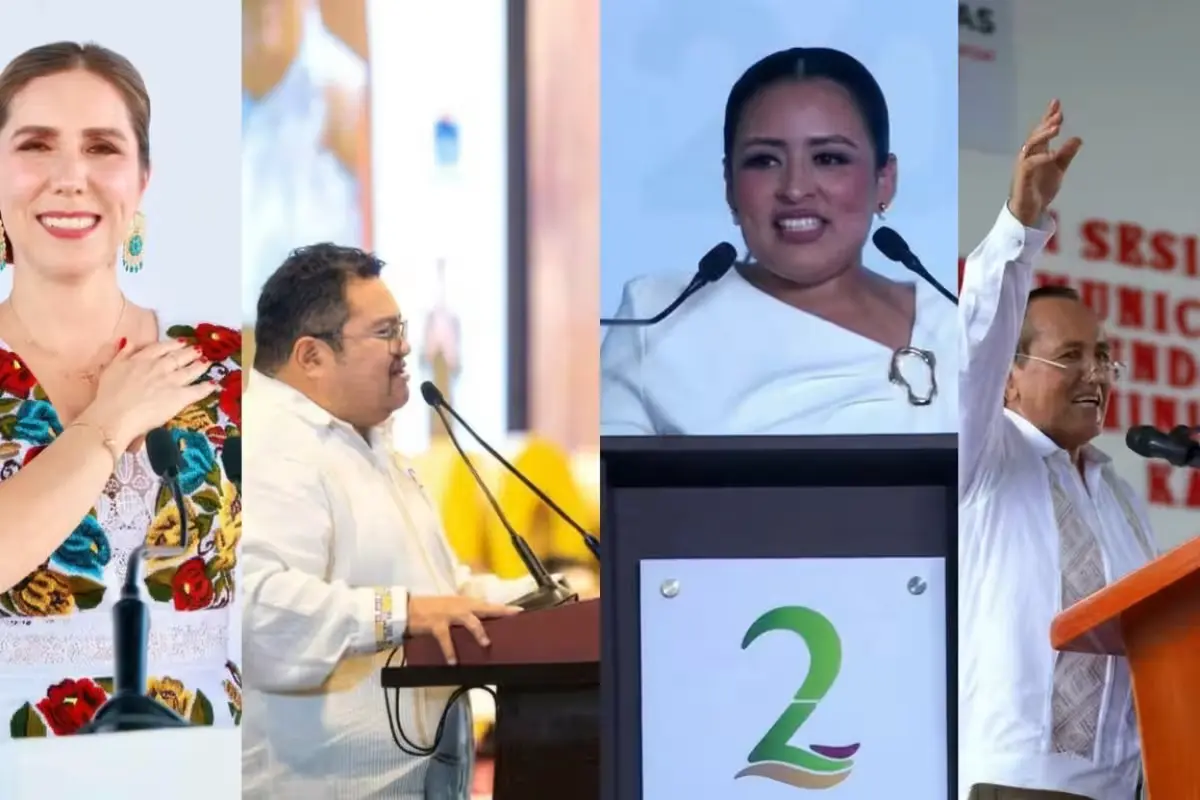
Cancún, Quintana Roo — The second-year government reports delivered by four municipalities in Quintana Roo — Isla Mujeres, Cozumel, Puerto Morelos and Lázaro Cárdenas — produced the same contrast: mayors showcased public works, investment, social programs and equipment, while residents said those results are not visible in their streets and communities, where drinking water, drainage, roads, security, public transport, garbage collection and medical care remain deficient.
Isla Mujeres: Works Touted, Basic Services Still Pending
Mayor Atenea Gómez Ricalde highlighted more than 170 public works, 228,000 square meters of paved streets and avenues, social programs and new infrastructure, saying the projects were carried out over five years across two terms on both the island and in Ciudad Mujeres. She pointed to the modernization of Rueda Medina and the undergrounding of electrical infrastructure in downtown Isla Mujeres.
Former councilman Emilio Sosa said one of the main pending issues is basic services in Ciudad Mujeres, where he said no solution was reached to guarantee drinking water supply or expand the sanitary drainage network. Roberto Cutiz agreed that both were commitments made for the mainland area that never translated into concrete action with participation from residents.
Although the mayor included the “Agua para Ti” program among her social initiatives, residents said such support does not replace the expansion of water and sanitation infrastructure.
Public transport also drew criticism. Pedro Medrano said service has deteriorated on both the mainland and the island because the vehicle fleet has not been expanded, and that eight of the 10 units operating on the island are in the workshop, leading to canceled runs to some neighborhoods.
Residents also questioned the lack of modernization at the two municipal markets and the absence of a market in Ciudad Mujeres. They cited pending work at the cemetery, the island slaughterhouse and a planned multidisciplinary unit near the convention center.
On land tenure, Mario Mukul said at least 20 neighborhoods in the mainland area and two on the island remain unregularized. In La Guadalupana, Gervasio Cajun said actions promised last year are still stalled despite the announcement of a regularization program.
Residents also noted that a registry of plots adjoining the federal maritime-terrestrial zone remains pending, along with the recovery of about six sea access points that remain occupied after streets leading to the coast were sold during a previous administration.
On environmental issues, residents criticized the lack of progress in cleaning up the Salina Grande, Salina Chica, Salina Aeropuerto, Makax and Chacmuchuch lagoons, where contamination persists, and said results on solid waste management and waste separation campaigns have been insufficient.
Noise pollution in downtown Isla Mujeres was another complaint. Sosa recalled that residents of Adolfo López Mateos and Hidalgo streets asked authorities to act on nighttime noise from an establishment known as “Stingrey.” According to the former councilman, Gómez Ricalde responded that she could not intervene because the business had not been authorized by her administration, leaving neighbors dissatisfied.
During her report, the mayor highlighted social programs including “Isleña de Corazón,” which she said benefits more than 4,000 women, as well as “Familia Pescadora,” “Agua para Ti” and “Médico en tu Casa.” She also reported the distribution of more than 14,000 backpacks over five years and the creation of “Isleño de Corazón” for tourism service providers.
Cozumel: Spending Figures Questioned, Cruise Funds Unclear
Mayor José Luis Chacón Méndez cited more than 800 million pesos in investment and programs, a figure he said exceeds spending by previous governments. Residents countered that the numbers are not reflected in the streets, where gaps in services, roads and security persist. Questions also surround tourism revenue and allegations that the mayor’s image is being promoted ahead of 2027.
During the event at the Cozumel Convention Center, attended by Governor Mara Lezama, Chacón Méndez highlighted the more than 800 million pesos allocated to public works and social programs during his first two years in office.
Branda Ortiz, a resident of the downtown area, questioned the figures. “It’s important to report how much has been invested, but also that the public can verify where those works are and what benefits they are generating in each neighborhood,” she said.
Arturo Borges, a resident of the Maravilla neighborhood, said basic problems remain. “There are neighborhoods that still lack water and electricity, and these issues have gone unsolved for a long time. People want to see results on their street, not just hear figures during a report,” he said. He also complained about deteriorated streets and failures in garbage collection.
The contrast extends to tourism revenue. The report referred to roughly 600 million pesos tied to a trust fund fed by cruise passenger fees, whose use is questioned because of a lack of clarity on projects, amounts and results.
Bertha Cruz, a resident of Chentuk, said those resources should serve the local population. “If there are funds designated for Cozumel, it would be important to know precisely how much money came in, what it was used for and which works were carried out with it,” she said.
“Cozumel generates a lot through tourism, but we also have to ask how much of that wealth actually reaches the neighborhoods and improves the quality of life for those who live here,” said Alberto Loria, a local businessman.
Residents also raised concerns about the promotion of Chacón Méndez, saying they had seen people linked to the municipal government handing out flyers, caps and T-shirts bearing his image, along with official vehicles carrying propaganda and walls promoting his re-election.
“When materials with an official’s image are used, citizens have the right to ask who paid for them and with what resources they were purchased,” said Ana Castellano.
“Government communication should inform the public about official actions. When an official’s image takes on greater presence, it’s necessary to examine where institutional information ends and personal promotion begins,” said Jorge Silva, a resident of the Independencia neighborhood.
Puerto Morelos: Potholes, Robberies and Water Shortages
Mayor Blanca Merari Tziu Muñoz presented a municipality making progress on security, services, public works and social development, but residents said the figures presented in the report do not correspond to conditions in Puerto Morelos and its communities, where potholes, service deficiencies, insecurity and water supply problems persist.
As the event unfolded at the dome in the Zetina Gasca neighborhood, residents voiced disagreement with the municipal administration. Andrea N. questioned the progress cited by authorities and said the city lacks basic services, particularly public transport, and that streets have had potholes for months without Public Works responding to reports.
On security, under the first axis of her report, “Primero Tu Seguridad,” the mayor highlighted more police officers, patrol vehicles, drones, cameras and a new bilingual Tourist Police. However, residents of Villas Morelos I and II, Pescadores and Leona Vicario reported home burglaries, robberies on the federal highway and extortion of businesses in the tourist zone.
Ana Rodríguez questioned the usefulness of the installed cameras, saying they cannot even identify those dumping debris at various points in the municipality, and accused some officers of remaining in their patrol cars using their cellphones instead of carrying out surveillance.
The “Cero Baches” program, to which the municipal government allocated 5 million pesos and later another 4.9 million between July and October 2025, has also failed to convince residents, who noted that Zetina Gasca Avenue, Timón Avenue, José María Morelos Avenue in Leona Vicario and the access road to Crococun remain damaged, while the municipality itself acknowledges limits in responding to reports. The taxi sector has been requesting repairs for a year.
The situation also contrasts with the administration’s talk of healthy finances and public works. Residents of Villas La Playa and the entrance to Leona Vicario reported flooding during rains, while in Leona Vicario and Central Vallarta the water supply is intermittent and some families must buy tanker water at costs of up to 1,200 pesos.
On social programs, while the report cited sports activities and programs for women and children, residents pointed to deficiencies in public spaces and services. The Zetina Gasca field where the report was held has unlit areas, closed bathrooms and overgrown sections. In Leona Vicario, residents also reported a lack of lighting and deficiencies at the clinic.
Discontent was reflected in testimony shared during the report. Martha Chan, a resident of Villas Morelos II, said: “She says there are more police, but not a single patrol passes here all night. We were robbed twice and they never came.”
Jorge Ku, a motorcycle taxi driver in Leona Vicario, said: “She boasts about Cero Baches and my José María Morelos street looks like a war zone. I’ve already fallen twice because of the holes.”
Irma Batún, a mother from Pescadores, said: “She talks about protecting women, but the clinic has no gynecologist and the streetlights are dead. We go out in fear.”
Felipe Méndez, a merchant in the tourist zone, said: “The Tourist Police doesn’t exist. Tourists ask us about safety and we don’t know what to say. There are extortions.”
Rosa Pech, a resident of Central Vallarta, added: “She says she solved the water problem, but we’ve been buying tanker water for three weeks. Her figures are not our reality.”
Lázaro Cárdenas: Report Starts Nearly Four Hours Late
The second government report of Mayor Josué Nivardo Mena Villanueva began nearly four hours late, irritating guests and residents; some left after waiting an hour. Outside the official event, residents complained that investment figures are not reflected in security, public works, health or municipal services.
The event was scheduled for 11 a.m. and began after 3 p.m. at the double domes of the Unidad Deportiva neighborhood, after the arrival of Governor Mara Lezama.
During his report, Mena Villanueva highlighted social programs and 67 million pesos from the Municipal Social Infrastructure Fund (FAIS) for drinking water networks, storm drainage, paving, 82 bedrooms and 94 toilets with biodigesters, as well as the rehabilitation of the Isla Holbox market.
He also cited the “Del Mar a tu Mesa” program, with more than 72 tons of fish distributed across 33 communities to benefit some 14,353 people, and more than 10 million pesos allocated to citizen services, medicines, medical care and hospital transfers.
On security, he reported the modernization of the Command and Control Center (C2), salary improvements, training, uniforms, vehicles and four patrol units, while in education, culture and sports he highlighted support for schools and the construction of two five-a-side soccer fields.
However, Glaudiela Cruz, a resident of Kantunilkín, said the announced results do not match reality, noting that local road repairs have been superficial and that garbage, health and security problems continue.
Cruz said garbage collection on Holbox is deficient following the departure of the contracted company, and that the municipal dump truck lacks functional tires. She also questioned medical care, saying programs such as Fara Maya have not resolved overcrowding or medicine shortages, and warned that public security is in alarming condition, though many residents avoid filing reports out of fear.
Raymundo Canul said municipal actions are concentrated mainly on Holbox, while the southern zone receives isolated pothole patching and cleaning work. He also criticized the concentration of decisions in a single person, leaving areas such as Public Works without operational capacity, and urged attention to communities including El Naranjal, San Antonio and Valladolid Nuevo.
Jesús Hoil, a representative of Nuevas Generaciones de Valladolid Nuevo, said the distribution of support and fish does not represent a structural solution.
Carolina K. reported that the failure to clean absorption wells causes flooding and standing water on commercial streets in Kantunilkín.
On security, the delegate of Valladolid Nuevo, Olegario Cen, had warned that a single patrol vehicle is insufficient to cover 14 communities. The problem was exposed again hours before the report when a narco banner was placed in Solferino.
The lack of response also led Ana D., a merchant in the Miguel Borge Martín neighborhood, to hire machinery to spread rubble over the most damaged section of Independencia street after requesting repairs for two years without a solution.
Mena also responded during his report to questions about public works and rural roads, and to an alleged fraud involving 1,800-peso housing assistance handled by a foundation called Fundación Nivardo Mena. He said the foundation used his name and that the case was reported on social media.
More Government
- Hotel and Business Groups Warn 35.8% Non-Resident Fee Hike Threatens Quintana Roo Tourism
- Latinus Audio: Businessman Says He Gave Money to Marina del Pilar’s Campaign
- US Ambassador Warns Cartels Pose Terrorist Threat at 9/11 Ceremony in Mexico
- US Northern Command Praises Mexico’s Anti-Drone Efforts
- Trump Says US Will Not Exit USMCA and Promises ‘Great Relationship With Mexico’
More Cozumel
- Search Ends, but Questions Mount After Fatal Puerto Aventuras Jet Ski Trip
- Cozumel Beach Club Kuzá Targets 4,000 Daily Visitors in Protected Area With CONANP Backing
- Cozumel Park Secures 25-Year Protection for 22 Hectares of Mangrove
- Cancún Airport Loses 15% of International Passengers in August
- Cozumel to Host Second Free Rabies Vaccination and Microchip Clinic for Pets
