
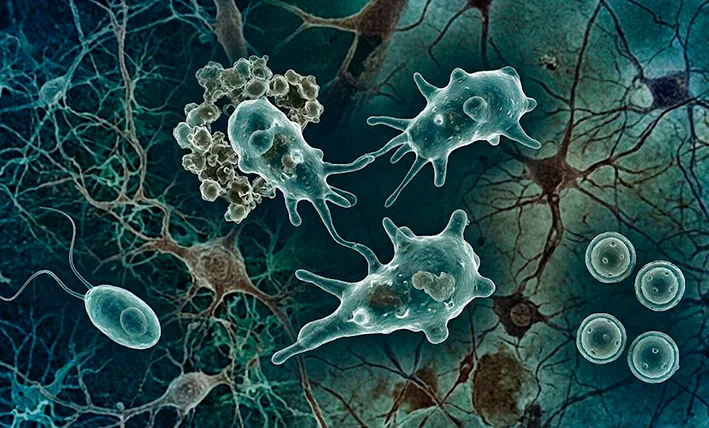
Cancún, Quintana Roo — The confirmation of Naegleria fowleri — commonly known as the “brain-eating amoeba” — in an artificial lake in Mérida, Yucatán, has refocused attention on a rare but serious infection that can occur when contaminated freshwater enters through the nose. The case is tied to one specific site and does not mean Quintana Roo is under a general alert.
What Is the ‘Brain-Eating Amoeba’?
Naegleria fowleri is a microorganism that lives in the environment and can be found in warm freshwater, mainly in lakes, rivers, ponds and other bodies of water. When water containing the amoeba enters the nose, the organism can travel to the brain and cause primary amebic meningoencephalitis, an uncommon infection that progresses rapidly.
How Is It Contracted?
Infection occurs mainly while swimming, diving, jumping or taking part in other activities in warm freshwater where the liquid can enter the nose. Cases have also been linked to the use of contaminated water for nasal washes or sinus irrigation.
It does not spread from person to person, and it is not contracted by drinking water that contains the amoeba. The risk of infection is very low, although the consequences can be severe.
What About Quintana Roo’s Cenotes, Rivers and Lakes?
Because these are freshwater environments, the same prevention advice should be considered during recreational activities in cenotes, rivers, lakes, lagoons and other freshwater bodies, especially when the water reaches high temperatures.
That does not mean the cenotes or other bodies of water in Quintana Roo are contaminated, nor that the state is currently under a general health alert. The presence of the amoeba cannot be determined simply by how the water looks, and conditions can vary from one body of water to another.
In the case that triggered the recent alert, Yucatán health authorities identified the microorganism in one specific artificial lake in Mérida, so measures were concentrated on that site.
What Are the Symptoms?
The first symptoms can appear about five days after exposure, although the period can range from one to 12 days. Early signs include headache, fever, nausea and vomiting.
The illness can advance quickly, causing neck stiffness, confusion, loss of balance, seizures, hallucinations and coma. Anyone who develops compatible symptoms after being in warm freshwater should seek medical attention immediately.
How Can It Be Prevented?
Health authorities recommend preventing freshwater from entering the nose, especially during activities such as diving. People can also use a nose clip, keep their head out of the water in naturally hot waters, and avoid disturbing sediment on the bottom in shallow freshwater.
Another important measure is to use distilled, sterile or previously boiled water for nasal washes or sinus irrigation.
In Quintana Roo, where cenotes and other freshwater bodies are part of recreational and tourist activities, these steps help reduce a risk that, based on available evidence, is extremely low.
For now, the confirmed case corresponds to the site identified in Mérida, and there is no information indicating the presence of Naegleria fowleri in the cenotes, rivers or lakes of Quintana Roo. The main recommendation is to understand how transmission occurs and to take precautions during activities in warm freshwater.
More Community
- Cancún’s Teatro de la Ciudad Nears 75% Capacity Ahead of Second Anniversary
- Dead Sea Turtle Hatchlings Found With Dog Bites at Playa del Carmen Beach
- Explorers Document New Underwater Cave System South of Cozumel
- Ángeles Viajeros to Take 16 Children With Cancer to Cozumel for a Week by the Sea
- Gender Identity Change Discount Benefits 10 People in Playa del Carmen
More Quintana Roo
- Drought Crisis Forces Quintana Roo Wildlife to Seek Water Near Roads and Towns
- Quintana Roo to Add 10,000 Hotel Rooms by 2028
- Quintana Roo Graduates 244 New Police Officers and Debuts First Bomb Squad
- Morena Taps Gino Segura as Quintana Roo Governor Candidate
- Quintana Roo Marks 216th Anniversary of Mexico’s Independence With Statewide Celebrations