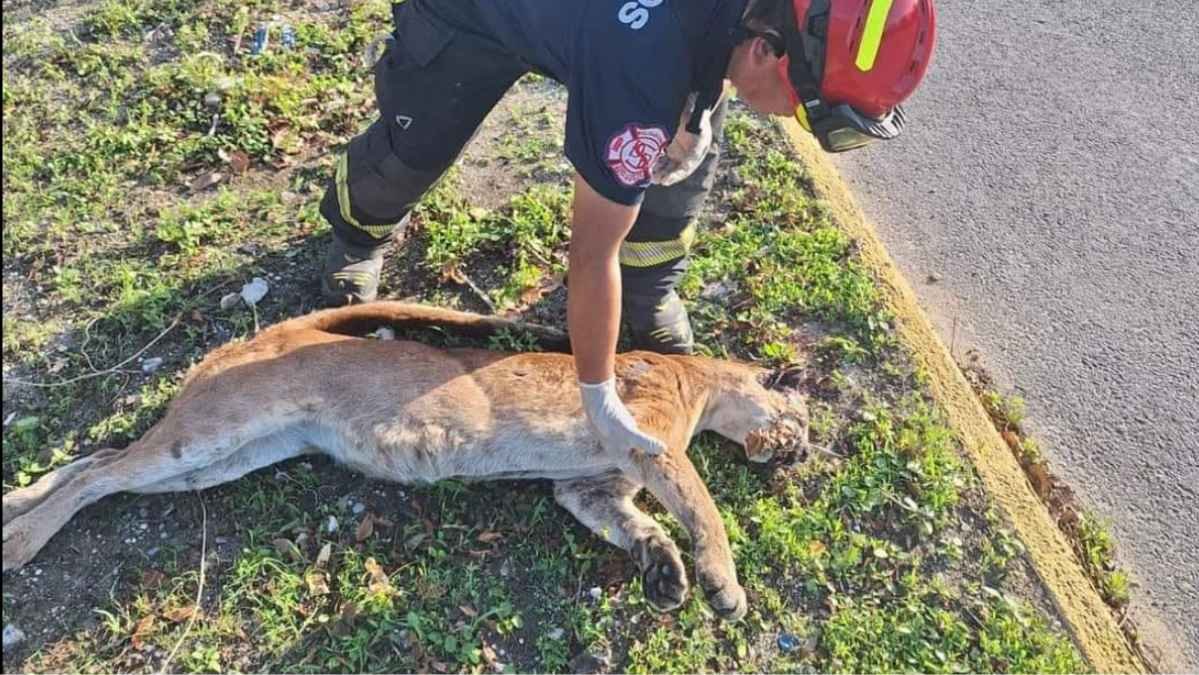
Mahahual, Quintana Roo — A deepening water crisis in Quintana Roo is beginning to take a toll on the state’s wildlife. A lack of rainfall and high temperatures are shrinking the small bodies of water scattered across the jungle, forcing jaguars, pumas, tapirs, little spotted cats and ocelots to roam farther in search of somewhere to drink.
According to data from the National Water Commission (Conagua), during the second half of August about 96 percent of the state’s territory was classified as abnormally dry or in moderate drought. The conditions have persisted since May, making Quintana Roo the state with the largest share of its territory affected by the phenomenon.
Effects Visible Near Mahahual
The consequences are especially clear in areas near Mahahual. Víctor Rosales, who leads the Aak Mahahual Project, warned that the aguadas — small lagoons and temporary pools that serve as natural water sources — are disappearing or drying up significantly, pushing animals toward dirt tracks, highways and populated areas.
That movement raises risks on both sides. Wildlife can be attacked by domestic animals or by people who, fearing an encounter with a big cat or another wild species, try to drive it off with force. At the same time, animals searching for water must cross roads, increasing the odds they will be struck by vehicles.
Using more than 16 camera-trap stations installed around Mahahual, the Aak Project has documented a striking diversity of species, including jaguars, jaguarundis, tapirs and pumas, as well as little spotted cats, ocelots, opossums and others. The region is home to five of the six large cat species found in the Americas, underscoring the importance of the jungle corridor now under water stress.
Mounting Risks
Rosales said the scarcity of water is forcing animals to take risks they would normally avoid. The search for a place to drink can pull them away from their usual ranges and into areas where they are exposed to traffic, human presence and other hazards, including water sources contaminated by human activity and the irresponsible dumping of waste.
Poaching compounds the problem. Environmentalists and community rangers face the challenge of protecting wildlife that, because of the lack of water, has become more vulnerable and more predictable in its movements. Even the camera traps used to document the animals are destroyed or stolen by hunters seeking to erase evidence of their activity.
Conservationists are urging residents and visitors to avoid confrontations with wildlife and to respect the animals’ movements. The water crisis is not only a problem for human communities: it is also disrupting the natural patterns of species that depend on the jungle’s water sources to survive.
As long as drought conditions and pressure on the region’s water bodies persist, the search for a place to drink may become, for Quintana Roo’s wildlife, a race against the heat, the highways and humans themselves.
More Environment
- Dead Sea Turtle Hatchlings Found With Dog Bites at Playa del Carmen Beach
- Explorers Document New Underwater Cave System South of Cozumel
- Farm and Cattle Expansion in Quintana Roo Squeezes Native Wild Bees
- Activists Warn Playa del Carmen Real Estate Boom Is Driving Deforestation
- Activists Find Archaeological Remains at Playa del Carmen Hotel Site
More Quintana Roo
- Quintana Roo to Add 10,000 Hotel Rooms by 2028
- Brain-Eating Amoeba Confirmed in Mérida Lake: What to Know in Quintana Roo
- Quintana Roo Graduates 244 New Police Officers and Debuts First Bomb Squad
- Morena Taps Gino Segura as Quintana Roo Governor Candidate
- Quintana Roo Marks 216th Anniversary of Mexico’s Independence With Statewide Celebrations