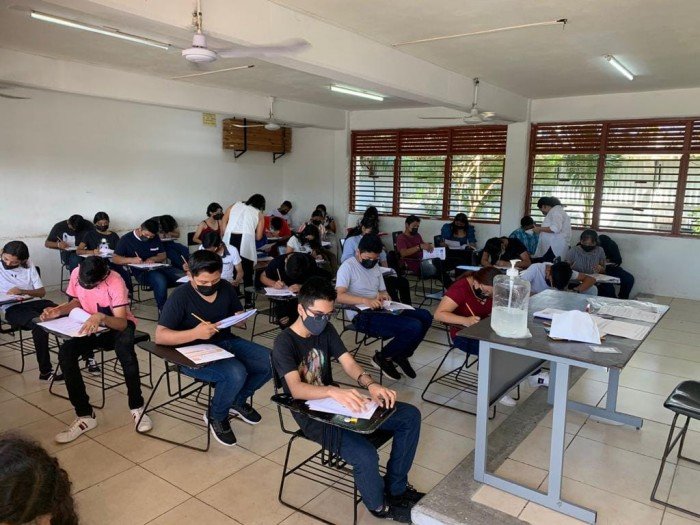
Chetumal, Quintana Roo — Students in Quintana Roo continue to struggle with pandemic-era learning losses, with mathematics and reading comprehension presenting the greatest difficulties for children in primary and secondary schools, according to a regional parents’ organization.
Sergio Acosta Manzanero, regional vice president of the National Association of Parents, said the estimated proportion of students affected by learning gaps declined from 40% after the COVID-19 pandemic to 38% at the end of the 2025-2026 school year.
The figures represent estimates cited by the parents’ association rather than results from a publicly released statewide assessment. No methodology, sample size or grade-level breakdown accompanied the numbers, making them difficult to compare with official educational indicators. They nevertheless reflect concerns reported by teachers and families since students returned to classrooms.
Acosta described the two-percentage-point improvement as insufficient given the amount of time that has passed since schools reopened. He called for more academic support during the summer and renewed legislative action to limit students’ use of cellphones during class.
“Parents should prioritize learning, not just recreation, during these vacations,” Acosta said, encouraging families to consider tutoring and academic reinforcement programs focused on reading and mathematics.
The recommendation does not mean students should spend the entire break in formal classes. Short, regular sessions involving reading, writing and age-appropriate math exercises can help students retain skills without recreating a full school schedule. The association is particularly concerned about children entering a new grade without mastering material required for the next level.
Evidence from elsewhere in Mexico supports concerns that recovery has been slow. A study of approximately 20,000 fifth- and sixth-grade students in six Guanajuato municipalities found that scores in Spanish and mathematics fell substantially following pandemic school closures. The losses were equivalent to roughly two-thirds of a school year in Spanish and as much as a full year in mathematics.
By June 2023, the students had recovered about 60% of what they had lost, but their performance remained below pre-pandemic levels. The study was limited to Guanajuato and cannot be directly applied to Quintana Roo, although it provides a documented example of the difficulty Mexican schools have faced in rebuilding foundational skills.
Pandemic closures affected students differently depending on access to computers, internet service, parental support and a suitable place to study. Children who had difficulty participating in remote education often returned with larger gaps, while absenteeism and school abandonment made assessment and recovery more complicated.
Cellphone Proposal Remains In Committee
The parents’ association is also urging the Quintana Roo Congress to resume consideration of a proposal regulating cellphones, tablets and similar electronic devices in basic-education classrooms.
The initiative was introduced in February by legislators Hugo Alday Nieto, Diana Frine Gutiérrez García and José María Chacón Chablé. It received a formal reading during the March 4 legislative session but has not completed the committee process.
The measure would amend Articles 15 and 55 of the Quintana Roo Education Law. Under the proposal, students in preschool, primary and secondary schools would be prohibited from using cellphones and other personal electronic devices during class unless a teacher authorizes them for educational purposes or an emergency requires their use.
The bill would not impose an absolute ban throughout the school day. Its focus is the teaching and learning period, with exceptions for classroom activities, emergencies and students who need a device because of a medical condition or disability.
Schools would be required to establish procedures governing how devices are stored and returned. The proposal also states that restrictions should respect students’ privacy and other rights. Details are contained in the initiative filed with the Quintana Roo Congress.
Acosta said restricting phones would reduce distractions and help students concentrate on material they are already struggling to master. Supporters also point to concerns involving cyberbullying, unauthorized recording and access to social media during lessons.
International guidance generally supports limiting smartphones when they do not contribute to learning, although it cautions against treating a ban as a substitute for stronger teaching and student support. UNESCO recommends that technology be used in classrooms only when it has a clear educational purpose. Its latest monitoring found that 114 education systems, representing 58% of countries, had adopted national cellphone restrictions in schools by March 2026.
The organization also notes that policies differ widely. Some countries require phones to remain out of sight throughout the school day, while others leave implementation to individual schools or permit supervised educational use. UNESCO’s guidance emphasizes that rules should be clear, enforceable and designed around students’ educational needs.
For Quintana Roo, cellphone restrictions would address only one part of the problem. The parents’ association is calling for tutoring, family involvement and sustained classroom support alongside any new rules governing technology.
The state Congress has not announced when the cellphone initiative will return for committee debate or a possible vote. Meanwhile, Acosta urged families to use part of the summer break to identify subjects in which their children need help before the next school year begins.
More Community
More Quintana Roo
- Call to Scrap Visitax Puts Quintana Roo’s Tourist Fee Under Scrutiny
- Quintana Roo Eyes ‘Set-Jetting’ Boom as Expedia Report Links Film Exposure to Bookings
- Caribbean Hoteliers Ask Mexico to Earmark 28% of Non-Resident Fee for Tourism Promotion
- Belize Tightens Río Hondo Border Patrols, Presses Mexico on Maya Train Extension
- Women’s Groups Demand Purge of Quintana Roo Police Forces Over Abuse and Criminal Ties