
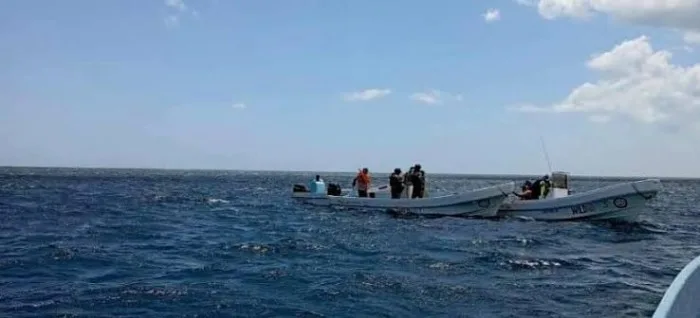
Mérida, Yucatán — At least six divers suspected of taking part in illegal fishing have been rescued in less than a year after the boats they were working from abandoned them at sea off the Yucatán coast, according to the National Commission of Aquaculture and Fisheries (Conapesca).
Rodrigo, a pseudonym, said he feared he would die or end up in prison when it happened to him. He went out before dawn on June 26 to catch octopus during the closed season with five other fishermen in an area known as Costa Esmeralda. They all knew the activity was illegal and that they could be arrested. When Rodrigo dove to the bottom, his companions saw inspectors from Conapesca approaching and fled, leaving him in the water.
“You think we’re all in this together, right? But when you see everyone trying to save their own skin, you realize you’re alone,” Rodrigo said.
When he surfaced and found the boat gone, he thought about swimming to shore or waiting for help. Then a Navy vessel appeared.
“I knew we had been caught,” he said. “We know what we’re doing is wrong, but sometimes we feel we have no choice because we have to support our families.”
At least six divers believed to be engaged in poaching have been rescued in similar circumstances in less than a year, according to Conapesca. The practice exposes divers to serious danger and contributes to environmental damage.
Félix Luna Gómez, a fisherman and former head of the National Chamber of the Fishing and Aquaculture Industries (Canainpesca), said fishing is inherently dangerous. “Unfortunately, work at sea is high-risk because it’s so vast,” he said. In illegal fishing, he said, the risks are greater because boats often operate without safety equipment or tracking devices, making rescue more difficult.
Abandoned during patrols
The first reported case in Yucatán occurred on June 26, 2025, during a patrol by the Mexican Navy and Conapesca off the Yaxcukul lighthouse in Costa Esmeralda. Five boats fled when authorities showed up, leaving four divers in the water. Navy personnel found them floating and brought them aboard, though the divers initially refused help, saying their boats would return. Officials seized spearguns, octopus hooks, and other diving equipment.
Another case took place in April 2026 off the coast of Dzilam de Bravo. During a joint operation involving the Navy, Conapesca, and the conservation group Sea Shepherd Conservation Society, two divers were abandoned by boats that escaped to avoid inspection.
Arturo González, a fishing and community surveillance officer in Yucatán who has taken part in Conapesca patrols for years, said such incidents occur two to three times a year.
“They don’t carry radios. They have no buoy. Sometimes only a snorkel tube is visible above the water while they try to stay afloat two or three kilometers from shore,” he said. “The boats leave them there, and we have to go look for them. If nobody sees them, they simply disappear.”
González said patrols focus on catching the boats. “We pursue the boat because we want to end the illegal fishing effort. But often, while we’re heading to the vessel, we find people in the water, and we can’t leave them.”
Swimming for survival
Abandoned divers sometimes reject help at first because they expect their crew to return. When it doesn’t happen, they must swim one to three kilometers to shore using only a mask, snorkel, and fins. Many spend hours waiting on the beach for another vessel to pick them up. In most cases, their families never learn what occurred.
“We notify the harbor master’s office because the relatives only know they went fishing,” González said. “They don’t know if the boat capsized, if the men were arrested, or if they’re still lost at sea.”
Jonathan Vergara, an environmental engineer specializing in maritime safety, said illegal fishing boats often operate with no clear records. Some use altered or false registration numbers, and when they are seized, no one claims them. That lack of information makes it harder to locate vessels when something goes wrong. Vergara also said there are reports of boats diving illegally in deep waters where divers with decompression sickness do not receive immediate care.
The United Nations Food and Agriculture Organization (FAO) warns that illegal, unreported, and unregulated fishing threatens the sustainability of marine populations, reduces the income of fishers who follow the law, and is often linked to other criminal activities.
More Crime
- Gunmen Kill Dentist Outside Plaza Galerías in Cancún
- Mothers from Quintana Roo Search for Missing Relatives in Yucatán, Hoping to Find Them Alive
- Diocese of Cancún-Chetumal Warns of Man Posing as a Priest in Chetumal
- Two Suspected Drug Dealers Arrested in Playa del Carmen
- Students in Cancún Protest Alleged Sexual Assault at Teachers College