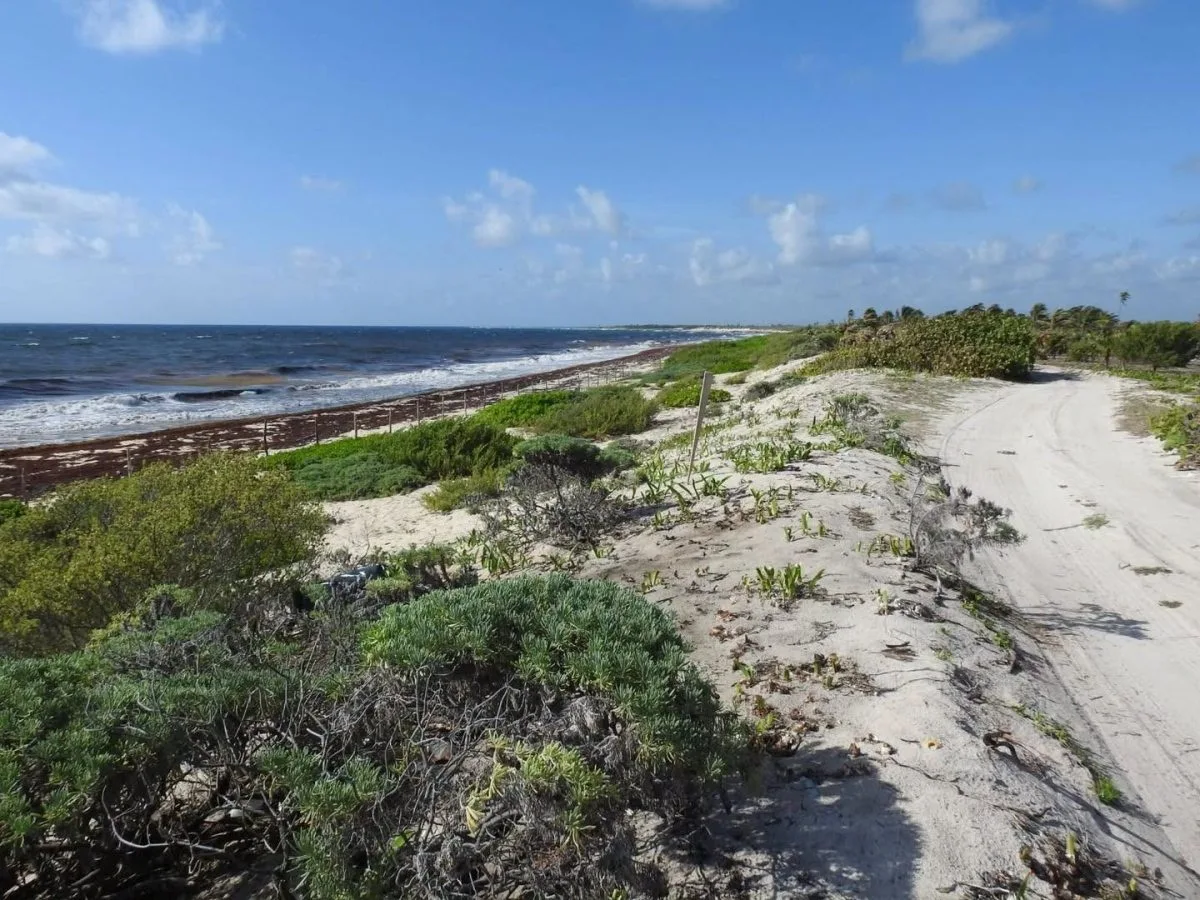
Felipe Carrillo Puerto, Quintana Roo — The degradation of vegetation covering Quintana Roo’s coastal dunes is eroding the shoreline’s natural defenses, weakening the stability of the sand and disrupting the balance of coastal ecosystems, according to research led by a scientist at the Instituto Tecnológico de Chetumal.
Eloy Gayosso Soto, who holds a doctorate in environmental sciences and is a visiting professor at the Chetumal institute, has studied these environments since 2014 through field surveys, satellite analysis, geographic information systems and aerial surveys. His research estimates that the Mexican Caribbean has roughly 860 kilometers of coastline, of which some 12,277 hectares correspond to frontal dunes.
One of the researcher’s main concerns is the removal of native vegetation and the introduction of plants foreign to the area. Among the introduced species that can displace local flora are beach lettuce (Scaevola taccada), beach pine (Casuarina equisetifolia) and Indian almond (Terminalia catappa). Any effort to restore vegetation, he argues, should rely exclusively on species native to these ecosystems.
Sian Ka’an Study Documents Species and Damage
In the Sian Ka’an Biosphere Reserve, a study by Gayosso-Soto and other researchers from the Tecnológico Nacional de México’s Chetumal campus analyzed the composition and distribution of vegetation across about 80 kilometers of coastline and 1,600 hectares of dunes and associated areas.
The team identified 32 species from 23 families, recording 1,182 individual plants. A notable finding was the presence of 328 specimens of Thrinax radiata, a palm classified as threatened under Mexico’s NOM-059-SEMARNAT-2010 standard, in the northern part of the reserve.
Although scientific indicators pointed to acceptable conservation conditions in the areas studied, aerial imagery also revealed damage tied to tourism, including the disappearance of vegetation cover and changes to the natural shape of the dunes.
The findings underscore the importance of preserving these spaces as living ecosystems, whose vegetation stabilizes sand, shelters biodiversity and provides natural protection between the sea and the mainland — particularly in a state exposed to extreme weather events.
More Environment
- Xcalak Fishermen Help Track Reef Fish Larvae in Chetumal Bay
- Aguakan Nears Completion of Colector Playero Project in Playa del Carmen
- Playa Aventuras DIF Records Historic Sea Turtle Nesting Season
- Pacific Tropical Depression Forecast to Become Hurricane Polo, Possibly Category 3
- Isla Contoy Cleanup Removes 249 Kilos of Waste From Marine Park
More Tulum
- Felipe Carrillo Puerto Weighs Access Fee for Puerta al Mar
- Tulum Faces Budget Deficit as Tourism Slump Slashes Revenue
- Drought Stalls Corn Planting in Tulum’s Maya Communities
- Mexico Moves to Curb Misleading Hotel Ads Claiming Private Beaches
- Tulum Tour Guides Pin Recovery Hopes on Cruise Ships and Year-End Holidays