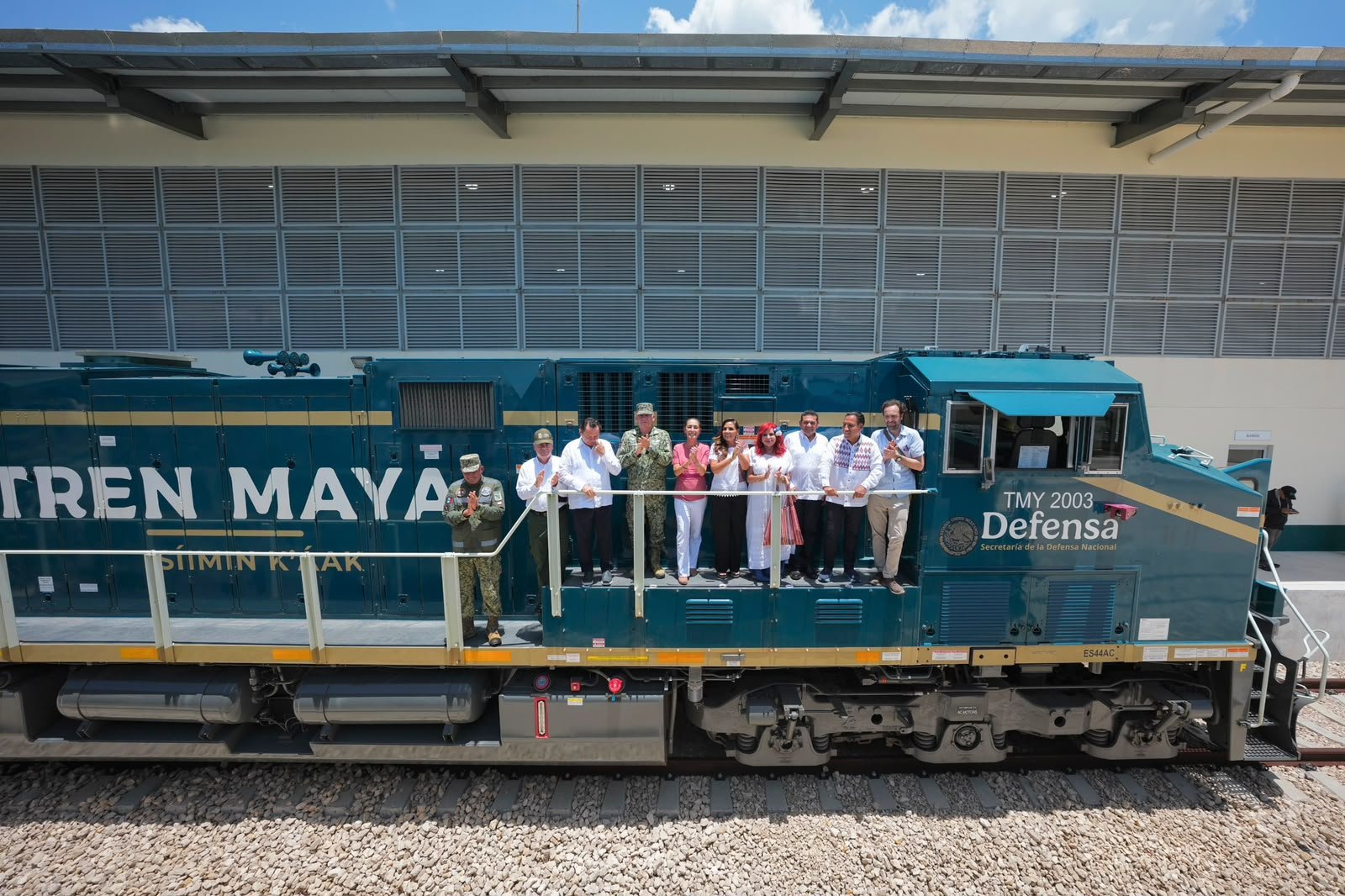
Puerto Morelos, Quintana Roo — President Claudia Sheinbaum Pardo on Friday inspected the progress of the Maya Train freight service during a working visit to Puerto Morelos, accompanied by Quintana Roo Governor Mara Lezama and other southeastern state governors.
The officials reviewed the development of the railway infrastructure, which will complement the passenger Maya Train with a specialized freight system. The project is considered one of the most important logistics initiatives for the region.
The freight service is scheduled to begin operations in the first half of 2027, with the launch of multimodal terminals, rail yards, and transfer centers that will connect the southeast with the national rail network.
The plan includes building a multimodal logistics corridor linking the Yucatan Peninsula to central Mexico by integrating with existing freight rail networks operated by national concessionaires.
Freight Transport and Port Connections
The Maya Train freight service will use state-of-the-art diesel-electric locomotives designed to meet international freight rail standards. It will be capable of moving intermodal containers, agricultural products, construction materials, hydrocarbons, and general cargo, expanding logistics options for businesses in the southeast.
The railway will use high-resistance rails that can support heavier axle loads than those used for passenger service, a requirement for heavy freight.
Key logistics hubs include Campeche, linking to the national rail network and its deep-water port; Uman, Yucatan, the peninsula’s main logistics center; Cancun and Puerto Morelos, where rail operations will converge with airport and maritime infrastructure; and the Port of Progreso, whose modernization will boost import and export activities.
Cost Reduction and Less Highway Pressure
One of the main expected benefits is a reduction of up to 30% in logistics costs for moving goods between the southeast and central Mexico.
The project also aims to significantly reduce truck traffic on federal highways, particularly on Federal Highway 180, which could improve road safety, reduce wear on road infrastructure, and lower maintenance costs.
The system is also intended to strengthen the southeast’s economic integration by connecting with the Chetumal Free Zone, developing industrial parks, and new investment hubs in Quintana Roo and Yucatan.
Complementary Operation to Passenger Service
Under the project plan, freight service will operate mainly at night or during separate time windows to avoid affecting the frequency of the passenger Maya Train.
Federal authorities also say rail transport will reduce the carbon footprint by replacing some road freight, favoring a more energy-efficient logistics system.
For Quintana Roo and the rest of the peninsula, the consolidation of the Maya Train freight service also represents the possibility of lowering costs for moving supplies and raw materials, which could boost business competitiveness and eventually improve the supply of basic goods in the region.
Sheinbaum’s visit to Puerto Morelos was part of a working tour that also included supervision of sargassum seaweed control efforts and other strategic projects promoted by the federal government in the southeast.
More Development
- Tulum Pivots to Luxury as Airlines Cut Flights, Occupancy Drops
- Environmentalists Warn Tulum Jungle Road Could Open Door to Real Estate Expansion
- Cancún Delivers 460 Property Deeds to Families in 14 Neighborhoods
- Cruise Tourism Trust Fund Spends 1.27 Billion Pesos Across Quintana Roo
- CFE and Playa del Carmen to Review Plan for Submarine Power Line to Cozumel
More Puerto Morelos
- Puerto Morelos Mayor Denies Detention After Federal Search of Rented Home
- Quintana Roo Names Winners of 2026 State Craft and Embroidery Prizes
- Only Four Sargassum Fishing Permits Processed in Mexico, Imipas Says
- Puerto Morelos Wins Two World Travel Awards for Adventure and Nature Tourism
- Puerto Morelos Looks to Boost Culinary Scene With New Tourism Projects