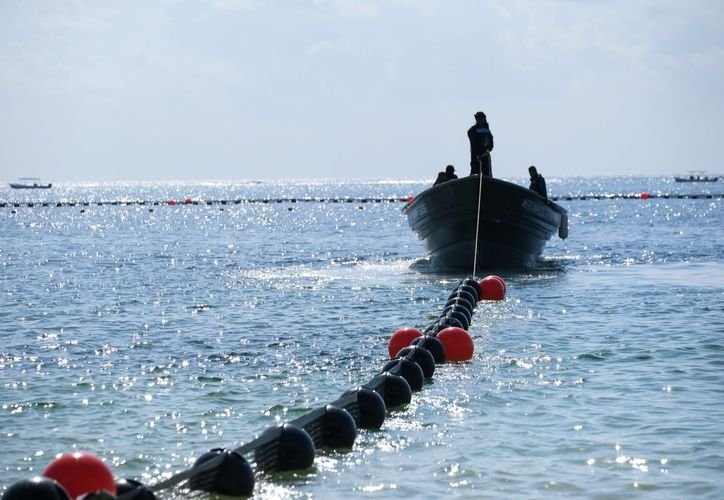
Puerto Morelos, Quintana Roo — Mexico has processed only four permits to harvest sargassum in open water since the seaweed was formally recognized as a fisheries resource, officials say, with just one of those authorizations granted for commercial use and that one now expired.
All four applications went before the National Aquaculture and Fisheries Commission (Conapesca) after the publication of the National Fisheries Charter, according to Manuel Jesús Puerto Mocoroa, head of the Regional Center for Fisheries and Aquaculture Research in Puerto Morelos, part of the Mexican Institute for Research in Sustainable Fisheries and Aquaculture (Imipas).
Puerto Mocoroa said Imipas serves as Conapesca’s technical arm, assessing whether each project is viable.
What Permits Have Been Granted
Only one permit has been issued so far, to the company Carbon Wave, which received a development-fishing authorization more than a year ago to produce biostimulants.
Two research and development permits went to the Yucatan Center for Scientific Research (CICY), to a researcher identified as Dr. Leal, and to La Unión. A fourth permit — the only one for commercial exploitation — has already expired, and Conapesca has not said whether a renewal process is underway.
“We are the technical arm. They gather the guidelines that have to be submitted, Conapesca analyzes them and tells us which institute should review whether what this person is presenting is viable or not,” Puerto Mocoroa said.
He described the process as slow but said it marks a first step after sargassum was declared a fisheries resource and added to the National Fisheries Charter, which he said is the only legally binding regulation in the country, unlike best-practice publications that offer no legal certainty.
“It gives the investor certainty. It’s as if you had a permit to catch scaled fish or shrimp — you already own the resource,” he said.
No Price Set Yet
Asked about interest in exploiting the massive volumes of sargassum reaching the coast, Puerto Mocoroa said setting a price now could create problems because the activity must first be organized.
“It arrives and anyone collects it and takes it away and disposes of it. For example, I believe Carbon Wave is exporting; how it is exporting, nobody knows, but it is moving it out because its tax base is in Puerto Rico,” he said.
He said no price currently exists for sargassum and that one must be established through a pilot project with fishermen, which would generate data on harvestable biomass, fishing gear, operating costs and processing capacity.
“You have to work out the operating costs. Once you have that information from the value chain — these are my expenses, I have to sell at this price to make a profit — that is where the price will be set,” he said.
More Environment
- Isla Mujeres Ports Reopen as Heavy Rain Targets Cancun
- Why Quintana Roo Is Checking Waters for Brain-Eating Amoeba
- Baby Manatee Dies After Boat Strike in Río Hondo
- Children’s Drawings on Climate Change Take Center Stage at Cancún Environmental Art Exhibition
- Maya Women in Mérida’s Outlying Communities Launch Stingless Beekeeping Projects
More Puerto Morelos
- Puerto Morelos Wins Two World Travel Awards for Adventure and Nature Tourism
- Puerto Morelos Looks to Boost Culinary Scene With New Tourism Projects
- Mexican Caribbean Destinations and Resorts Win Across 2026 World Travel Awards
- Water Main Rupture Closes Busy Puerto Morelos Intersection
- Puerto Morelos Port Eyes New Guatemala Trade Route