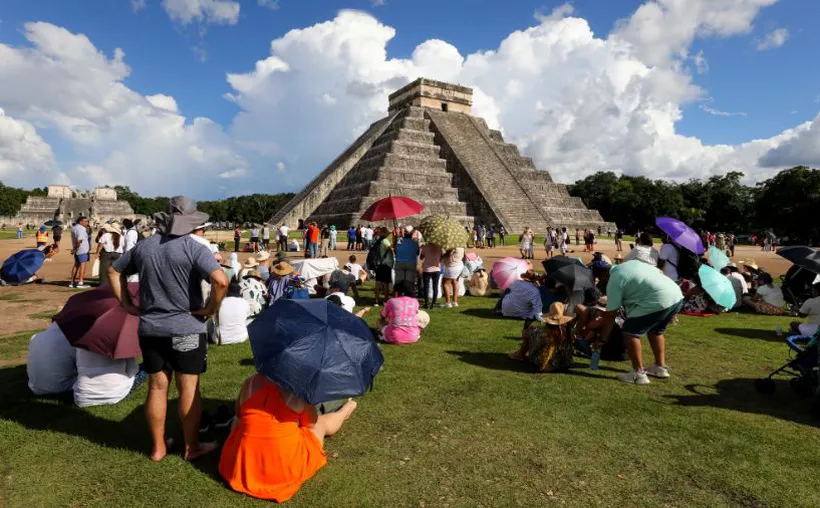
Mérida, Yucatán — Chichén Itzá, long the undisputed leader of Mexico’s archaeological tourism circuit, lost its top spot in May 2026 after a prolonged access dispute and maintenance-related closure sharply reduced visitor numbers.
Preliminary figures from the National Institute of Anthropology and History (INAH) show that Chichén Itzá received 104,117 visitors in May, an average of 4,732 per day. That was the site’s lowest monthly total in six years and enough to push it behind Teotihuacán, which recorded 110,113 visitors during the same month.
The shift ended a streak that had lasted from January 2020 through April 2026, during which Chichén Itzá remained Mexico’s most-visited archaeological site every month. The May result was not a minor fluctuation. Attendance fell 34.55% from April 2026, when 159,089 people visited, and 26.37% from May 2025, when the site recorded 141,413 visitors. Even May 2024 performed better, with 135,747 visitors.
The decline was tied directly to a 13-day disruption caused by conflict between artisans, merchants, guides, INAH, and state authorities over access, commercial reorganization, and the relocation of vendors toward the Centro de Atención a Visitantes, known as CATVI. Local reporting estimated that roughly 40,000 tourists were unable to visit Chichén Itzá during the suspension.
The conflict centered on how commerce should be organized inside and around one of Mexico’s most important heritage sites. State and INAH officials said dialogue tables were opened with artisans and guides, and they publicly stated there would be no eviction of artisans included in the 2025 census delivered to INAH. Authorities also said no new vendors would be allowed into the site, and that spaces would be respected for those choosing to relocate to CATVI.
For visitors, the dispute was confusing and disruptive. Chichén Itzá is not just another stop on a Yucatán itinerary. It is a UNESCO World Heritage site, one of the New Seven Wonders of the World, and a major anchor for tours from Mérida, Valladolid, Cancún, Playa del Carmen, and Tulum. INAH describes the site as a key example of cultural exchange in Mesoamerica, combining Maya and central Mexican influences, with its peak tied to the Early Postclassic period. (inah.gob.mx)
The economic impact extends well beyond the ticket office. Guides, transport operators, restaurants, hotels, souvenir vendors, and nearby communities all depend on steady traffic to the site. When Chichén Itzá slows down, the effect spreads quickly through the regional tourism economy.
But the May numbers also revealed something important: tourists did not simply disappear. Many were redirected to other archaeological sites, especially Ek’ Balam. The site recorded 24,831 visitors in May, up from 11,708 in April, a 112.09% increase. Compared with May 2025, when Ek’ Balam received 9,896 visitors, the increase was 150.92%. That surge pushed Ek’ Balam into fifth place nationally among Mexico’s most-visited archaeological sites, behind only Teotihuacán, Chichén Itzá, Monte Albán, and El Tajín.
Ek’ Balam’s rise is noteworthy because it suggests travelers are increasingly willing to consider alternatives when Chichén Itzá is unavailable or overcrowded. Located north of Valladolid, Ek’ Balam offers a very different experience from Chichén Itzá, with fewer crowds, impressive stucco decoration, and a setting that still feels less industrialized than Mexico’s biggest archaeological attractions.
The preliminary INAH report also noted that most archaeological sites open to the public saw decreases in May, making Ek’ Balam’s growth stand out even more. In that context, the Chichén Itzá disruption did not just change the monthly ranking. It temporarily reshaped the flow of cultural tourism across Yucatán.
Whether Chichén Itzá’s fall from first place proves temporary will depend on how quickly access, vendor organization, maintenance work, and visitor confidence stabilize. The site remains one of Mexico’s most famous cultural landmarks and will almost certainly continue drawing massive numbers.
Still, May 2026 exposed a vulnerability: even the country’s strongest archaeological brand can lose momentum when local conflict, visitor logistics, and administrative decisions collide.
More Culture
- Quintana Roo Governor Invites Families to First Janal Pixán Festival in Calderitas
- Mexico Blocks Shipment of Six Archaeological Artifacts Bound for Britain at Mexico City Airport
- Quintana Roo Seeks Geographic Indication to Protect Melipona Honey
- Playa del Carmen Prepares Third Janal Pixán Festival With 300 Artists and Two Parades
- Cozumel’s Museum of the Island Hosts Day of the Dead Festival ‘Tradition, Light and Reunion’