
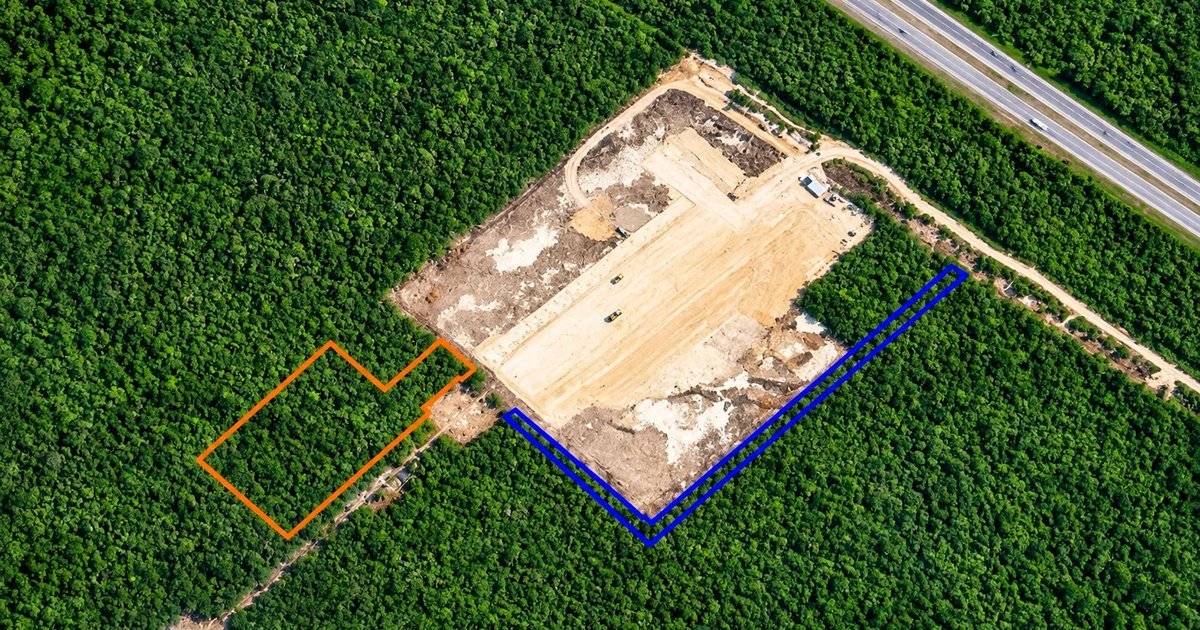
Playa del Carmen, Quintana Roo — Two energy companies are pressing ahead with plans for an industrial battery storage plant south of Playa del Carmen, even though federal environmental officials rejected an earlier permit for the site after finding jungle had been cleared without authorization.
Atlantica and Quartux Almacenamiento de Energía want to build SAE Kantenah, a facility that would store electricity and feed it back into the grid when demand rises. The project sits on the San Francisco property in Kantenah, a community within the Riviera Maya tourist corridor.
Semarnat rejected earlier application
The project’s history dates to September 2026, when it emerged that the Environment and Natural Resources Department (Semarnat) had denied the environmental authorizations requested for SAE Kantenah. During a technical site visit, inspectors found vegetation had been removed before the corresponding permits were issued.
The rejection covered both the environmental impact authorization and the forest land-use change permit, which are required before construction can begin. The original application was filed on Feb. 26, 2026, under case number 23QR2026TD019.
Despite that record, the project’s environmental paperwork still proposes building the storage infrastructure on the same property. It has yet to be confirmed whether the documents represent a new administrative filing after the rejection or an update to the earlier case file.
What the plant would do
The facility would be a utility-scale battery energy storage system, known in the industry as BESS. Unlike a conventional power plant, it would not generate electricity; it would hold power and release it to the grid to shave peak demand.
The executive summary of the environmental impact statement lists 20 megawatts of power and 60 megawatt-hours of storage capacity. The filing’s project description, however, cites 72 megawatt-hours. The discrepancy has yet to be explained.
The installation would include industrial battery containers, transformers, power conversion equipment and an underground transmission line. The documents allow three years for site preparation and construction and project a 50-year operating life.
Companies acknowledge damage to jungle
The environmental study says the project would occupy two parcels totaling 16,520.754 square meters, roughly 1.65 hectares. The first, measuring 4,629.452 square meters, would hold an access road; the second, at 11,891.302 square meters, would house the electrical facilities.
Both areas contain secondary growth from medium sub-evergreen forest. The assessment identifies negative impacts during site preparation and construction, including habitat disturbance, loss of vegetation cover, soil changes, airborne particulate matter and altered landscapes.
Although the study’s authors consider none of the impacts significant, they acknowledge effects in the moderate category. Proposed mitigation measures include rescuing wildlife and plants, controls to limit pollution, and environmental management during construction. Those measures remain proposals subject to review by regulators.
Land-use questions remain
The property lies within Environmental Management Unit 12, known as the Calica-Akumal corridor, where land-use rules allow infrastructure and equipment under certain conditions. The developers argue the project fits the zoning, although the study concedes federal authorization is needed because forest vegetation would be affected.
The document also notes that no sustainable tourism development program has been published for the area, limiting how certain urban compatibility standards can be defined.
The earlier unauthorized clearing raises questions about the current condition of the land, restoration of the areas already disturbed and compliance with environmental requirements. It also remains unclear whether the newly announced storage capacity reflects a redesign of the previously rejected project.
More Development
- Tulum Council Approves Request for 75 Million Peso Credit to Cover Operating Costs
- VIMA Foods Aims to Double Mexico Revenue to $140 Million in Five Years
- Aguakan Invests 7 Million Pesos in New Sewer Line in Puerto Morelos
- Cancún Opens Participatory Budget to Newly Regularized Neighborhoods
- Tulum Construction Sector Sees Gradual Recovery After Tren Maya and Airport Boom
More Playa del Carmen
- Playa del Carmen Rights Commission to Follow Up on Canadian Tourist’s Extortion Complaint Against Police
- Gas Leak Triggers Evacuation at Coppel Store in Playa del Carmen’s Plaza Las Américas
- Quintana Roo Promotes Underwater Tourism at DEMA Show 2026 in New Orleans
- Playa del Carmen Residents Say Aguakan Leaves Streets Ruined After Unfinished Works
- Foreign Tourists Return to Playa del Carmen’s Fifth Avenue, but Sales Still Lag