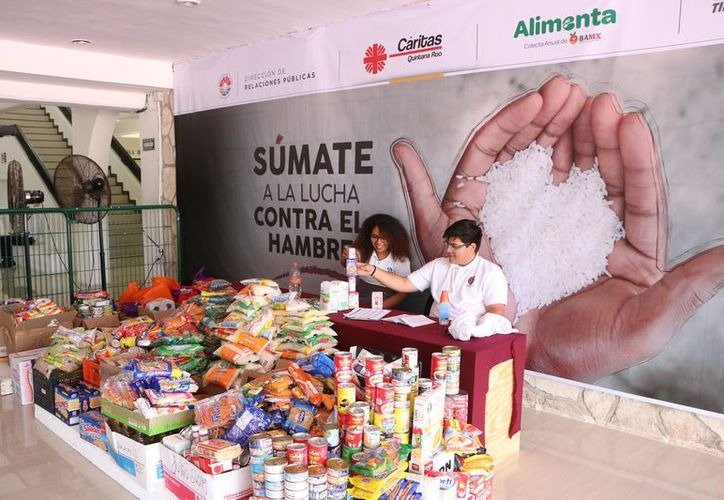
Cancún, Quintana Roo — Cancún has the second-highest rate of food waste in Mexico, with each resident discarding about 260 grams of food a day — roughly 95 kilograms a year — according to a study by Cáritas Banco de Alimentos.
Only Guadalajara records a higher figure. The research was carried out with support from universities in Quintana Roo and INEGI, Mexico’s national statistics agency.
Specialists, professors and students from the Universidad del Caribe, the Universidad de Quintana Roo and the Universidad Politécnica took part in the two-week study, which measured the volume of organic waste generated by households. INEGI helped select the homes that were monitored.
Nearly Six in Ten Wasted Items Were Avoidable
Miguel Gutiérrez Pacheco, director of Cáritas Banco de Alimentos, said the research set out to measure household food waste and to separate avoidable waste from material that can no longer be consumed.
Researchers collected and analyzed organic waste from the selected homes. Among the avoidable waste they found food that was still edible but had been thrown out after being stored for too long — an overripe piece of fruit that was not eaten in time, for example. Peels and pits made up the unavoidable share.
The study found that 59 percent of the food wasted in Cancún was avoidable, meaning it could still have been used or donated.
A Triple Impact: Environment, Society and Economy
Gutiérrez Pacheco said the problem has three dimensions: environmental, social and economic.
Environmentally, food waste generates greenhouse gases. The Pacto por la Comida coalition also links it to the unnecessary use of water, farmland and other resources consumed during production.
On the social side, roughly 493,000 people in Quintana Roo struggle to access nutritious, quality food, according to figures cited by the food bank.
Economically, every item that ends up in the trash represents wasted water, energy, labor and transport, along with other resources used to produce food and deliver it to consumers.
Hotels and Restaurants Add Five Tonnes a Day
The hotel and restaurant sector is also a major source of waste. According to the food bank, up to five tonnes of food are discarded daily by the sector in Cancún.
Some of that food may still be fit for human consumption, but recovering it requires meeting sanitary protocols, particularly for prepared dishes. Establishments must maintain a cold or hot chain during storage and transport; without those conditions, they cannot hand the food over for consumption.
Gerardo Macedo Díaz, a counselor at Casa Nuevo Corazón, said the organization has sought to work with hotels and restaurants to secure donations of food and non-perishable goods.
“We have met with hoteliers and restaurants to seek donations of unprepared food so we can reach more vulnerable families, but work is still underway; most give us pantry staples, but the idea is that some supplies that do not require refrigeration are also donated,” he said.
Chef César Hernández Palma said hotels have internal policies for keeping prepared food. Once the permitted period ends, or if an adequate temperature cannot be guaranteed during transport, the food must be thrown out. That does not always mean the food has lost its properties, he said — the obstacle is the inability to guarantee sanitary conditions while it is moved.
As a result, the hotel sector tends to donate products and ingredients that do not require refrigeration, which can be moved more easily to aid organizations.
Food Banks Step In
Civil organizations play a key role as intermediaries between companies and vulnerable families. Cáritas Banco de Alimentos receives products from hotels, restaurants and supermarkets, and runs the Al Rescate program, which uses a mobile app to coordinate the recovery of surplus cooked food from the hospitality and restaurant sector.
In 2024, Cáritas Quintana Roo reported it had rescued 9,424.69 kilograms of surplus food through the program.
The nonprofit Integración Para la Vida (Inpavi) also works with vulnerable families, distributing supplies through food packages. The Quintana Roo Food Security Agency is involved as well through state programs aimed at addressing food deficits. In 2026, the “Comemos Tod@s” program expanded its coverage to 60,000 families across the state’s 11 municipalities.
Collection and Distribution Remain the Challenge
Quintana Roo has legislation to encourage food donations, but the willingness to give is not the only obstacle. Sociologist Oliver Tabares Castro said one of the main challenges is securing enough resources to collect, transport, conserve and distribute food, keeping usable products out of landfills while families struggle to cover their food needs.
The call extends to consumers, companies and authorities alike, with the goal of managing food better, cutting waste and strengthening recovery and distribution. Pacto por la Comida promotes measures to prevent and reduce food loss across the supply chain, from production through consumption.
More Environment
- Pacific Tropical Depression Forecast to Become Hurricane Polo, Possibly Category 3
- Isla Contoy Cleanup Removes 249 Kilos of Waste From Marine Park
- Quintana Roo Reports 33 New Dengue Cases, Reinforces Prevention Efforts
- Tropical Wave 40 Lashes Quintana Roo, Toppling CFE Pole and Cutting Power in Cancún
- Coastal Erosion Topples Palm Trees at Playa Coral as Quintana Roo Beach Recovery Slips to 2027
More Cancun
- Cancún Mayor Ana Paty Peralta Delivers Second Government Report
- Cancún Drivers Accuse Quintana Roo Mobility Institute of Abusive Inspections and Impound Fees
- Puenteando Festival Returns to Cancún’s Nichupté Bridge for Third Edition
- Quintana Roo Hotel Zone to Close Year With 226 Million Pesos in Spending: Infratur
- Cancún Shelter Holds 32 Migrant Minors Awaiting Family Reunification