
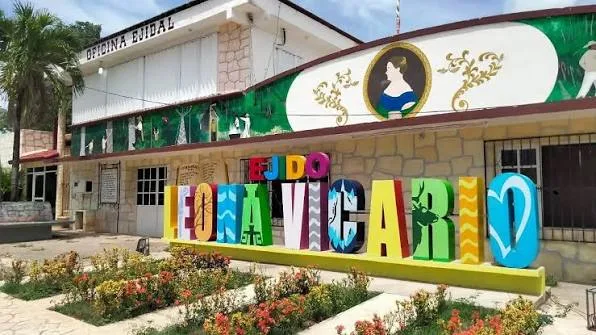
Leona Vicario, Quintana Roo — An audio recording attributed to Fausto Eduardo Ramírez Bastida has cast new scrutiny on the land-regularization program that Tire Terracasa Inmobiliaria Real Estate ran in the Leona Vicario ejido, where disgruntled landholders say the company collected more than 12 million pesos without delivering the titles it promised.
In the recording, Ramírez Bastida says he holds an “active participation” in the company, refers to roughly 300 hectares that would be sent in initial batches to the National Agrarian Registry (RAN), and describes the consequences that those who refused to pay would supposedly face.
The audio surfaced after the Sept. 6 assembly of the Leona Vicario ejido, where the company’s legal representative, Eusebio Arnaldo Arreola Semadeni, reportedly told those present that the payments received covered only 88 hectares.
The gap between the 88 hectares reported at the assembly and the roughly 300 hectares mentioned in the recording has opened a new line of inquiry into the true scale of the program, how many people were enrolled and how much Tire Terracasa expected to collect.
‘I have an active participation’
In the audio, Ramírez Bastida identifies Tire Terracasa as the ejido’s regularization company and says it holds a valid contract. He also says he was recently invited into the project, while acknowledging that the company had already been working for about two and a half years.
“I have a participation in the company, obviously an active one, not a passive one,” he says during the conversation.
That statement will have to be checked against Tire Terracasa’s articles of incorporation and corporate filings to determine whether Ramírez Bastida is a shareholder, partner, agent, employee, promoter or outside representative. If he does not appear formally in the company’s structure, he will need to explain what the participation he claims consists of and under what arrangement he may have received economic benefits.
Ramírez Bastida also refers to the change of leadership in the Leona Vicario ejido and to the assembly scheduled for Sept. 6. According to his account, the meeting was meant to renew support for the company and allow it to remain until the end of the new leadership’s term.
“Yesterday we closed ranks,” he says at another point in the recording, after mentioning the winning slate and those who contested control of the ejido.
The remark raises questions about the relationship between Tire Terracasa’s representatives and the current ejido leadership headed by José Rogelio Concha Naal. Dissenting landholders who provided the material accuse Ramírez Bastida of offering financial benefits to secure the leadership’s backing.
The recording contains a claim of participation in the company and references to internal political agreements, but on its own it does not prove that money was handed to the ejido leadership.
300 hectares promised to the agrarian registry
During the conversation, Ramírez Bastida says the first batches were being prepared for submission to the National Agrarian Registry.
“We’re going to send the first packages to the RAN, which are roughly about 300 hectares,” he says.
That claim would have to be verified directly with the registry through entry numbers, file references, case records, the names of applicants and the surface areas involved. If the batches were already submitted, Tire Terracasa should produce the corresponding receipts. If they do not exist, the company should explain why landholders and developers were assured the process was ready to move forward.
It also remains to be established why the assembly was told of payments tied to 88 hectares while a figure closer to 300 hectares was being offered in private. The amounts could correspond to different stages, but no public breakdown explaining the difference has been provided.
A warning for those who do not pay
Ramírez Bastida says in the audio that joining the program is voluntary, but he immediately describes consequences for those who decline. According to his explanation, the names of those who do not pay could be left out of the process, their land could be registered under the ejido’s name, and landholders would have to approach their representatives again to negotiate a transfer of ownership.
Affected residents interpreted the warning as pressure to secure more payments. The company and the ejido leadership will have to explain whether the assembly legally approved excluding certain landholders, under what procedure they could lose recognition of their land, and what legal remedies they would have to defend it.
Simply refusing to hire a private company’s services does not automatically mean losing possession of land. Any change to agrarian rights requires procedures and agreements adopted in accordance with the law.
The recording also attributes the regularization effort to an alleged agreement among the federal, state and municipal governments. Authorities will have to clarify whether they participate formally and whether they recognize Tire Terracasa as an authorized intermediary.
Who is Francisco Arreola Barraza
Francisco Arreola Barraza is identified as the majority partner of Tire Terracasa and one of the main figures behind the contract signed with the ejido. According to information provided to Diario CAMBIO 22 by dissenting landholders, he previously sold heavy machinery and later took part in works related to the Maya Train, particularly sections 4 and 5.
The landholders say his economic growth was tied to contracts obtained during the railway’s construction and to a family relationship with Raúl Bermúdez Arreola.
Substantiating that account would require locating contracts, supplier companies, subcontracting agreements, invoices and machinery records linked to the works. A family tie by itself does not prove that contracts were awarded improperly; it would still have to be established who hired the services, which company received the payments, what amounts were involved and whether Raúl Bermúdez took part in the award.
Raúl Bermúdez’s removal at Fonatur
Raúl Bermúdez Arreola was removed in December 2021 from his post as acting head of Fonatur’s Cancún Integrally Planned Center. The federal agency said at the time that the decision followed public allegations and investigations opened by its internal oversight office.
One of the questions raised was that a federally owned residence in Cancún’s hotel zone was allegedly offered for vacation rental through digital platforms. Fonatur did not find the accusations proven, but removed him to allow the investigations to continue and said it would cooperate with what was then the Public Function Ministry.
That record shows Bermúdez was set aside from Fonatur while under investigation, but it does not show that he intervened on Francisco Arreola’s behalf or took part in Tire Terracasa’s activities.
Alleged family ties to Hernán Bermúdez
The information provided also suggests that Raúl and Gerardo Bermúdez Arreola are relatives of Hernán Bermúdez Requena, publicly identified as an alleged leader of the gang known as “La Barredora,” and that Francisco Arreola Barraza has a family relationship with Raúl Bermúdez.
Those relationships would have to be documented through civil registry records or other official documents before being treated as fact. Even if confirmed, family ties would not automatically show that Francisco Arreola or Tire Terracasa are involved in criminal activity. Linking the regularization program to a criminal structure would require prosecutors’ files, financial transactions, contracts, communications or concrete acts pointing to a relationship beyond kinship.
So far, the source has asked for possible connections to contracts, fuel theft and casinos to be investigated, but did not provide enough documents in the material reviewed to substantiate those activities.
The legal representative’s record at the RAN
Eusebio Arnaldo Arreola Semadeni, Tire Terracasa’s legal representative, previously served as general director of Rural Cadastre at the National Agrarian Registry. On Oct. 2, 2014, the responsibilities unit of the RAN’s internal oversight office issued document 15/998/OIC/1669/2014, corresponding to case R-89/2012, summoning him to a legal hearing.
The proceeding accused him of failing to supervise compliance with a 2011 contract between the National Agrarian Registry and the Autonomous University of Zacatecas, as well as an agreement with the Inter-American Institute for Cooperation on Agriculture. According to the notice, the omission caused the RAN an improper loss of 863,305.51 pesos: 815,023 pesos in fuel, 29,403.50 pesos in materials and office supplies, and 18,878.80 pesos in printing and reproduction items.
The additional resources were supplied by RAN delegations in Chiapas, Guerrero, Oaxaca, San Luis Potosí, Veracruz and Yucatán, even though the items were supposedly already covered by the signed instruments.
The document is a notification of alleged facts and an administrative hearing. By itself it does not establish a final sanction or prove that Arreola Semadeni was found responsible. The case’s final resolution would have to be located to determine whether he was sanctioned, cleared or the proceeding ended another way. The record is relevant because he now serves as legal representative on a contract whose purpose is precisely to manage land regularization before agrarian authorities.
Ramírez Bastida and the Adara Foundation
Fausto Eduardo Ramírez Bastida is also linked to a foundation dedicated to treating people with addiction problems, whose facilities are said to be located in Leona Vicario. The source accuses him of requiring residents and staff to call him “godfather,” and of responding with threats, isolation or denial of food when someone refuses.
Those are serious allegations, but publishing them as established facts would require direct testimony, formal complaints, medical records, health inspections or action by authorities. It would also have to be established what the Adara Foundation’s legal name is, who is listed as its legal representative, what permits it holds and which agencies oversee conditions at the facility.
Ramírez Bastida’s role at Tire Terracasa, by contrast, requires immediate clarification because he himself stated in the audio that he holds an active participation in the company and promoted payments for the regularization.
An audit and unresolved questions
The disclosures leave three levels of responsibility to be clarified:
- Contractual and financial: what was promised, how much money was received and why the titles have not been delivered.
- Promotion of the program: who authorized warning landholders about consequences for not paying, and what basis there was for promises to regularize up to 300 hectares.
- Business, political and family relationships: the ties of those involved in Tire Terracasa.
The audit agreed by the ejido must determine where the more than 12 million pesos went. In parallel, the National Agrarian Registry is expected to confirm whether it received the announced batches and whether any formal proceeding exists over the land in question.
More Development
- Hyatt Zilara Cancún Targets 70% Winter Occupancy After $75 Million Renovation
- New CFE Substation in Cancún’s Polígono Sur to Be Ready in December
- Paseo de las Sirenas Becomes a New Isla Mujeres Attraction
- Autocar Adds 100 Hybrid Buses to Its Cancún Fleet
- Playa del Carmen to Regularize Two Ejido Neighborhoods Gradually, Aguakan Role Undecided
More Puerto Morelos
- Puerto Morelos Mayor Accuses Predecessor Laura Fernández Piña of 1.26 Billion-Peso Embezzlement
- Puerto Morelos Announces Mar de Almas Janal Pixan 2026 Day of the Dead Festival
- Cancún Hoteliers Plan Rate Hikes of Up to 35% for Winter Season
- Ejido Leona Vicario Orders Audit of 12 Million Pesos Land Regularization Contract
- Activists in Playa del Carmen Demand Resignation of Quintana Roo Environment Chief Over Alux 33 Approval