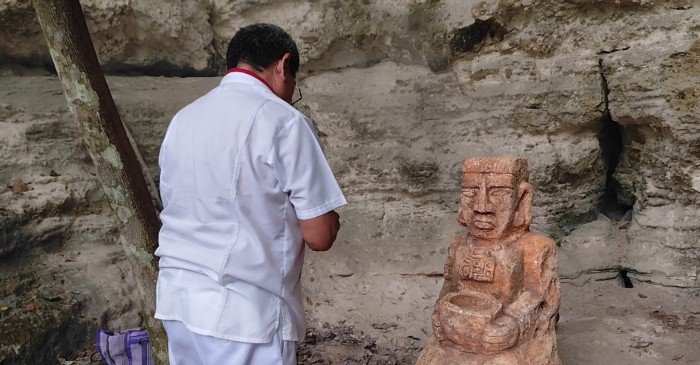
José María Morelos, Quintana Roo — A new sculpture designed to look like a pre-Columbian artifact was installed in the cenote at Sacalaca during a ceremony led by a Maya priest, the latest step in the rural community’s push to build itself into a tourism destination.
The piece, placed in the natural limestone sinkhole, depicts a Maya figure carrying a water jug. Its creator, artist Francisco Pacheco Polanco, said the aim is for the sculpture to be presented as the cenote’s guardian.
Pacheco Polanco said he spent several years completing the work, deliberately adding wear and small cracks so it would appear to be centuries old. It sat in his workshop for a long time before it “found its home” in Sacalaca, he said.
A few finishing touches remain and will be applied over the coming weeks, once the sculpture is in place, to keep it from being damaged during transport, he added.
Maya priest Aniceto Velázquez Chi led the ceremony that gave the work its status as guardian of the cenote.
Residents have worked to rehabilitate the cenote as a tourist attraction, and installing the sculpture was the final step in that effort.
Representatives of Sacalaca asked councilwoman Jaddla Pacheco Hernández to take on the project. She contacted staff at the Universidad Intercultural Maya de Quintana Roo (Uimqroo) to draw up the plan and reached out to the artist.
Speaking at the event, the councilwoman said the sculpture is only the beginning of the push to promote Sacalaca as a community tourism destination.
Fredi Reynaldo Un Noh, a Uimqroo professor and cultural adviser, said Sacalaca is now part of the registered Caste War Route, which also includes Sabán, X-Cabal and Tihosuco and offers tours of churches and historic sites along with natural attractions such as the cenote.
“Community tourism is starting to establish itself as an alternative for making use of Sacalaca’s natural, cultural and historical resources without putting them at risk, through small-group tours with the direct participation of residents,” he said.
Each tour is limited to 10 people to keep the ecological impact in check. Activities include rappelling, birdwatching, hiking, cycling, church tours, museum visits, apiaries and traditional milpa plots, as well as experiences at plant nurseries and communal plots.
The association Amigos de Sian Ka’an provides training for residents to work as guides.
More Culture
- Cozumel Opens Registration for Day of the Dead Catrina Costume Contest
- Mexico Reaches National Agreement to Regulate Cellphones in Classrooms
- Mexico Opens First IMSS-Bienestar Hospital Blending Traditional Midwives With Clinical Medicine
- Puerto Morelos Announces Mar de Almas Janal Pixan 2026 Day of the Dead Festival
- Tren Maya Finds Reshape Understanding of the Maya ‘Collapse’
More Zona Maya
- Farm and Cattle Expansion in Quintana Roo Squeezes Native Wild Bees
- UIMQROO to Build Student Dormitories With 19 Million Peso Investment
- Tulum Delivers Free Medicines to Health Houses in Vulnerable Communities
- Tulum Tourism Slump Spreads to Inland Maya Communities as Businesses Close Along Cobá Route
- Mahahual Groups Build Reinforced Dog Shelters to Shield Pets From Jaguar Attacks