
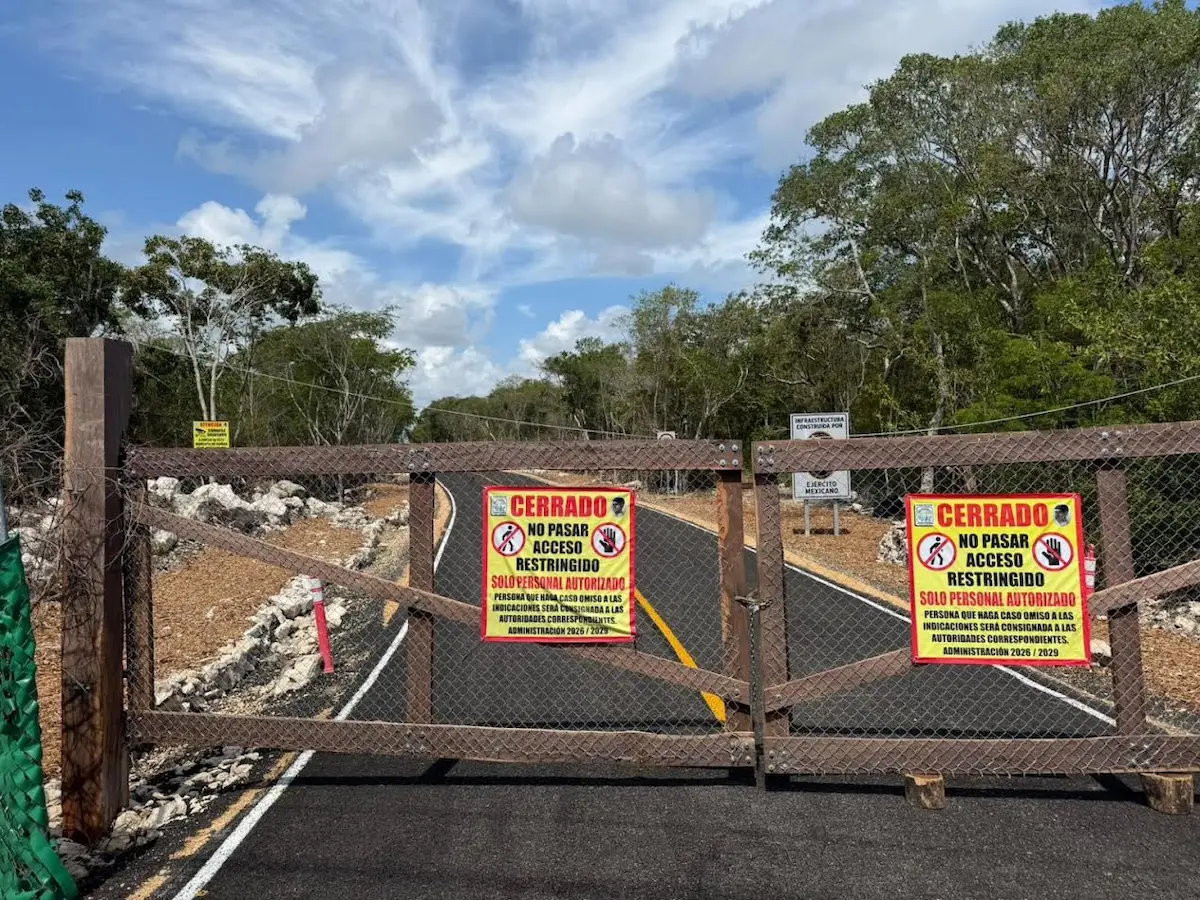
Tulum, Quintana Roo — The Mexican Army has nearly finished a 16-kilometer road through virgin jungle above the Sac Actún flooded cave system, despite lawsuits and complaints from environmental groups that call the project illegal and a direct threat to one of the world’s largest underground aquifers.
Civil-society organizations Sélvame MX, Greenpeace México and the Mexican Center for Environmental Law (Cemda) documented an illegal project endangering the second-largest flooded cave system on the planet, yet federal authorities pressed ahead with construction. A comparison of the groups’ June observations with conditions in the first week of September shows the work is all but complete and ready to open.
The organizations were unable to stop the project: a federal judge dismissed the injunction, or amparo, they filed against it.
Soldiers have confirmed that military engineers built the road. A sign mounted behind a wooden gate that blocks passage along the roadway reads: “Infrastructure built by the Mexican Army.”
A separate warning posted by the board of the Jacinto Pat communal land, or ejido, states: “Closed. No entry. Restricted access, authorized personnel only. Anyone who disregards these instructions will be handed over to the corresponding authorities. Administration 2026/2029.”
Officials expect the road to open in the coming weeks. Critics say it was built to sidestep the lack of permits for the Tulum bypass: the road occupies what would have been half of the bypass’s original route but was presented to the Secretariat of Environment and Natural Resources (Semarnat) as a crop-hauling road.
On June 23, the environmental groups laid out their position: “Faced with the persistent destruction of the Mayan jungle and the advance of works operating outside the framework of environmental legality, the organizations Sélvame MX and Cemda filed legal complaints over the illegal construction of a 16-kilometer road in the municipality of Tulum carried out by the Mexican Army.”
“The work is being carried out over the Sac Actún system, one of the largest and most fragile underground aquifers on the planet, fracturing the heart of the virgin jungle and placing the region’s freshwater supply at imminent risk,” the groups said.
According to complaints filed by specialists and activists, the road on the Jacinto Pat ejido serves no mobility, health or education needs of any local Indigenous community, since it does not pass through any populated area. They describe it instead as a real-estate speculation project funded with public money.
The Tulum municipal government has also denied that the road functions as a bypass or shortens travel times toward Chetumal or Tulum, meaning it serves no public connectivity purpose.
The Mexican Army says the route stems from an agreement with the Jacinto Pat ejido, but Sélvame MX argues the affected area has no agricultural activity or human settlements that would justify the roadway as a genuine crop-hauling road.
“This road is a vector of mass destruction. It is not for the people; it is a 16-kilometer scar cut into virgin jungle with the sole purpose of triggering real-estate speculation, encouraging land invasions and forcing disorderly urban development onto the aquifer,” warned Pepe Tiburón, a representative of Sélvame MX.
Gustavo Alanís Ortega, founder and executive director of the Mexican Center for Environmental Law, said the road “places the largest system of underground rivers in the world at risk and will cause ecosystem changes in a site that is potential habitat for as many as 78 species at risk of extinction, highlighting the importance of the habitat of the spider monkey.” He added that the project violates provisions of the Cancún-Tulum Ecological Land Use Program, the General Law on Sustainable Forest Development, the General Law on Ecological Balance and Environmental Protection, and the General Law on Wildlife.
Judge Dismisses Injunction Against the Road
Last week, a federal judge dismissed the injunction filed against the road advancing across the Sac Actún area without ruling on the merits of the case. As a result, the exemption from an environmental impact statement (MIA) that Semarnat granted the Mexican Army remains in force. The agency justified the exemption by claiming the project was the rehabilitation of a pre-existing crop-hauling road — which the groups say is false, since the work involved building a new road through standing jungle.
The challenge was filed by Elijo por el Clima, a civil association linked to the Sélvame MX environmental collective. According to the case record, the appeal targeted the document through which Semarnat exempted the “Jacinto Pat road” project from presenting an environmental impact statement.
The court’s decision closed the proceeding without examining whether Semarnat’s resolution was correct, meaning Elijo por el Clima can still file a review appeal before a collegiate court.
More Environment
- Akumal Halts Turtle Swim Tours Through September
- Mexico Assigns $110 Million Navy Budget to Fight Sargassum in Quintana Roo
- Mérida Opens First Green Corridor to Fight Climate Change
- El Niño Keeps Atlantic Hurricane-Free, Setting Record for Latest First Storm in Decades
- Semarnat Rejects 54-Hectare Real Estate Project in Punta Sam
More Tulum
- Five to Face Trial in Tulum Funeral Home Equipment Theft
- Advocates Urge Quintana Roo Governor to Expand Xcacel-Xcacelito Turtle Sanctuary
- Three Arrested in Tulum After Taxi Driver Beaten and Robbed for Refusing Extra Passengers
- Tren Maya Archaeological Finds Won’t Be Displayed in Chetumal, INAH Says
- Tulum Hotels Stay Open Through Renovations Ahead of High Season, Union Says
