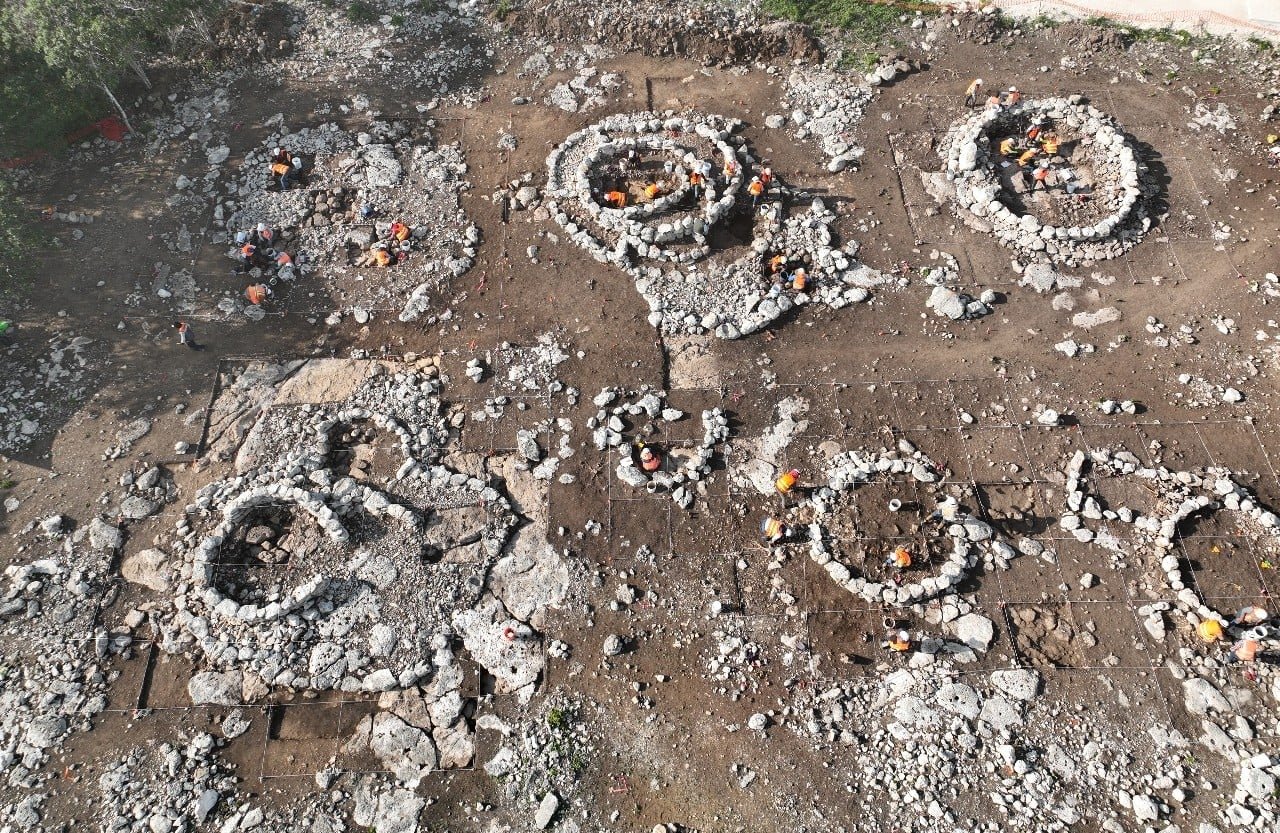
Progreso, Yucatán — Archaeologists have discovered a previously unknown Maya settlement during construction of the Maya Train cargo line near the Progreso multimodal terminal, the National Institute of Anthropology and History (INAH) announced.
The site, named K’oxol Ja’ II, is located near the coast in Yucatán. The name derives from the Maya words k’oxol (mosquito) and ja’ (water), meaning “water of the mosquitoes” or “water where mosquitoes emerge,” a reference to the insects that thrive in the area.
INAH said the settlement offers insight into the lives of ordinary Maya people, rather than the rulers and priests who inhabited great temples and palaces. It is made up of 21 monuments and associated natural features, was located in mid-2025, and has been slated for conservation and protection in situ.
The settlement covers 2,257 square meters and appears to have been primarily residential, with remains of foundations and other architectural elements typical of ancient homes, according to David Medina Arona, field chief at the Progreso multimodal terminal.
The research team includes archaeologists Abraham Alarcón Carmona, Carlos Avendaño Rincón, Darwin Velázquez González, and 16 other field specialists, coordinated by Susana Echeverría Castillo. Their findings suggest the site was occupied from the regional Preclassic period (400 BC–AD 250) through the Late Classic period (AD 450–900).
Medina highlighted the presence of permanent or seasonal water bodies at the site. “The main cenote, for example, preserves the remains of a wellhead built to modify its entrance and, probably, to manage the water it held,” he said.
Because of these features, INAH said K’oxol Ja’ II may have been a settlement of intermediate importance, possibly subordinate to the nearby site of El Chiik (“badger” in Maya), located to the northwest and also discovered during the archaeological rescue work for the Maya Train cargo line.
The site has yielded little pottery, suggesting that many household utensils were made from perishable materials. No human burials have been found in the investigated areas, likely because houses were built directly on bedrock with shallow fill, making it difficult to dig graves beneath the floors.
The 21 monuments have been cleaned, their walls restored, and the site enclosed with protective fencing. INAH and the Mexican Army, which is building the Progreso multimodal terminal, have agreed to create a protection polygon to allow for future research.
“These are sites that complete our knowledge of the Maya people,” Medina said. “Many people go to the great pyramids and urban centers, but here we have those other Mayas who left nothing written and are often forgotten. Domestic archaeology lets us give them back their voice.”
More Culture
- Documentary Exposes 30 Years of Pollution in Cancún’s Chacmuchuch Lagoon
- Xcaret Says It Will Abide by Any Supreme Court Ruling on Use of Maya Culture
- Mérida to Host 2026 Mucbipollo Festival at San Sebastián Park
- Cancún Moves to Reactivate Puerto Juárez Market for Hanal Pixán
- Playa del Carmen Seeks Alternative Event After Jazz Festival Suspension