
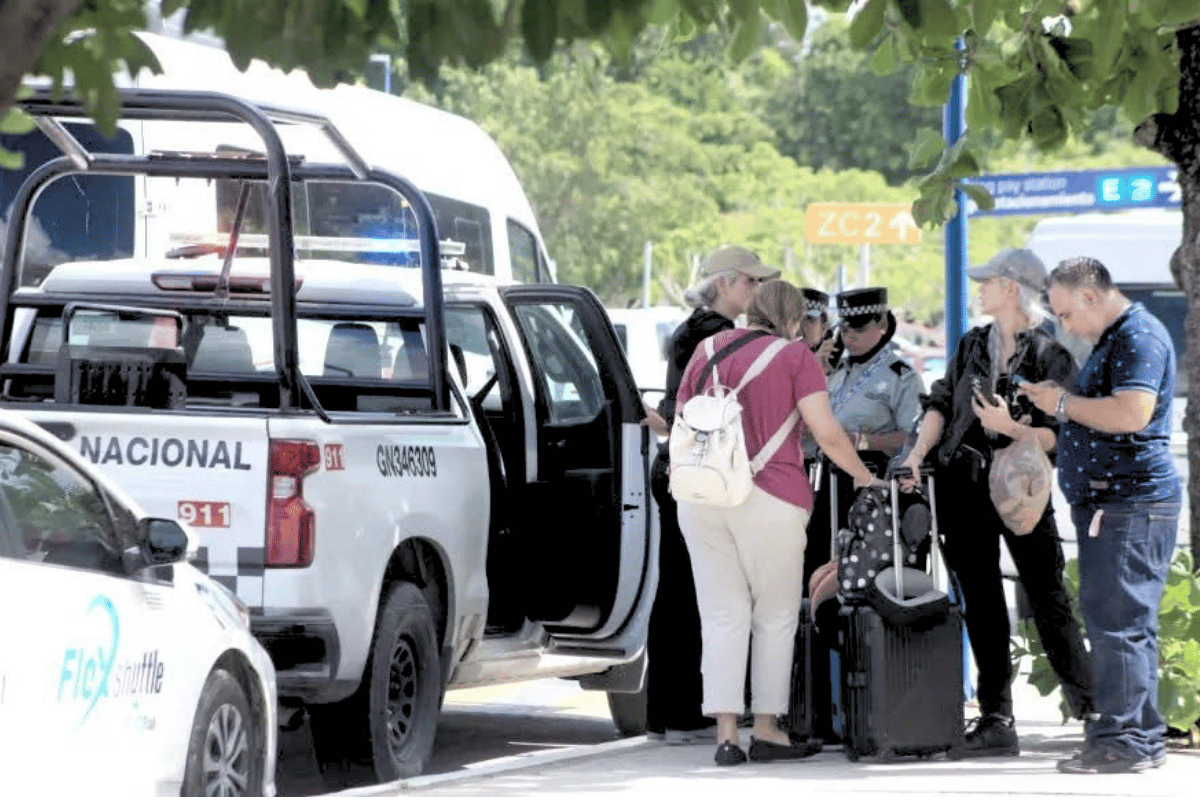
CANCUN, Quintana Roo — A public complaint about alleged periodic payments involving Uber drivers has raised new questions about security at Cancun International Airport, stating that members of the National Guard are allowing a group of drivers to pick up passengers in exchange for payments made every ten days. The complaint also puts access controls and the actions of those responsible for surveillance under scrutiny amid the controversy between Uber and the Ministry of Infrastructure, Communications and Transportation (SICT) over operations at federal terminals.
According to the report, the alleged scheme involves approximately 100 drivers who are supposedly given preferential treatment to work at the terminal through a list managed by a member of the federal agency. The report does not specify the individual amounts of the alleged bribes, nor does it provide an investigation number to indicate whether the matter has been formally reported to the authorities.
The complainants identify Adrián Romero García, alias “El Camarita,” as the alleged intermediary of the agreements and describe him as an active element in charge of traffic tasks at the airport, attributing to him the receipt of payments to allow the boarding of passengers. At the center of the story is also a driver identified as Francisco, known as “El Sony,” who allegedly boasted of having protection from public officials to operate in the airport area, including the support of an investigative agent from the State Attorney General’s Office assigned to the mainland area of Isla Mujeres.
The complaint mentions conversations, screenshots and recordings as part of the material supporting its claims, although those files were not provided for this review and, therefore, their content, authenticity or context were not directly verified.
Accusations extend to airport security and surveillance personnel
The accusation also extends to Juan Carlos González Molina, whom the complainants attribute with knowledge of the alleged scheme and support for the individual who would manage the list of drivers. His identification as a second captain and airport security commander coincides with public statements released in August about the National Guard’s surveillance duties at the terminal, but that background proves his public function and not his participation in the alleged collections.
The informants also mention José Luis Chávez, identified in public records as the airport’s head of security, and attribute to him instructions to facilitate access for the driver known as “El Sony.” The existence of public references to his role does not, however, corroborate the conduct alleged in this complaint.
During the search, no statement was found from the National Guard, ASUR or the State Prosecutor’s Office that specifically responded to these accusations, nor was there an administrative or judicial resolution establishing the responsibilities of the people mentioned.
Regulatory dispute between SICT and Uber
The regulatory context is relevant because the complainants maintain that some operators work without permits, license plates or federal licenses, in addition to using vehicles registered in other entities, circumstances that must be reviewed individually through their documents and the applicable provisions.
The Ministry of Infrastructure, Communications and Transportation (SICT) stated in a press release on March 11, 2026, that Uber is not authorized to provide services within the perimeter of the capital’s airport and other airports in the country, and specified that the actions of the authority must comply with the regulations. Previously, the agency explained that the court injunction obtained by the company seeks to prevent arbitrary or discriminatory operations, but that this measure does not equate to an administrative authorization to provide airport transportation services.
Uber, for its part, maintains a different interpretation of the scope of judicial protection, stating that the definitive suspension related to file 1202/2025 prevents the arrest or sanctioning of drivers solely for making trips through its application, although it acknowledges that the authorities can request documents and carry out inspections within the legal framework.
This controversy must be distinguished from allegations of corruption, since the discussion about permits or judicial measures does not prove the existence of clandestine payments, just as a possible judicial protection does not authorize public servants to charge for omitting reviews or granting preferential treatment.
Airport volume and unverified video evidence
The size of the airport helps to understand the importance of its transport controls: according to the ASUR report, between January and September 2026 Cancun registered 20 million 882 thousand 658 passenger movements, compared with 22 million 196 thousand 857 in the same period of 2025, a reduction of 5.9 percent.
In September alone, the airport recorded 1,607,088 passengers, a figure that demonstrates the volume of users passing through a terminal where access to ground transportation is a fundamental service. This data describes airport activity and does not represent the number of customers of digital platforms.
The complaint also refers to videos in which the driver in question apparently consumes alcoholic beverages while driving a gray Chevrolet Spark, but without examining the original recordings it cannot be determined what the drinks contain, when the events occurred or if there was an infraction.
The central point of the complaint is the alleged selective application of access controls through private payments, an accusation that demands clarification of who supervises the agents, how their interventions are documented, and under what criteria passengers are allowed to be picked up, in order to determine if the rules are followed equally or if there is liability for improper charges.
More Crime
- Cancun Shield Deploys 102 Officers to Fight Crime
- Tulum Business Owners Say Police Still Extorting Tourists and Residents
- Tourists Say Playa del Carmen Pemex Station Charged Them $150 for a Partially Filled Tank
- Alleged International Money Laundering Operator ‘El Panameño’ Arrested in Playa del Carmen
- Hells Angels Leader Arrested in Cancun Over Cartel Drug Trade
More Cancun
- Quintana Roo to Boost Tourism Promotion by 20% as Cancún Travel Mart 2026 Opens
- Mexico State Symphony Orchestra Brings Free Concert to Cancún Airport Station
- Mexico’s Caribbean Diversifies Markets as US Tourist Flow Slows, Tourism Secretary Says
- Red Ambiental Donates 25 Breast Prostheses and 80 Medical Screenings in Cancún
- Tourist Boat Traffic Slumps Across Quintana Roo Ports in September