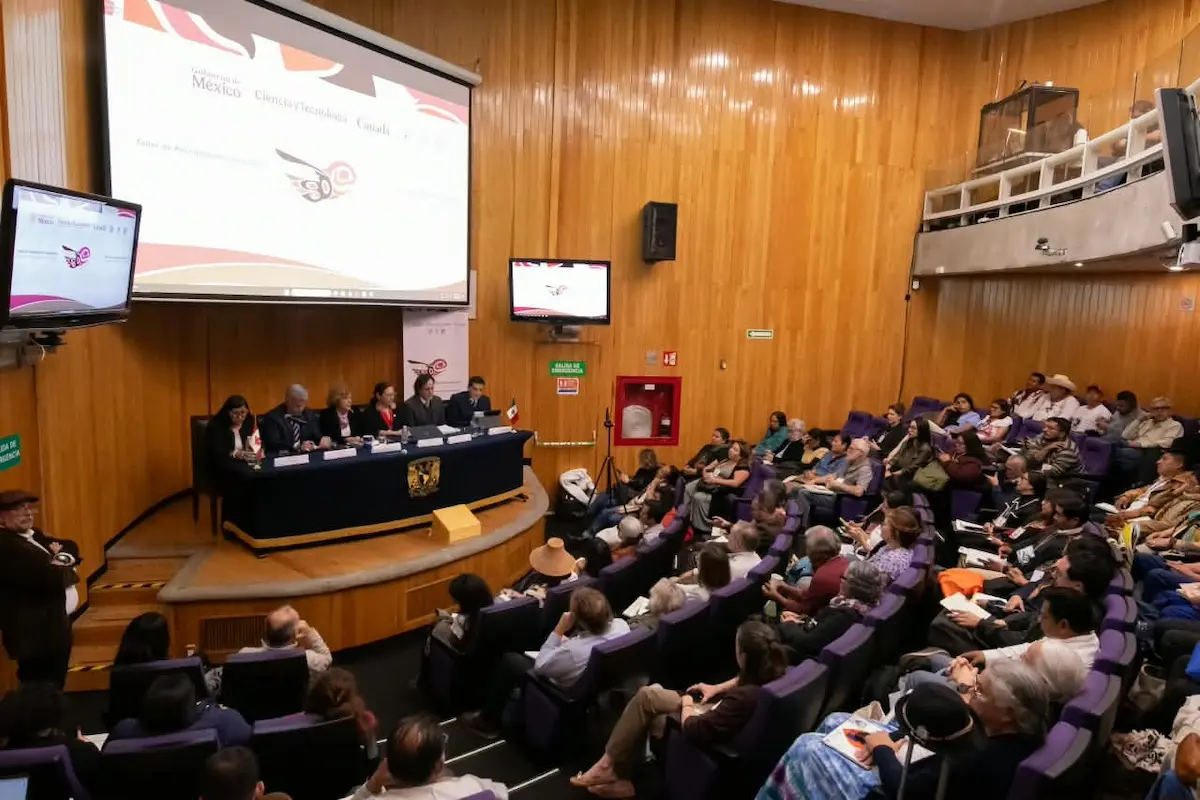
Rosaura Ruiz Gutiérrez, head of the Secretariat of Science, Humanities, Technology and Innovation (Secihti), warned that artificial intelligence could deepen the exclusion of Indigenous communities if their languages are not represented in digital systems. She called for the development of technologies with community participation and respect for peoples’ rights over their knowledge and cultural heritage during a Mexico-Canada cooperation workshop.
“Science and technology must be placed at the service of the people,” Ruiz Gutiérrez said, recalling that the Chapultepec Principles stipulate that artificial intelligence must recognize and respect the country’s cultural and linguistic diversity.
Ruiz Gutiérrez made the remarks during the Workshop on Linguistic Revitalization Experiences: Mexico-Canada Experiences, organized by Secihti and the Canadian Embassy in Mexico. The three-day workshop was scheduled to conclude the following day. It was attended by, among others, Canadian Ambassador to Mexico Cameron MacKay.
During the meeting, Ruiz Gutiérrez highlighted the launch of the Purépecha Linguistic Pride Network, made up of 20 promoters from nine communities in Michoacán, as part of efforts to strengthen the transmission and use of Indigenous languages.
Ruiz Gutiérrez explained that these efforts, led by Violeta Vázquez-Rojas Maldonado, undersecretary of Science and Humanities at Secihti, are part of the National Research Network on Indigenous Languages. The network brings together more than 1,800 members and seeks to link academic knowledge with community needs and priorities.
Ruiz Gutiérrez explained that the workshop is one of the first outcomes of a memorandum of understanding signed in March 2026 with the Social Sciences and Humanities Research Council of Canada. Over three days, Indigenous representatives, speaker communities, academic institutions and authorities from both countries were brought together to share experiences in language revitalization.
This work, Ruiz Gutiérrez said, should enable new generations to learn, produce knowledge and participate in public life in their own language. “But revitalizing a language also means expanding the opportunities for those who speak it,” she said.
Canadian Ambassador to Mexico Cameron MacKay emphasized that bilateral cooperation in research recognizes Indigenous knowledge systems and seeks to ensure inclusive, equitable, transparent and sustainable relationships. He stressed that incorporating the leadership of Indigenous peoples means acknowledging their capacity to generate solutions.
“You are bearers of ancestral knowledge, innovators, educators, and leaders whose perspectives are essential for addressing contemporary challenges and building more resilient societies,” MacKay said.
MacKay explained that Canada places Indigenous communities at the heart of the recovery and strengthening of their languages through instruments such as the Indigenous Languages Act. MacKay linked this effort to reconciliation and the exercise of linguistic rights and affirmed that the exchange with Mexico allows for the sharing of experiences based on respect for the knowledge and self-determination of Indigenous communities.
On behalf of Leonardo Lomelí Vanegas, rector of the National Autonomous University of Mexico (UNAM), Miguel Armando López Leyva, coordinator of Humanities, proposed that the workshop give rise to shared projects between universities, research centers, community organizations and the governments of Mexico and Canada. López Leyva expressed confidence in establishing alliances that will transform institutional commitments into concrete actions.
“Because revitalizing a language is also contributing to repairing historical injustices,” López Leyva said.
As part of the capabilities UNAM contributes to this effort, López Leyva mentioned the teaching of Indigenous languages as second languages, linguistic research and documentation, and the development of learning materials. Among the available resources, López Leyva highlighted an ethnobiological vocabulary of a language from the border region between Chiapas and Guatemala, with 330 words, definitions and pronunciation recordings, as well as a scholarship and academic tutoring program for students from Indigenous and Afro-Mexican communities.
Gustavo Torres Cisneros, general coordinator of Cultural Heritage and Indigenous Education at the National Institute of Indigenous Peoples (INPI), reported that in its first year the Indigenous Language Community Houses project includes about 430 spaces to support initiatives of the peoples themselves.
Torres Cisneros explained that communities define the actions to recover and transmit their languages, while institutions contribute financial resources and technical assistance. He proposed sharing this experience with Canada.
Candice St-Aubin, acting commissioner of the Office of the Commissioner for Indigenous Languages of Canada, warned that the loss of languages also constitutes an emergency and requires sustained efforts in the face of fluctuating funding. She highlighted young people’s interest in revitalizing their communities and emphasized that the exchange with Mexico offers learning opportunities. She added that the Office is accountable to the communities it serves and will monitor the progress of the cooperation.
Inocencia Arellano, director general of the National Institute of Indigenous Languages (INALI), emphasized that revitalization requires creating conditions for speaking the languages in everyday life, transmitting them between generations and expanding their presence in educational, cultural, community and institutional spaces. She considered it essential to coordinate capacities and resources among institutions and countries, respecting the autonomy of the peoples and the particularities of each linguistic context, and placing speaker communities at the center of decision-making.
More Lifestyle
- Mexico City’s 32-Meter Catrina Aims for Guinness World Record
- Quintana Roo Expands Free Mental Health Care Network Across the State
- Quintana Roo to Bar Cellphones for Teachers as Well as Students Starting Nov. 3
- Playa del Carmen Councilwoman Proposes Reviving Under-Bridge Spaces Along Boulevard
- Quintana Roo Names Winners of 2026 State Sports Award