
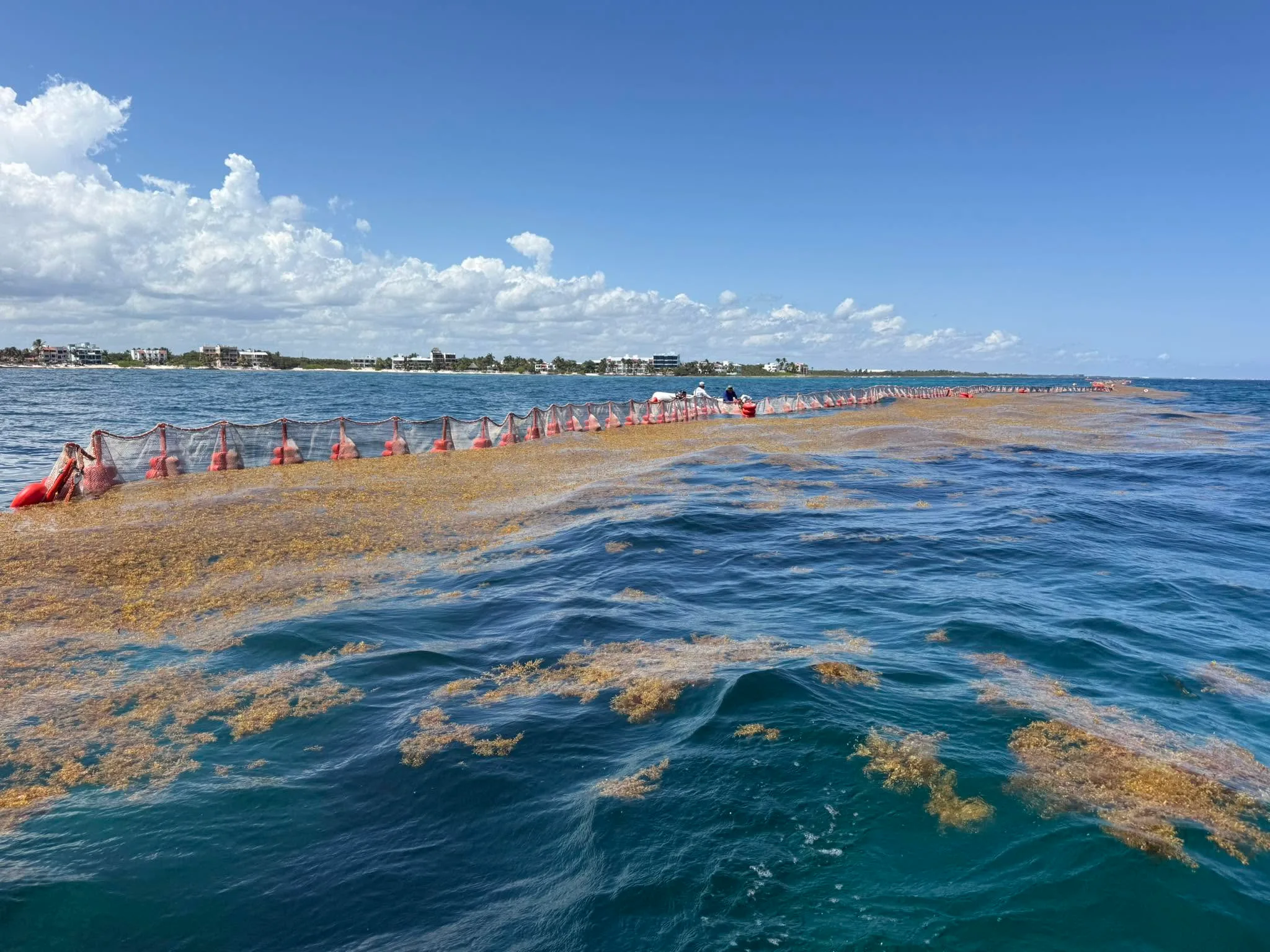
AKUMAL, Quintana Roo — Residents and business owners in Akumal have been asked to develop a coordinated local proposal showing how Mexico’s newly announced sargassum strategy could be adapted to the community’s environmentally sensitive bays.
Federal, state and municipal representatives met with members of the Akumal community at Lol-Ha Restaurant on August 6. According to a summary prepared by participants, the meeting included representatives from the Ministry of Environment and Natural Resources, known as Semarnat; the Mexican Navy; Fonatur; tourism agencies; the federal maritime zone authority, Zofemat; and the Municipality of Tulum.
The meeting did not produce a confirmed budget, vessels, barriers or other equipment specifically for Akumal. Its most concrete result was an invitation for the community to organize a local working group and prepare an Akumal-wide proposal for consideration by the government.
Participants said officials responded positively to the possibility of using Akumal as a pilot location, but no pilot project has been formally approved.
A follow-up meeting was discussed for approximately two to three weeks from now, possibly by videoconference.
Akumal says beach cleanup is no longer enough
Community representatives described a problem that has become increasingly difficult and expensive to manage.
Akumal Bay Resort reportedly told officials that its sargassum response can cost as much as US$30,000 per week during periods of heavy accumulation. Club Akumal Caribe reported removing between six and eight truckloads per day during major arrivals.
Those figures were provided by the businesses during the meeting and have not been independently audited. They nevertheless illustrate why Akumal’s hotels, restaurants, cooperatives and residential communities are asking for a response that goes beyond repeatedly shoveling the algae from the beach.
Manual collection is labor-intensive, and equipment used too aggressively on the sand can worsen erosion or disturb sea turtle nesting areas. Sargassum also becomes more difficult to handle after it reaches shore, where it mixes with sand and begins decomposing.
Akumal presents additional complications because it is not one continuous, uniform shoreline. Akumal Bay, Half Moon Bay, Jade Bay and the coastal areas to the north and south differ in shape, currents, reef formations, beach access and development.
A barrier or collection method that works in one location may be ineffective or environmentally inappropriate in another.
Akumal Bay is also an important feeding area for green sea turtles and contains seagrass beds protected under federal environmental rules. Any barrier system, vessel route or mechanical collection program would therefore need to account for wildlife movement, shallow water and the nearby reef.
Community representatives told officials that the response must protect turtles, coral, seagrass and water quality while avoiding further loss of beach sand.
How the national plan is supposed to work
The Akumal meeting followed the federal government’s July 30 announcement of a 2.64-billion-peso strategy for Quintana Roo. President Claudia Sheinbaum described approximately 2 billion pesos of that total as the federal contribution.
The plan is intended to reverse the current system, under which considerably more sargassum is removed from beaches than captured at sea. The government wants to intercept a larger share before it reaches shore, when the algae are cleaner, contain less sand and may be easier to transport and process.
The first phase carries a projected investment of 768.7 million pesos. It is intended to increase collection capacity from approximately 1,227 to 1,870 metric tons per day. A second phase is expected to raise capacity to as much as 4,000 tons per day, although the government has not announced a completion date for all of that infrastructure.
The strategy includes additional sargassum vessels, support boats, equipment for beach collection and approximately 35 kilometers of new containment or redirection barriers. Combined with existing equipment, authorities expect the barrier system to eventually cover roughly 50 kilometers.
Approximately 1,500 meters of dynamic barriers are also planned. Unlike fixed barriers installed close to shore, these can be moved in response to currents and forecasts to concentrate floating sargassum where collection vessels can reach it.
Monitoring, satellite information and early warnings are supposed to help crews decide where equipment is most urgently needed. The government is also planning a support dock at Puerto Juárez and a more organized system for transporting, tracking and processing the material after collection.
The broad plan identifies Cancún, Puerto Morelos, Playa del Carmen, Tulum and Mahahual as priority destinations. Akumal lies within the municipality of Tulum, but the announcement did not assign a specific amount of equipment or funding to the community.
That distinction is important. Inclusion of “Tulum” in the regional strategy does not automatically mean that barriers or collection vessels will be placed in Akumal.
A record-breaking year
Semarnat Secretary Alicia Bárcena said 2026 has produced four times as much sargassum as 2025 and approximately 27 times the historical average.
The amount moving through the wider Caribbean on a given day has ranged from approximately 40,000 to more than 90,000 metric tons, according to figures presented by the federal government. Authorities estimate that about 10 percent eventually reaches Quintana Roo.
During severe events, more than 9,000 tons may arrive on the state’s coast in a single day. The government is using 4,000 tons as its planning figure for an average daily arrival during significant sargassum periods.
Those volumes help explain why officials are not promising to keep every beach free of sargassum. Even after the proposed fleet and barrier network are completed, the system will have limited capacity and will need to be deployed according to forecasts, currents, environmental conditions and local priorities.
What Akumal must decide
Officials reportedly encouraged Akumal to form a working group or commission representing the different parts of the community. Participants said it should include residential neighborhoods, hotels, tourism cooperatives, restaurants and other businesses, along with environmental specialists and government agencies.
Its first task would be to document where sargassum arrives, how much is being removed, what businesses currently spend and which collection methods have already been tried.
The proposal would also need to identify suitable locations for offshore interception, temporary transfer points and truck access. It must explain how equipment would operate without damaging reefs, seagrass beds, turtle habitat or the beach itself.
Disposal is another major issue. Removing sargassum from the shoreline solves only the most visible part of the problem. The material must be transported to an authorized location where runoff will not contaminate groundwater, mangroves or coastal water.
The federal plan includes traceability and industrial use of collected sargassum, but not all of it can immediately be converted into a commercial product. Its high moisture and salt content complicate transportation and processing, and contaminants must be evaluated before it is used in products such as fertilizer or animal feed.
No equipment has been promised yet
The August 6 meeting represents an opening for Akumal, not a completed agreement.
Government representatives listened to local concerns and indicated a willingness to consider an Akumal-specific approach. However, the community summary makes clear that no budget has been assigned, no barriers or vessels have been approved and no final plan exists.
The next step belongs largely to Akumal: bring its different neighborhoods and economic sectors together, document their needs and present the government with one coordinated proposal instead of a collection of unrelated requests.
If that process succeeds, Akumal could become a useful test of whether the national strategy can be adapted to smaller coastal communities where tourism, private property, public beach access and fragile marine habitats all occupy the same narrow stretch of shoreline.
More Environment
- Texas’ Big Bend Becomes Border Wall Battleground
- Contemporary Maya Sculpture Installed in Sacalaca Cenote to Draw Community Tourism
- Mexico to Review Private Events Held Inside Tulum National Park
- Cancún Sargassum Arrivals Ease in September, but Officials Watch the Winds
- Mexico Holds Second National Earthquake Drill; Alerts to Sound at Noon