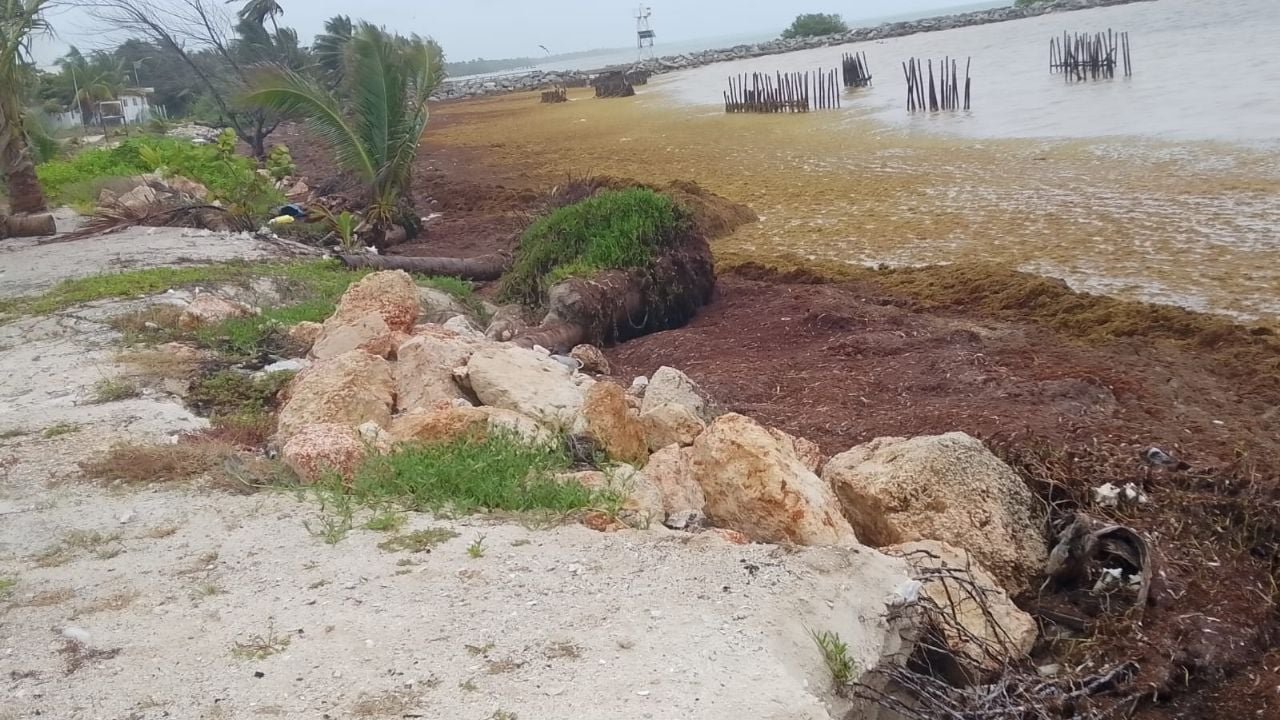
Xcalak, Quintana Roo — While major tourist destinations in Quintana Roo receive millions in investment to deal with massive sargassum influx, the small community of Xcalak is facing an environmental and economic crisis largely on its own, threatening fishing, tourism, and one of the most important ecosystems in the Mexican Caribbean.
Residents, fishermen, and tourism service providers say government support is scarce or nonexistent, forcing them to rely on community efforts to keep beaches clean amid what they describe as a historic sargassum arrival.
The problem has been worsened by strong swells and weather conditions that have prevented more than 50 fishermen from going out to sea for the past 21 days, resulting in losses exceeding 230,000 pesos (about $12,000 USD).
Fishermen in the area primarily catch scale fish such as grouper, jewfish, and yelloweye snapper, along with other smaller species. Each fishing trip typically yields around 50 kilograms, with prices ranging from 170 to 220 pesos per kilogram depending on the species.
Adding to the hardship, the lobster season is currently closed — the main economic activity in the town — leaving families in a difficult financial situation with no food or economic aid from authorities.
Pedro Duarte, one of the affected fishermen, said they decided not to go out to sea for safety reasons due to the strong waves in recent days. He noted that conditions are too risky and an accident could mean losing their boats, which are the only asset and source of income for many families.
The accumulated sargassum also threatens the Mesoamerican Reef and local navigation. Julián Colonia said the sargassum influx has reached unprecedented levels and warned that the macroalgae is beginning to approach the reef, posing an environmental threat while also damaging boat engines and hindering navigation.
Specialists have pointed out that decomposing sargassum alters marine ecosystem conditions and puts pressure on the Xcalak reef, part of the Mesoamerican Barrier Reef System, considered one of the most important in the world.
Gilberto Beltrán Yam, the community’s sub-delegate, said that in addition to the lack of fishing activity, the massive sargassum arrival and bad weather have led to a drop in visitors, affecting hoteliers, restaurateurs, and tourism service providers. He explained that the economic crisis has been ongoing since the beginning of the year and lamented that state and municipal authorities have not sent aid to the population, as they usually did during the lobster closed season.
The community is facing the crisis through collective efforts due to the lack of sufficient support. Adding to the economic hardship are infrastructure problems: frequent power outages in recent days have left the population without drinking water supply, a situation reported to the Federal Electricity Commission (CFE) but not yet resolved.
Despite the adverse outlook, Beltrán Yam emphasized that the community remains hopeful and is coping through solidarity among residents. “The authorities have abandoned us, but we don’t lose hope of moving forward. The town is united and we help each other to overcome this situation,” he said.
More Economy
- Tren Maya Freight Complex in Chetumal to Break Ground in 2027
- 40-Hour Workweek in 2027 Will Speed Up Robots and AI in Hotels, IMEF Says
- Mexico’s Supreme Court Blocks Telmex Bid for Automatic Pay TV Access
- Mexico and EU Bring Modernized Global Agreement to Congress as Senate Ratification Looms
- Moody’s Warns Mexico Faces Negative Fiscal Trend on Rising Debt and Weak Growth