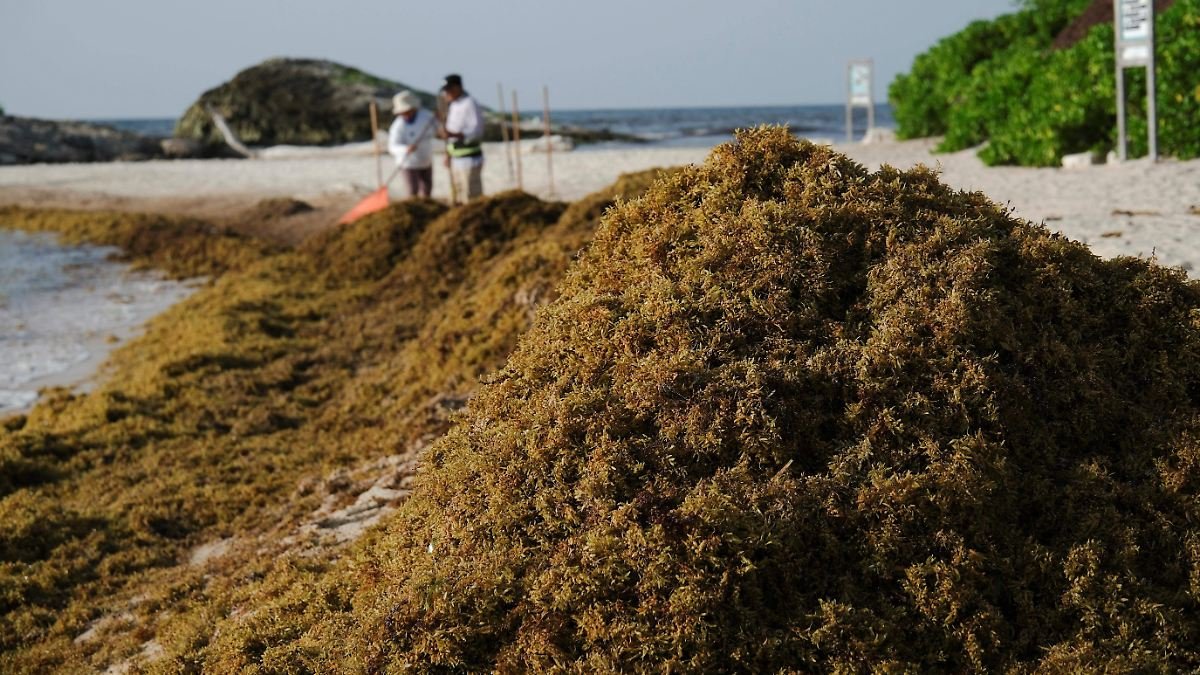
Chetumal, Quintana Roo — Sargassum collection in Quintana Roo has surpassed 99,000 tons this year, and officials project the total will reach 130,000 tons by the end of 2026.
The state’s Environment Department said collection efforts are being coordinated among federal, state and municipal authorities, along with the Mexican Navy, which intercepts part of the seaweed before it reaches the beaches.
Brandon Mex Martínez , director of Special Handling Waste at the Quintana Roo Ministry of Environment (Sema) , reported that the collection of sargassum in Quintana Roo exceeded 99,300 tons so far in 2026.
The figure surpasses the 2025 sargassum collection record, which was 92,783 tons, according to the Mexican Navy (Semar).
Brandon Mex said that this is the result of a permanent operation coordinated between authorities of the three levels of government, in addition to the support of volunteers that seeks to reduce the impact of this macroalga on the beaches , tourism and economic activities of the entity.
The official explained that a key part of the strategy is preventing the sargassum from reaching the beaches. To this end, the Mexican Navy (Semar) is conducting collection operations at sea using a specialized vessel capable of carrying up to 250 tons , allowing them to remove the seaweed before it reaches the Mexican Caribbean coast.
In addition to the work at sea, the work continues daily on the coastal strip through brigades made up of personnel from state, municipal and federal agencies and volunteers, who participate in the cleaning of the beaches of the municipalities located both in the north and south of the state.
He noted that sargassum will continue to arrive on the state’s coasts, although it is expected to do so in smaller quantities compared to the volumes recorded so far. Estimates indicate that the influx will be equivalent to approximately 40 percent of the amount currently collected, which would allow for a gradual decrease in the intensity of the phenomenon as the year progresses.
Some hoteliers plan to operate only during the months when there is no sargassum. “It’s a serious problem that, fortunately, is already being addressed. We hope that the efforts currently being made will be sufficient,” said Levi Williams, president of the Mexican Association of Travel Agents ( AMAV ), in an interview.
More Environment
- Polo strengthens to a Category 5 hurricane off Mexico’s Pacific coast in Record Time
- Cozumel Launches Rabies Vaccination Drive With 3,000 Free Doses for Pets
- Sargassum Collection in Quintana Roo Tops 133,000 Tons, Setting New Record
- Isla Mujeres Collects Over 160,000 Tons of Waste in Five Years
- Tulum Beach Cleanup Pulls 32 Kilos of Marine Debris From Playa del Pueblo
More Quintana Roo
- Quintana Roo Climbs 12 Spots to 9th in Competitiveness Index
- Quintana Roo Courts European Airlines to Boost Winter Flights to Cancún
- Mayan Council Urges Mexico’s Supreme Court: Don’t Decide About Us Without Us
- Quintana Roo Construction Demand Jumps 40% on Hotel Renovations
- Mexican Caribbean Sets Its Sights on Panama to Diversify Tourism