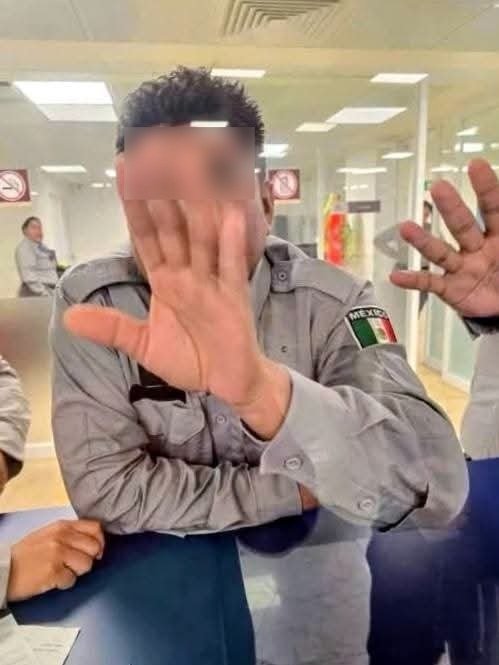
COZUMEL, Quintana Roo — A foreign tourist’s complaint about being charged nearly $400 in customs duties at Cozumel International Airport has reignited a familiar concern for divers, photographers and other travelers entering Mexico with specialized electronic equipment.
The traveler said Mexican customs agents classified his underwater photography equipment as merchandise rather than personal recreational gear and charged a 19 percent tax based on the assessed value. The total came to approximately 6,600 pesos, or about $385 USD, before he could recover his belongings.
The complaint, which circulated widely on social media, drew quick reaction from divers, underwater photographers and frequent Mexico travelers, many of whom said they have faced similar uncertainty when entering the country with camera housings, lights, lenses, drones or other high-value electronics.
The case has not been publicly addressed by Mexico’s tax or customs authorities. The agency responsible for customs operations is the Agencia Nacional de Aduanas de México, or ANAM, while the SAT remains tied to tax administration and customs-payment systems.
What Mexican Customs Rules Actually Say
Mexico’s official passenger baggage rules do allow travelers to bring photography and video equipment for personal use.
ANAM’s passenger baggage guide lists as part of personal baggage two photographic or video cameras, photographic material and their accessories, along with other electronics such as cell phones, GPS devices, tablets and laptop computers. The official English-language ANAM page also says passengers may bring additional goods beyond personal baggage under a $500 USD exemption, provided the value can be supported with an invoice or sales receipt.
That means a tourist traveling with one or two cameras and normal accessories should not automatically be treated as importing merchandise simply because the equipment is valuable.
The problem is where specialized equipment fits in practice.
Underwater photography systems can look very different from a standard vacation camera. A diver may arrive with a camera body, underwater housing, strobes, video lights, arms, clamps, dome ports, lenses, batteries, chargers and a hard case. To the traveler, it may be one personal camera system. To a customs agent, it may look like professional equipment or commercial merchandise, especially if the total value is high.
If customs determines that items are not covered by personal baggage or the $500 exemption, ANAM says passengers may import additional goods without using a customs broker if the value does not exceed $3,000 USD, or $4,000 USD for computer equipment, by paying a global tax rate. ANAM’s passenger-exemption page lists that rate as 19 percent on the amount exceeding the exemption.
That appears to be the rate applied in the Cozumel complaint.
Why Divers Are Worried
Cozumel is one of Mexico’s most important dive destinations, and underwater photography is part of that market. Visitors routinely arrive with dive computers, cameras, action cameras, lights and housings to document reef dives, marine life and wrecks.
For many of those travelers, the concern is not whether Mexico has customs rules. It is whether those rules are being applied consistently.
Online travel, scuba and photography forums contain recurring complaints from visitors who say they were charged duties at Mexican airports for personal electronics, drones, camera equipment or more than one laptop. Those posts are anecdotal and not official records, but they show that the Cozumel complaint is not being perceived as an isolated incident by the traveler community.
For destinations such as Cozumel, that perception matters. If divers believe their camera gear may be reclassified unpredictably at arrival, some may choose to leave equipment at home, rent elsewhere or travel to competing dive destinations with clearer procedures.
What Travelers Can Do Before Arriving
The most useful step is to travel with documentation. ANAM states that when travelers use the $500 exemption, the value of goods can be proven with invoices or sales receipts. If no receipt is available, customs personnel may determine the value.
For photographers and divers, that means carrying receipts, serial-number lists, photos of the equipment in use before the trip, and a written inventory showing that the gear is used, personal and will leave the country with the traveler.
Travelers bringing professional gear for journalism, film or media production have a more formal option. ANAM says people living abroad who perform press, radio, television journalism or cinematography activities may temporarily import necessary goods by presenting a detailed list and proof issued by a Mexican consulate, or by using a valid ATA Carnet. An ATA Carnet can also be used for temporary importation, with the goods required to leave Mexico within six months.
Most recreational divers will not have an ATA Carnet, and for many casual travelers it may be more process than they need. But for professional photographers, production crews, commercial dive videographers or anyone entering with several cases of high-value equipment, it may be worth considering before travel.
What to Do If There Is a Dispute
ANAM’s FAQ says passengers can bring in personal baggage tax-free and use the additional exemption for goods beyond baggage. It also says that if the exemption is exceeded, taxes must be paid on the excess amount, up to the applicable limits.
The agency also provides a public complaints and denunciations channel and states that it has “zero tolerance” for improper acts, encouraging people to file reports so cases can be reviewed and sanctioned when appropriate.
In practical terms, travelers who disagree with a customs assessment should ask for the official document showing what was charged, the customs classification used, the value assigned and the payment receipt. Those documents are essential if the traveler later wants to file a complaint or seek clarification.
Time can be the biggest obstacle. In the Cozumel case, the tourist reportedly tried to challenge the assessment before boarding his return flight but was unable to reopen the matter before departure. That is a common problem in airport customs disputes, where travelers are often forced to choose between paying quickly or missing a flight.
A Tourism Image Problem
The issue is especially sensitive in Cozumel because the island’s tourism economy depends heavily on diving, snorkeling and marine activities. Visitors who come specifically to photograph reefs, turtles, rays or underwater landscapes often carry equipment that is expensive but not commercial inventory.
Customs authorities have a legitimate responsibility to prevent undeclared imports and commercial goods from entering the country without duties. But travelers also need clear, predictable rules, especially when official baggage allowances already include cameras and accessories.
For now, the practical advice is simple: do not assume that “personal use” will be obvious to the agent inspecting your luggage. Bring documentation, keep your camera system organized, avoid traveling with unnecessary duplicate equipment, and know the official baggage rules before arrival.
The broader question is whether Mexico’s customs agencies will provide clearer guidance for specialized recreational equipment such as underwater camera systems. Until they do, the line between a diver’s personal camera rig and taxable merchandise may continue to depend too much on who is standing at the inspection counter.
More Tourism
- Cancún Looks to Promote Its Cultural Heritage to Tourists
- Car With Two Children Overturns at Paamul Curve on Highway 307
- Anyma Brings ÆDEN to Zamna Tulum for 10th Anniversary Show on January 4
- AI and New Travel Trends to Headline AFEET Trends 2026 Summit in Cancún
- Tulum Pivots to Luxury as Airlines Cut Flights, Occupancy Drops
More Cozumel
- Quintana Roo Names Winners of 2026 State Craft and Embroidery Prizes
- Cruise Tourism Trust Fund Spends 1.27 Billion Pesos Across Quintana Roo
- CFE and Playa del Carmen to Review Plan for Submarine Power Line to Cozumel
- Cozumel’s Museum of the Island Opens Exhibition by Architect José Manuel Sáenz ‘Txepo’
- Mexican Caribbean Destinations and Resorts Win Across 2026 World Travel Awards